2nd Grade Fact Triangle Subtraction Worksheet: Write Two Related Facts
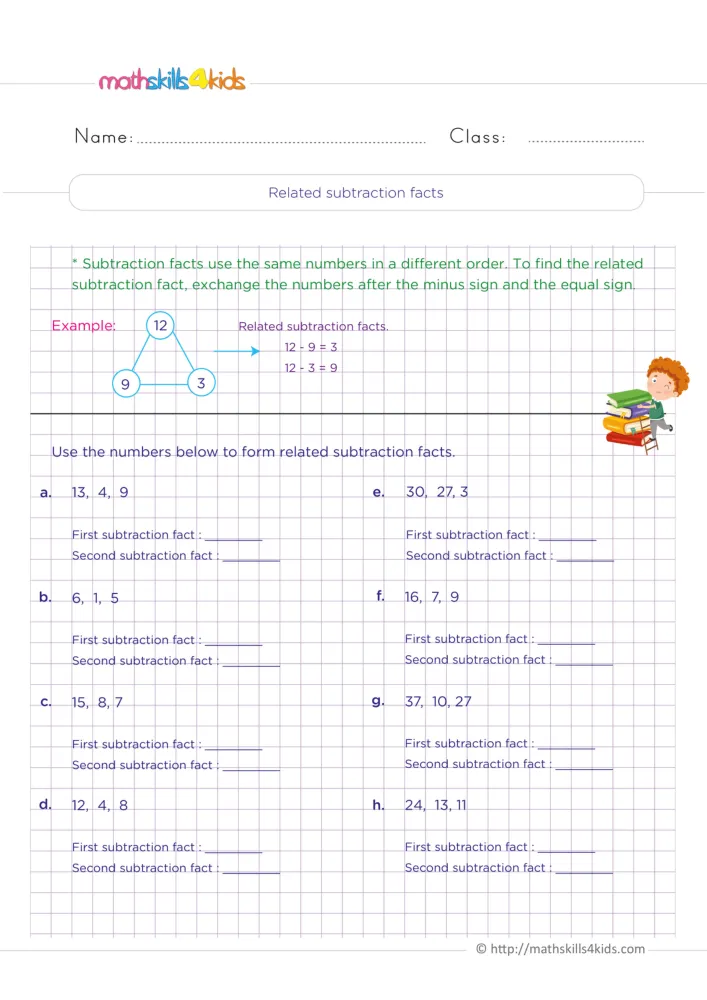
Give a seven-year-old 12 − 9 = 3 and ask what 12 − 3 makes, and you can almost hear them start counting backward. Yet the answer is already sitting in the first fact. This 2nd grade fact triangle subtraction worksheet helps your child see it. At the top, a fact triangle holds 12, 9 and 3, with its two subtraction facts written beside it. A short rule explains the trick: swap the numbers after the minus sign and the equal sign. Then eight sets follow, from small ones like 6, 1 and 5 to bigger ones like 37, 10 and 27. For each set, your child writes a first and a second related fact. A second page gives the answer key.
Why one fact gives you a second for free
Every subtraction hides a partner. If 13 take away 4 leaves 9, then 13 take away 9 must leave 4, because the 4 and the 9 are the two parts of the same 13.
The fact triangle shows this as a picture. The whole sits at the top, and the two parts sit at the bottom corners. So a child who starts from the top and removes one corner always lands on the other.
This is the heart of related subtraction facts, and it ties straight back to addition, since the two are inverse operations. In fact, the same three numbers make a full fact family: two additions and two subtractions. Seeing that link is what makes subtraction feel lighter in second grade.
At the table: start from the whole
Before writing, ask your child to find the biggest number in each set and point to it. That number always comes first in a subtraction fact.
The usual slip shows up in item e, 30, 27 and 3. A child may write 27 − 3, which gives 24, a number that is not in the set. Instead of correcting, ask, "Is your answer one of the three numbers?"
Item g, 37, 10 and 27, is a good place to talk about tens. Say, "Thirty-seven take away one ten. What is left?"
Finally, once both facts are written, cover one and ask your child to say it from memory. It sticks better that way.
After the page: whole and parts at home
Fact triangles work with anything you can split. Take 12 spoons from the drawer, set 9 on the table and hide 3 behind your back. Then swap: 3 on the table, 9 hidden. Your child names the subtraction each time.
Also, a game of Memory makes the pairs stick. Write subtraction facts on cards so that each card has a partner, like 15 − 8 and 15 − 7. Turn them face down and let your child find the matching pairs.
When you check the answer key, praise the reasoning: "You started from the whole every time." That steady habit pays off later with larger numbers too.
About this 2nd grade fact triangle subtraction worksheet and its key
Download the worksheet: 2nd Grade Fact Triangle Subtraction Worksheet: Write Two Related Facts
 Worksheet3rd Grade Addition and Subtraction Problems: 3 Stories
 Worksheet3rd Grade Divide by 1 Worksheet: 20 Facts and the Rule of One
 Worksheet3rd Grade 1 Times Table Worksheet: 18 Column Facts and the Identity Rule
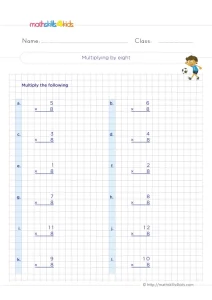 Worksheet3rd Grade 8 Times Table Worksheet: 12 Column Facts and a Doubling Trick
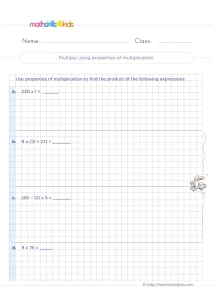 Worksheet3rd Grade Multiplication Worksheet: Find Products Using Properties
A few related activities
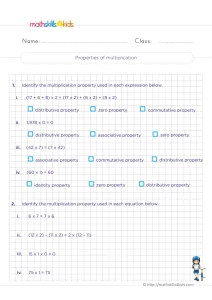 Tick the right property for four equations, from 1,978 x 0 = 0 to (60 x 1) =…See the activity3rd Grade Addition Properties Worksheet: Commutative, Associative, Identity
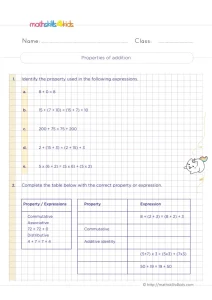 Five number sentences to name, from 8 + 0 = 8 to 5 x (6 + 2). Then…See the activity3rd Grade Count Coins and Bills Worksheet: 8 Money Totals
 Eight sets of $1 and $5 bills with pennies, nickels, dimes and quarters. Children find each total in…See the activity
