2nd Grade Multiplying by 2, 3 and 4 Worksheet: Twelve Vertical Facts
Ask a seven-year-old for 4 × 3 and you may see fingers fly as they count 4, 8, 12 under their breath. That counting is not a crutch; it is exactly how the facts get built. This 2nd grade multiplying by 2, 3 and 4 worksheet gives that counting a place to land. Twelve multiplication facts sit in neat columns, labeled a to l, with a small volleyball player in the corner. Eleven of them multiply by 2, 3 or 4, and one multiplies 10 by 5. The first numbers run from 2 up to 12. Your child writes each product under the line. A second page gives the answer key.
Why small factors come first
Multiplying by 2, 3 and 4 is where facts start to feel within reach. Times 2 is doubling, which most second graders already know from addition. Times 3 and times 4 are short chains of repeated addition, so a child can always rebuild a fact they forget.
That safety net matters on this page. Some facts are small, like 2 × 3 or 4 × 2. Others stretch further, like 12 × 3 or 11 × 4, which go beyond the usual times table. For example, 12 × 3 is just 12 + 12 + 12.
So the page mixes quick recall with a little reasoning. Over time, the reasoning gets faster and turns into memory. Both count as real math.
At the table: times, not plus
The most common slip on this page is adding instead of multiplying. In fact a, a child may write 9 for 6 × 3, because the column looks like an addition problem. Instead of correcting, ask, "What does the little x ask you to do?" Then let them read it aloud as "six, three times."
For the bigger facts, like 11 × 4 in g, offer scrap paper. Your child can write 11 four times and add while you point to each number, or count by elevens on their fingers.
Finally, look at d and h together: 10 × 2 and 10 × 5. Ask, "What do you notice about times ten?" Let your child explain the pattern. Wait for it.
Shoes, socks and counting rhymes
Facts by 2, 3 and 4 are all around the house. Count shoes by pairs, chair legs by fours, or tricycle wheels by threes: "Three trikes, how many wheels?" Also, while setting the table, ask how many forks you need if each of four people gets two.
The old rhyme "One, Two, Buckle My Shoe" already counts in pairs. Say it together, then try a new version that counts by threes or fours while clapping.
For multiplying by 2, a mirror works wonders: hold up some fingers and let the reflection double them. When the page is done, praise the strategy: "You rebuilt the hard facts with addition. That is smart thinking."
About this 2nd grade multiplying by 2, 3 and 4 worksheet and its answer key
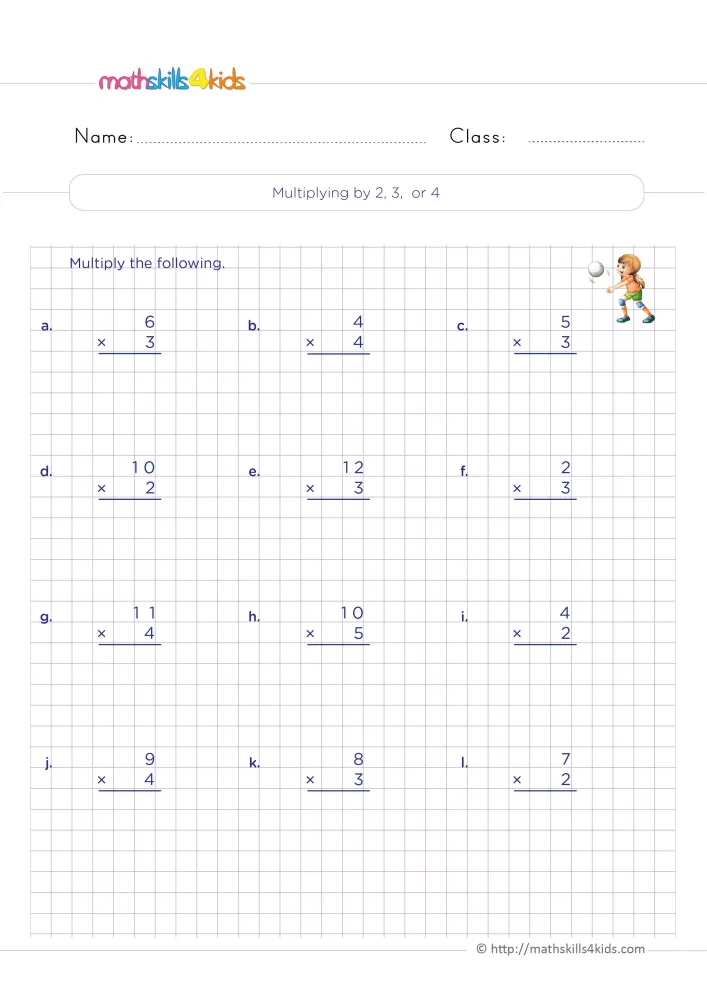
Download the worksheet: 2nd Grade Multiplying by 2, 3 and 4 Worksheet: Twelve Vertical Facts
 Worksheet3rd Grade Area with Length and Width Worksheet
 Worksheet3rd Grade Two-Step Multiply and Divide Problems: 3 Stories
 Worksheet3rd Grade Expressions for Arrays Worksheet: Write Each Product
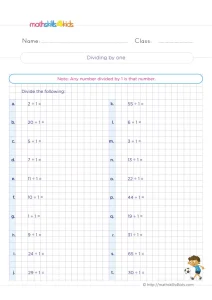 Worksheet3rd Grade Divide by 1 Worksheet: 20 Facts and the Rule of One
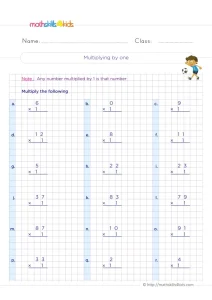 Worksheet3rd Grade 1 Times Table Worksheet: 18 Column Facts and the Identity Rule
A few related activities
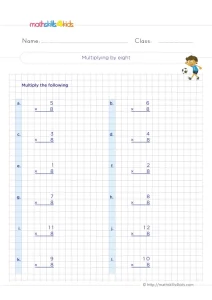 Twelve column facts times 8, from 1 × 8 to 12 × 8, in a mixed order. Double…See the activity3rd Grade Multiplication Properties Worksheet: Zero, Identity, Commutative
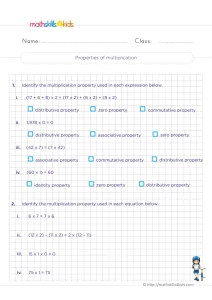 Tick the right property for four equations, from 1,978 x 0 = 0 to (60 x 1) =…See the activity3rd Grade Multiplication Worksheet: Find Products Using Properties
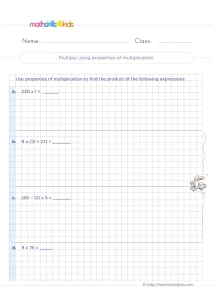 Work out four products, from 230 x 1 to 9 x 75, with the identity, distributive and commutative…See the activity
