2nd Grade Repeated Addition Arrays Worksheet: Tick Rows and Columns
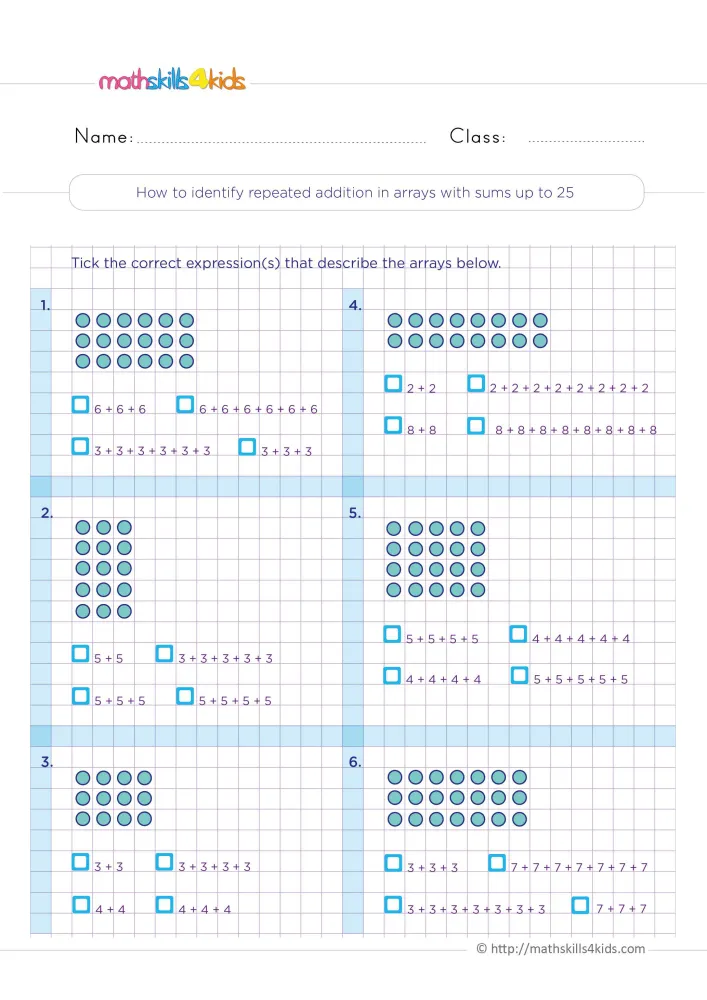
Show a seven-year-old a block of dots and ask how many, and you will see two kinds of counting: one dot at a time, or one row at a time. This 2nd grade repeated addition arrays worksheet trains the second kind. Six arrays of teal dots fill the page, from three rows of four up to three rows of seven. Under each array, four addition expressions wait beside a box. Your child ticks every expression that describes the array, and each array has two correct answers: one by rows, one by columns. Totals stay between 12 and 21, all within arrays up to 25. A second page gives the answer key.
Why arrays lead toward multiplication
An array is a set of objects arranged in rows and columns. Each row holds the same number, so the array is a picture of equal groups. In second grade, that picture is the bridge to multiplication.
The page asks for both readings. The first array has three rows of six, so 6 + 6 + 6 fits. However, it also has six columns of three, so 3 + 3 + 3 + 3 + 3 + 3 fits too. Both sums give 18.
Seeing that one array tells two stories is the start of the idea that 3 × 6 and 6 × 3 are equal. Your child does not need the times sign yet, because the repeated sums carry the meaning. That is real multiplication readiness. Rows first, then columns.
At the table: the near misses
Begin by having your child trace one row with a finger and say the number. Next, ask, "How many rows are there?"
The traps are the near misses. In the second array, 5 + 5 + 5 + 5 looks right, but there are only three columns of five. In the fifth array, 4 + 4 + 4 + 4 leaves out a whole column. Counting the plus signs is a useful check: one number for each row, or one for each column.
If your child ticks only one box per array, ask, "Could you read it the other way?" Then turn the page sideways so the columns become rows. That small trick often makes the second answer jump out.
Windows, muffin tins and a book about ants
Arrays hide in plain sight. Count the panes in a window, the eggs in a carton or the cups in a muffin tin, row by row and then column by column. Ask whether you got the same total both ways.
Also read One Hundred Hungry Ants by Elinor J. Pinczes. The ants march to a picnic in one long line, then in rows of 2, 4, 5 and 10, which is exactly the regrouping your child just practiced on paper.
Once you finish the page, compare it with the answer key and name the effort: "You checked rows and columns every time. That is careful thinking."
About this 2nd grade repeated addition arrays worksheet and its answer key
Download the worksheet: 2nd Grade Repeated Addition Arrays Worksheet: Tick Rows and Columns
 Worksheet3rd Grade Area with Length and Width Worksheet
 Worksheet3rd Grade Two-Step Multiply and Divide Problems: 3 Stories
 Worksheet3rd Grade Addition and Subtraction Problems: 3 Stories
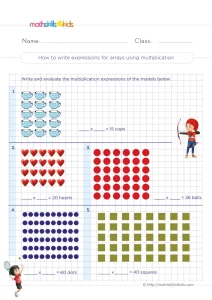 Worksheet3rd Grade Expressions for Arrays Worksheet: Write Each Product
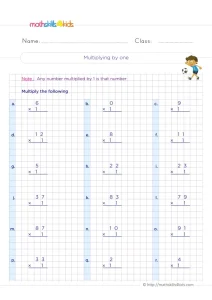 Worksheet3rd Grade 1 Times Table Worksheet: 18 Column Facts and the Identity Rule
A few related activities
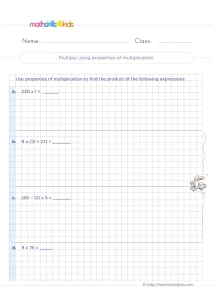 Work out four products, from 230 x 1 to 9 x 75, with the identity, distributive and commutative…See the activity3rd Grade Multiplication Properties Worksheet: Zero, Identity, Commutative
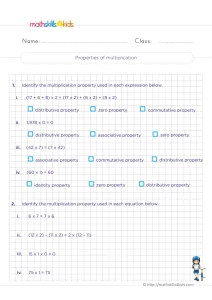 Tick the right property for four equations, from 1,978 x 0 = 0 to (60 x 1) =…See the activity3rd Grade 8 Times Table Worksheet: 12 Column Facts and a Doubling Trick
 Twelve column facts times 8, from 1 × 8 to 12 × 8, in a mixed order. Double…See the activity
