2nd Grade Shade the Area on a Grid Worksheet: Draw Your Own Shapes
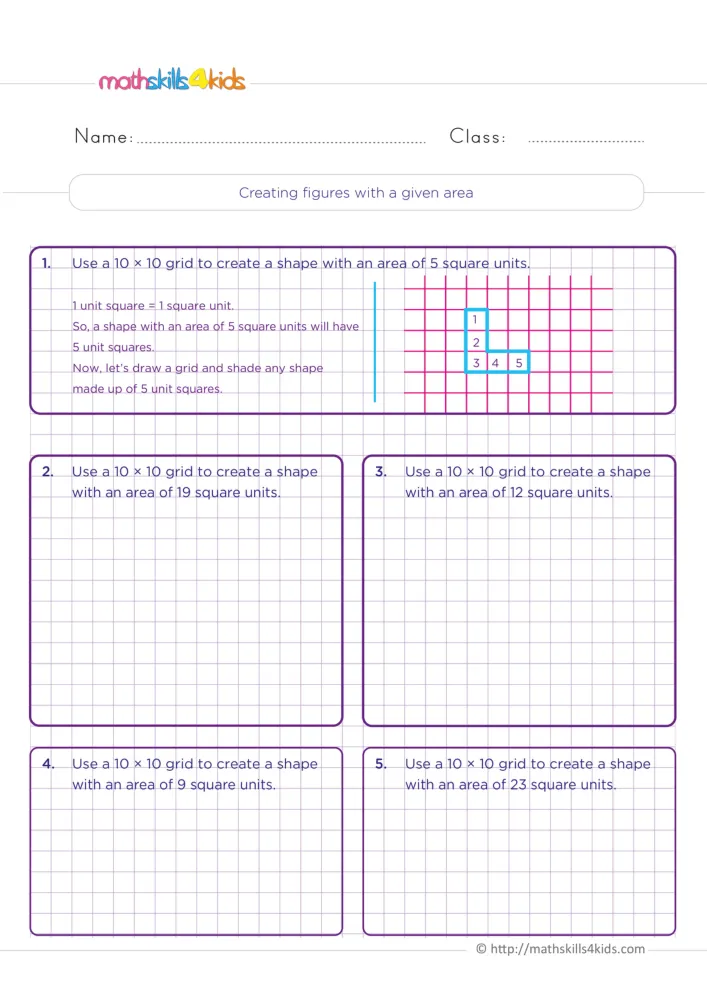
Most area pages ask a child to count. This one hands them the pencil. Give a seven-year-old the number 12 and a sheet of grid paper, and you will see a dozen different shapes appear. This 2nd grade shade the area on a grid worksheet starts with a worked example: one unit square equals one square unit, so a shape of 5 square units uses five squares, drawn as a small L. Then four empty boxes ask your child to create shapes with an area of 19, 12, 9 and 23 square units on a 10 by 10 grid. Any shape works if the count is right. A second page gives the answer key, with one possible shape for each.
Why building an area teaches more than counting one
Counting the squares inside a shape is a good first step. Building a shape from a number goes further, because your child has to plan. They must decide where each square goes, keep a running count and stop exactly on target.
That is real reasoning about area. For example, 12 square units can be a neat 3 by 4 rectangle, a long strip or a staircase. All of them are correct. So the page shows that one area can take many shapes, a key idea before any formula.
The worked example at the top helps. It numbers each square from 1 to 5, which models the counting. Numbering keeps the count honest.
At the table: 19 and 23 squares
Start with the box asking for 9 square units. Many children draw a 3 by 3 square, which is a lovely first success.
The boxes asking for 19 and 23 are the real challenge. A child may lose count halfway and end up with 18 or 21. Instead of correcting, suggest the same trick as the example: write a small number inside each square as you shade it. Then ask, "What number did the last square get?"
Some children like to build a rectangle first, then add a few extra squares. That works well. For example, a 4 by 5 rectangle makes 20, so three more squares give 23. Let your child find a plan of their own.
Building areas off the page
Areas are fun to build with real objects. Use square tiles, crackers or building bricks and ask your child to make a shape of exactly 10. Then ask for a different shape with the same count. Also, draw a 10 by 10 grid on paper and take turns shading a given area.
A Chutes and Ladders board is itself a grid of 10 by 10 squares. While you play, pause and ask your child to point to a row of ten, or to draw a shape in the air covering four squares.
When the page is done, compare your child's shapes with the answer key and praise the planning: "You numbered every square you shaded." Each careful count of square units builds real confidence.
About this 2nd grade shade the area on a grid worksheet and its answer key
Download the worksheet: 2nd Grade Shade the Area on a Grid Worksheet: Draw Your Own Shapes
 Worksheet3rd Grade Area with Length and Width Worksheet
 Worksheet3rd Grade Area of Rectangles in Real Life Worksheet: 3 Word Problems
 Worksheet3rd Grade Area of Shaded Parts Worksheet: Subtract the Gaps
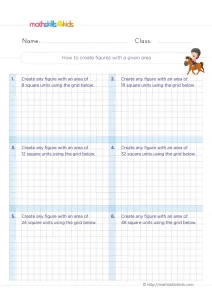 Worksheet3rd Grade Draw Shapes with a Given Area Worksheet: Six Grids
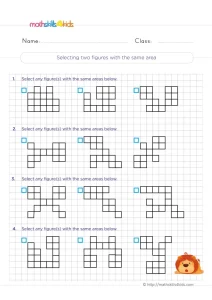 Worksheet3rd Grade Figures with the Same Area Worksheet: Count the Squares
A few related activities
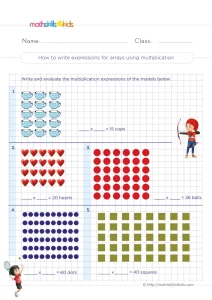 Five arrays of cups, hearts, balls, dots and squares. Your child writes the multiplication expression for each one…See the activity3rd Grade 1 Times Table Worksheet: 18 Column Facts and the Identity Rule
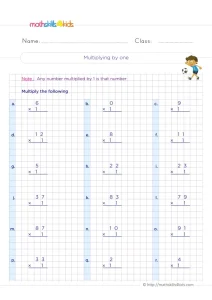 Eighteen column facts times 1, from 0 × 1 to 91 × 1. One rule solves them all:…See the activity3rd Grade Reading a Data Table Worksheet: 2 Tables
 Two small tables, one of office items and one of groceries in kilograms. Your child finds the numbers,…See the activity
