2nd Grade Shapes With Equal Sides Worksheet: Tick the Right Figure
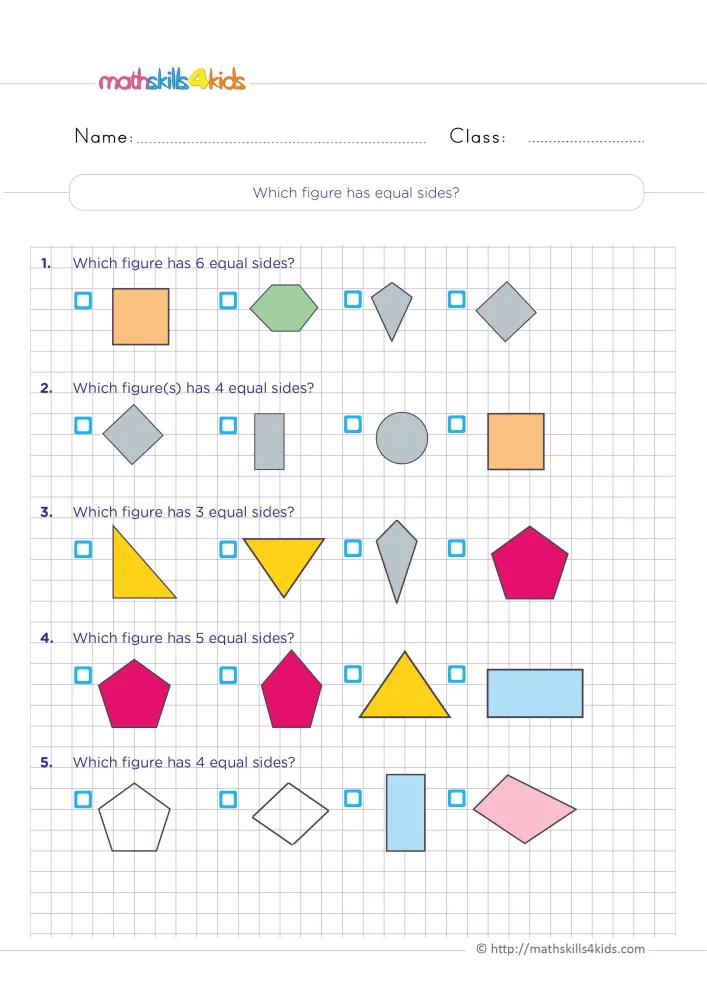
Show a seven-year-old two pink pentagons side by side, and they will often call them the same. Both have five sides, after all. This 2nd grade shapes with equal sides worksheet asks them to look one step further. Each of the five rows asks a single question, such as "Which figure has 3 equal sides?" Four figures follow, each with a box to tick. Squares, diamonds, triangles, kites and hexagons all appear. A few of them look right until your child checks the sides. One row even has two correct answers. A second page gives the answer key.
Why the number of sides is not enough
Counting sides tells a child which family a shape belongs to. Comparing the length of those sides tells them something finer, and this page trains that step.
For example, the kite in the first row has four sides. Two are short and two are long. The gray diamond next to it also has four sides, and all of them match. Same number of sides, very different shapes.
So the page pushes your child to judge with their eyes first. Then they confirm with a finger or a paper strip. This is early work on the properties of polygons. A shape is defined by its parts, not by its general look. Look twice.
At the table: the two pink pentagons
Read the first question aloud together. Then let your child scan the whole row before ticking anything. The hexagon usually jumps out quickly.
The fourth row is the real test. Both pink shapes are pentagons, so many children tick both. Instead of saying no, ask about the tall one: "Are all five sides the same length?" Hand over a strip of paper. Mark one side on it, then slide it around the shape.
In the second row, a child may stop after one tick. However, the question says "figure(s)", so prompt gently. Ask if another shape has equal sides too. The orange square and the gray diamond both fit. Seeing that the diamond is just a turned square is a small discovery.
Equal sides around the house
Equal sides hide in plenty of places. Hold up a square napkin and a rectangular one. Ask your child to fold each in half to test the sides. Also, look at floor tiles, a chess board or a window pane, and trace the edges with a finger.
A round of I Spy works well here. Start with a clue: "I spy something with four equal sides." While you walk or wait, take turns, and let your child set the next clue.
When you check the page together, praise the method more than the score. You might say that they tested every side before deciding. That habit of checking comes back each time a page asks your child to tick the shape that fits.
About this 2nd grade shapes with equal sides worksheet and its answer key
Download the worksheet: 2nd Grade Shapes With Equal Sides Worksheet: Tick the Right Figure
 Worksheet3rd Grade Missing Side Length Perimeter Worksheet: Find a, b, t
 Worksheet3rd Grade Rectangle Properties Worksheet: Is It a Rectangle?
 Worksheet3rd Grade Identifying Trapezoids Worksheet: 5 Shapes to Check
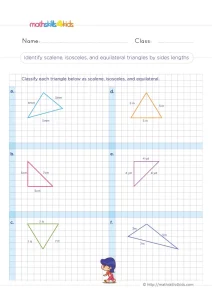 Worksheet3rd Grade Classifying Triangles by Side Lengths Worksheet: 6 Triangles
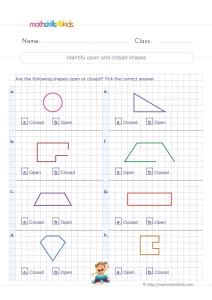 Worksheet3rd Grade Open and Closed Shapes Worksheet: 8 Shapes to Check
A few related activities
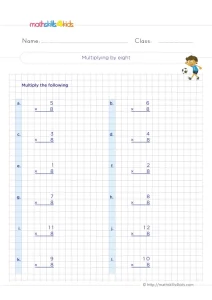 Twelve column facts times 8, from 1 × 8 to 12 × 8, in a mixed order. Double…See the activity3rd Grade Multiplication Properties Worksheet: Zero, Identity, Commutative
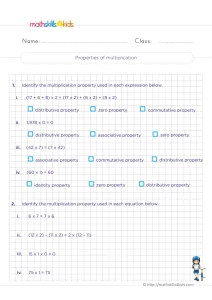 Tick the right property for four equations, from 1,978 x 0 = 0 to (60 x 1) =…See the activity3rd Grade Addition and Subtraction Problems: 3 Stories
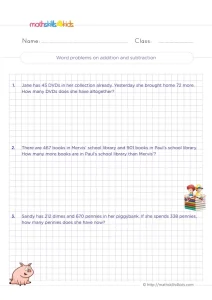 Three word problems about DVDs, school library books and pennies in a piggy bank. Your child adds or…See the activity
