2nd Grade Turnaround Addition Facts Worksheet: Two Facts from Three Numbers
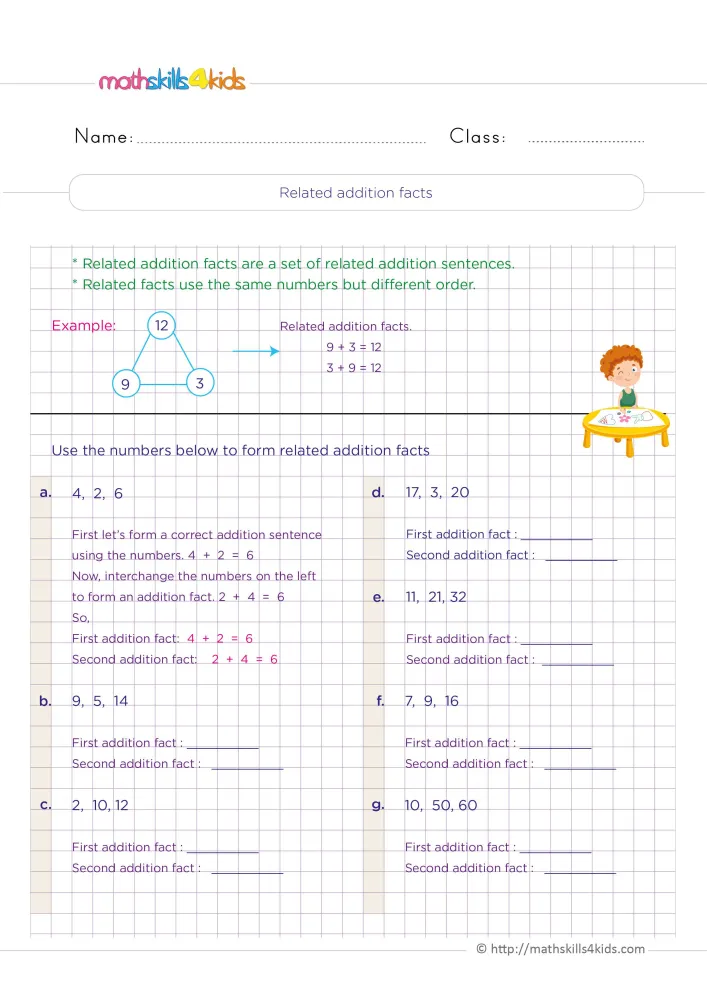
Ask a seven-year-old for 3 + 9 right after 9 + 3, and many will count all over again. They have not noticed yet that the answer cannot change. This 2nd grade turnaround addition facts worksheet makes that discovery the whole point. A small number triangle at the top shows 9, 3 and 12, with its two facts beside it. Item a is done for you: 4, 2 and 6 give 4 + 2 = 6 and 2 + 4 = 6. Then six more sets follow, from small ones like 7, 9 and 16 up to 11, 21 and 32 or 10, 50 and 60. For each set, your child writes two related addition facts. A second page gives the answer key.
Why switching the order is a big idea
When you add two numbers, their order does not change the total. Mathematicians call this the commutative property; in class it often goes by the friendlier name of turnaround facts. Either way, it halves the number of facts a child must remember.
The triangle at the top of the page gives that idea a picture. The two small numbers sit at the bottom corners, and their total sits at the top. So any addition sentence you write uses both bottom numbers to make the top one.
These three numbers also form part of a fact family. Later, the same triangle will give subtraction facts too, which is why this simple page prepares the next step.
At the table: which number is the total?
Start by pointing to the triangle. Ask, "Which number sits on top?" Then let your child touch 9 and 3 and say, "These two make 12."
The usual slip comes with a set like 17, 3 and 20. A child may write 17 + 20 because those numbers look important. Instead of correcting, ask, "Which number is the biggest? Can it be one of the parts?"
Item e, 11, 21 and 32, needs real adding, so let your child check that 11 + 21 really makes 32 before turning it around.
Also, item g uses tens. Say, "One ten and five tens. How many tens?" That keeps the mental math quick.
After the page: turn it around at home
Turnaround facts are easy to show with real things. Put 4 red grapes and 2 green ones on a plate, count them, then swap the two groups and count again. Your child sees that the total stays the same.
You can also draw a number triangle on a napkin and ask your child to say both facts out loud.
For a game, play Go Fish with a twist. A pair is any two cards that add up to a number you choose, like 10. While asking for cards, your child says both orders: "I need a 3, because 7 + 3 and 3 + 7 make 10."
When you check the answer key, praise the noticing: "You saw that the order did not matter."
About this 2nd grade turnaround addition facts worksheet and its key
Download the worksheet: 2nd Grade Turnaround Addition Facts Worksheet: Two Facts from Three Numbers
 Worksheet3rd Grade Addition and Subtraction Problems: 3 Stories
 Worksheet3rd Grade Divide by 1 Worksheet: 20 Facts and the Rule of One
 Worksheet3rd Grade 1 Times Table Worksheet: 18 Column Facts and the Identity Rule
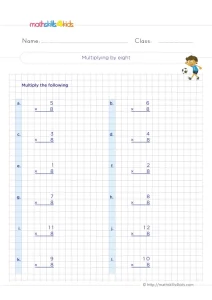 Worksheet3rd Grade 8 Times Table Worksheet: 12 Column Facts and a Doubling Trick
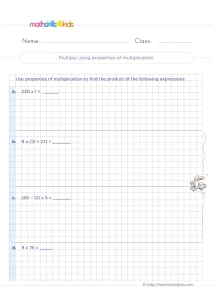 Worksheet3rd Grade Multiplication Worksheet: Find Products Using Properties
A few related activities
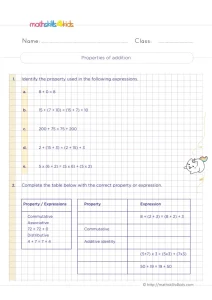 Five number sentences to name, from 8 + 0 = 8 to 5 x (6 + 2). Then…See the activity3rd Grade Count Coins and Bills Worksheet: 8 Money Totals
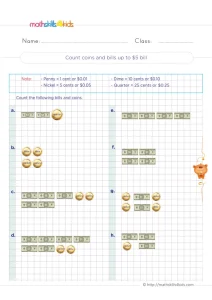 Eight sets of $1 and $5 bills with pennies, nickels, dimes and quarters. Children find each total in…See the activity3rd Grade Multiplication Properties Worksheet: Zero, Identity, Commutative
 Tick the right property for four equations, from 1,978 x 0 = 0 to (60 x 1) =…See the activity
