3rd Grade Comparing Money Amounts Worksheet: Use >, < or =
Which costs more, $1.49 or $1.21? This 3rd grade comparing money amounts worksheet has ten pairs of prices, written one under the other on grid paper. Each pair has an empty box in the middle, and your child writes one of the comparison symbols in it: greater than, less than or equal to. The amounts go from one cent, $0.01, up to $100, and three pairs are exactly the same, while others, like $0.98 and $0.01, are far apart. A hot-air balloon full of flowers and small animals floats in the corner. Page two gives all ten symbols in pink.
Dollars first, then cents
To compare two amounts, your child looks at the dollars first, and the bigger number of dollars wins. If the dollars are the same, they then look at the cents. For example, $1.49 is more than $1.21, because 49 cents is more than 21 cents. The answers are =, <, , , =, >, > and =.
The first pair, $54.6 and $54.60, is a trap on purpose. Since 6 tenths and 60 cents are the same, the symbol is =. However, prices are always written with two digits after the point, so tell your child that $54.6 is not a usual way to write money.
At the table: say it as a sentence
After each box, ask your child to read the pair as a sentence, such as "29 dollars and 31 cents is less than 79 dollars and 9 cents". This helps them choose the right symbol, because the open side of the sign faces the bigger amount. Then they can check the key on page two.
The text has a few slips. The instruction calls the prices "expressions", but they are plain amounts of money. Also, $100 is written without cents, while all the other prices have two digits after the point.
After the page: the store game
Write prices on sticky notes, such as $3.50 and $3.05, and put them on two toys. Your child says which toy costs more and writes the symbol between them. Next, swap the notes and ask again. Finally, check all ten pairs with the answer key on page two.
About this comparing money amounts page and its one-page answer key
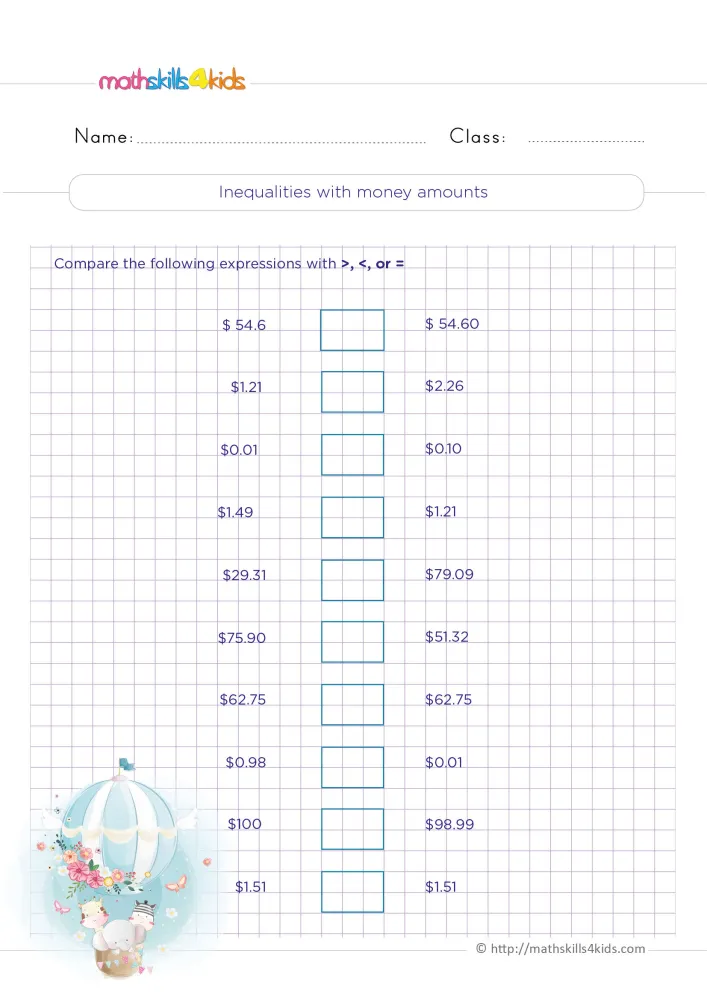
Download the worksheet: 3rd Grade Comparing Money Amounts Worksheet: Use >, < or =
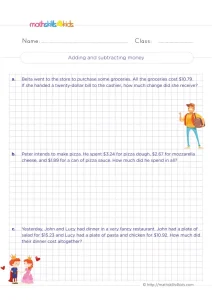 Worksheet3rd Grade Change and Total Cost Worksheet: Money Word Problems
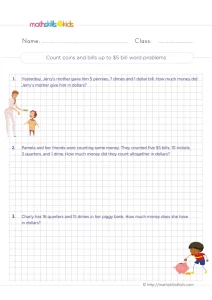 Worksheet3rd Grade How Much Money in All Worksheet: 3 Word Problems
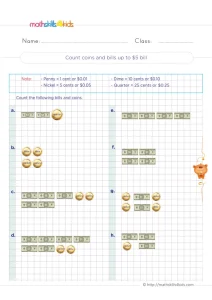 Worksheet3rd Grade Count Coins and Bills Worksheet: 8 Money Totals
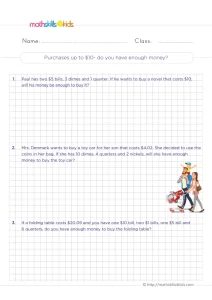 Worksheet3rd Grade Do You Have Enough Money Worksheet: 3 Word Problems
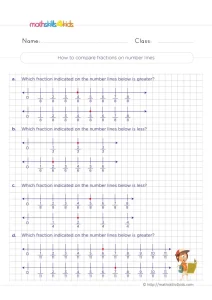 Worksheet3rd Grade Comparing Fractions Closer to Zero Worksheet: Which Dot Wins?
A few related activities
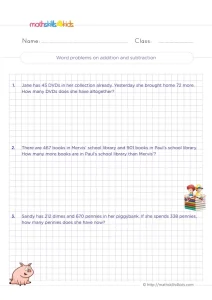 Three word problems about DVDs, school library books and pennies in a piggy bank. Your child adds or…See the activity3rd Grade Reading a Data Table Worksheet: 2 Tables
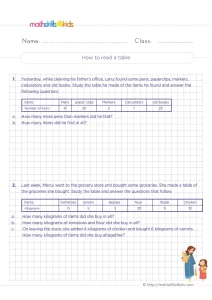 Two small tables, one of office items and one of groceries in kilograms. Your child finds the numbers,…See the activity3rd Grade 1 Times Table Worksheet: 18 Column Facts and the Identity Rule
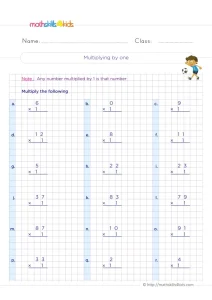 Eighteen column facts times 1, from 0 × 1 to 91 × 1. One rule solves them all:…See the activity
