3rd Grade Comparing Products Worksheet: Sort 21 Facts into Three Boxes
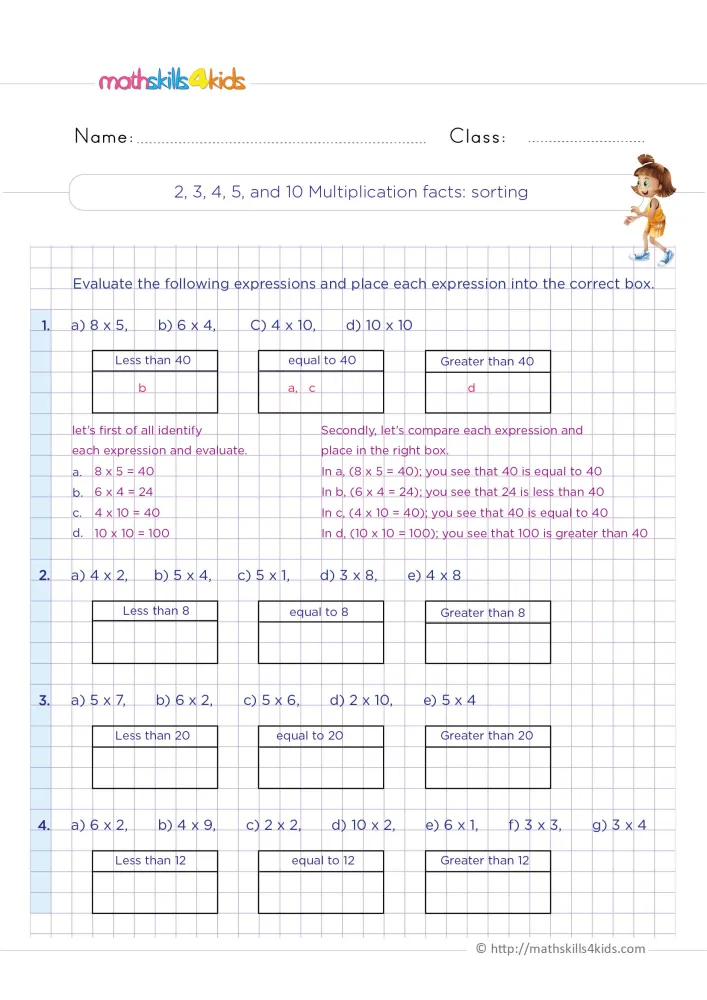
This page adds a second step to each fact. In this 3rd grade comparing products worksheet, children work out a product, then decide where it belongs. Four sets hold 21 facts in all, from the 2, 3, 4, 5 and 10 tables. Each set has three boxes: less than, equal to and greater than a target number such as 20. The first set is a worked example. A girl in a yellow dress stands by the title, and a second page gives the answer key.
Work it out, then sort
The worked example shows the method. First write each product: 8 × 5 = 40, 6 × 4 = 24. Then compare it with the target, 40, and write the letter in the right box.
Writing the product next to each fact keeps the two steps apart. Children who try to sort in their head often mix up less than and greater than.
At the table: twins and traps
Some sets hide twins. In set 3, 2 × 10 and 5 × 4 both make 20, so both letters go in the equal box. In set 4, 6 × 2 and 3 × 4 both make 12.
Watch the small facts too. 6 × 1 is 6, not 7, and 2 × 2 is 4. Remind your child that each product goes against the target number, never against the other facts in the row.
After the page: sort a deck
Write a few multiplication facts on cards and pick a target, like 15. Your child sorts the cards into three piles on the table, then checks by saying each product.
Comparing numbers this way builds number sense along with the facts. Open the answer key on page two to check all four sets.
About this 3rd grade comparing products worksheet and its answer key page
Download the worksheet: 3rd Grade Comparing Products Worksheet: Sort 21 Facts into Three Boxes
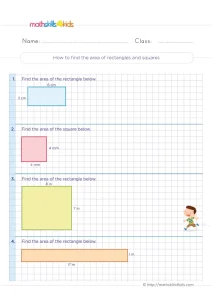 Worksheet3rd Grade Area with Length and Width Worksheet
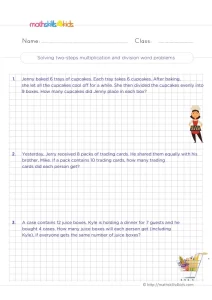 Worksheet3rd Grade Two-Step Multiply and Divide Problems: 3 Stories
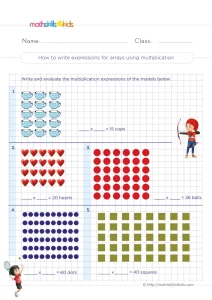 Worksheet3rd Grade Expressions for Arrays Worksheet: Write Each Product
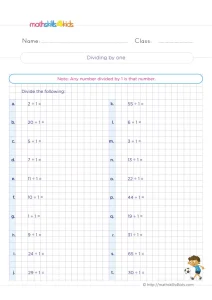 Worksheet3rd Grade Divide by 1 Worksheet: 20 Facts and the Rule of One
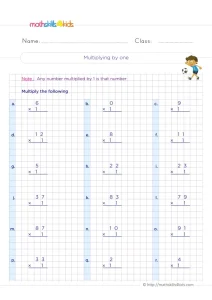 Worksheet3rd Grade 1 Times Table Worksheet: 18 Column Facts and the Identity Rule
A few related activities
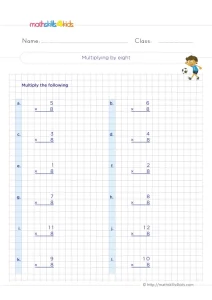 Twelve column facts times 8, from 1 × 8 to 12 × 8, in a mixed order. Double…See the activity3rd Grade Multiplication Properties Worksheet: Zero, Identity, Commutative
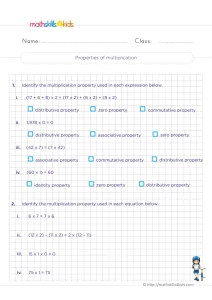 Tick the right property for four equations, from 1,978 x 0 = 0 to (60 x 1) =…See the activity3rd Grade Multiplication Worksheet: Find Products Using Properties
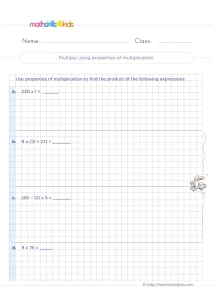 Work out four products, from 230 x 1 to 9 x 75, with the identity, distributive and commutative…See the activity
