3rd Grade Comparing Sums and Differences Worksheet: Which Side Is Bigger?
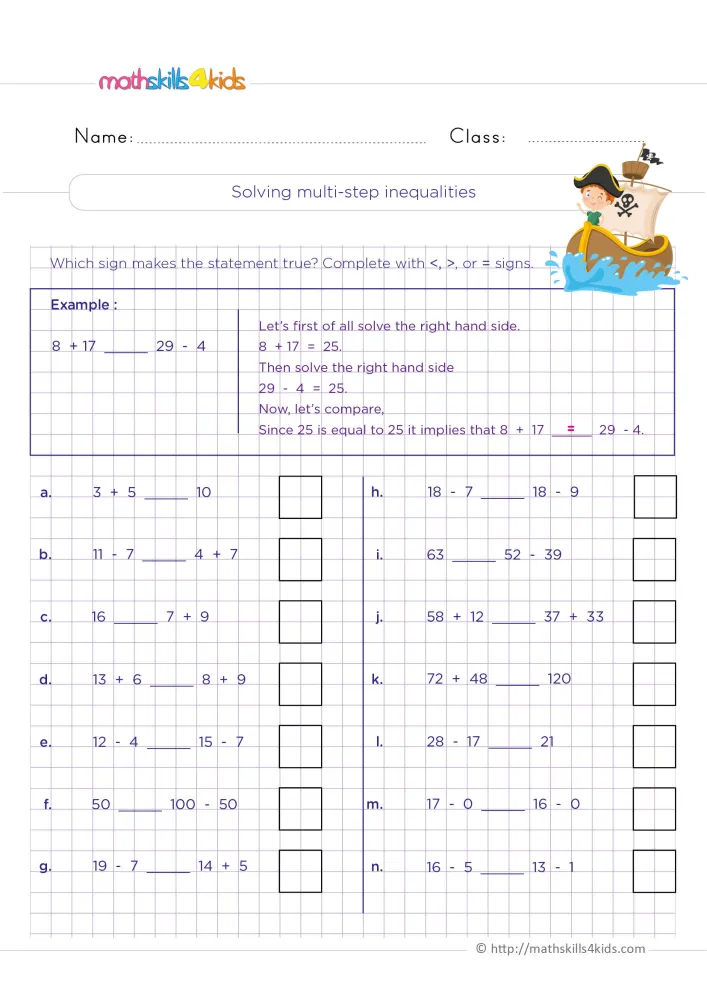
In 11 − 7 and 4 + 7, the 11 looks bigger than the 4. Yet 4 + 7 wins. This 3rd grade comparing sums and differences worksheet teaches children to work out both sides before they choose a sign. A worked example opens the page: 8 + 17 makes 25, 29 − 4 also makes 25, so the sign is =. Then come fourteen statements, from 3 + 5 and 10 up to 72 + 48 and 120. For each one, your child solves the left side and the right side, then writes <, > or = in the box. A second page gives the answer key.
Two sides, one sign
Each statement works like a balance. The sign tells which side is heavier, or that both weigh the same.
That is also the real meaning of the equal sign. It does not mean "the answer comes next." It means both sides have the same value, as in 58 + 12 and 37 + 33.
This idea matters a lot later, when third graders meet missing numbers in equations.
At the table: write the result under each side
Ask your child to write the result under each side, in small digits, before choosing the sign. For 13 + 6 and 8 + 9, that gives 19 and 17.
A small slip sits in the example. It says "right hand side" twice, but 8 + 17 is on the left. Point it out, as it is a good test of attention.
Some pairs can be solved without computing. In 18 − 7 and 18 − 9, taking away less leaves more, so the left side is bigger. In 17 − 0 and 16 − 0, nothing is taken away at all.
Finally, check all fourteen together with the answer key.
Two baskets at the store
This skill helps with money. Picture two baskets: one holds a $12 book and a $5 pen, the other a $20 game minus a $4 coupon. Which basket costs more?
Invent a few of these at home, with real prices. Let your child explain the answer out loud.
Once the page is done, name the effort: "You worked out both sides every time, before you chose the sign."
About this 3rd grade comparing sums and differences worksheet and key
Download the worksheet: 3rd Grade Comparing Sums and Differences Worksheet: Which Side Is Bigger?
 Worksheet3rd Grade Divide by 1 Worksheet: 20 Facts and the Rule of One
 Worksheet3rd Grade 1 Times Table Worksheet: 18 Column Facts and the Identity Rule
 Worksheet3rd Grade 8 Times Table Worksheet: 12 Column Facts and a Doubling Trick
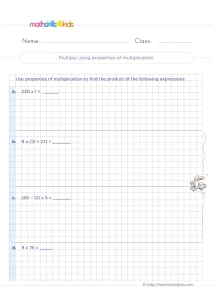 Worksheet3rd Grade Multiplication Worksheet: Find Products Using Properties
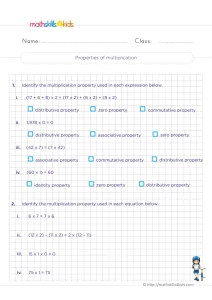 Worksheet3rd Grade Multiplication Properties Worksheet: Zero, Identity, Commutative
A few related activities
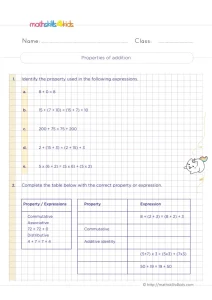 Five number sentences to name, from 8 + 0 = 8 to 5 x (6 + 2). Then…See the activity3rd Grade Expressions for Arrays Worksheet: Write Each Product
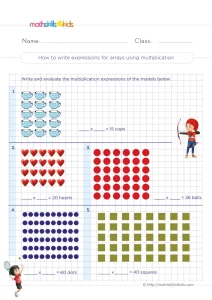 Five arrays of cups, hearts, balls, dots and squares. Your child writes the multiplication expression for each one…See the activity3rd Grade Area of Shaded Parts Worksheet: Subtract the Gaps
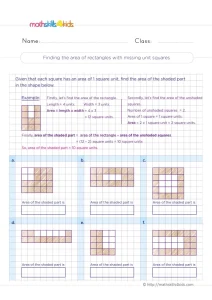 Six grid rectangles with a few white squares each. Children find the whole area, take away the white…See the activity
