3rd Grade Distributive Property Missing Numbers Worksheet: 3 Puzzles
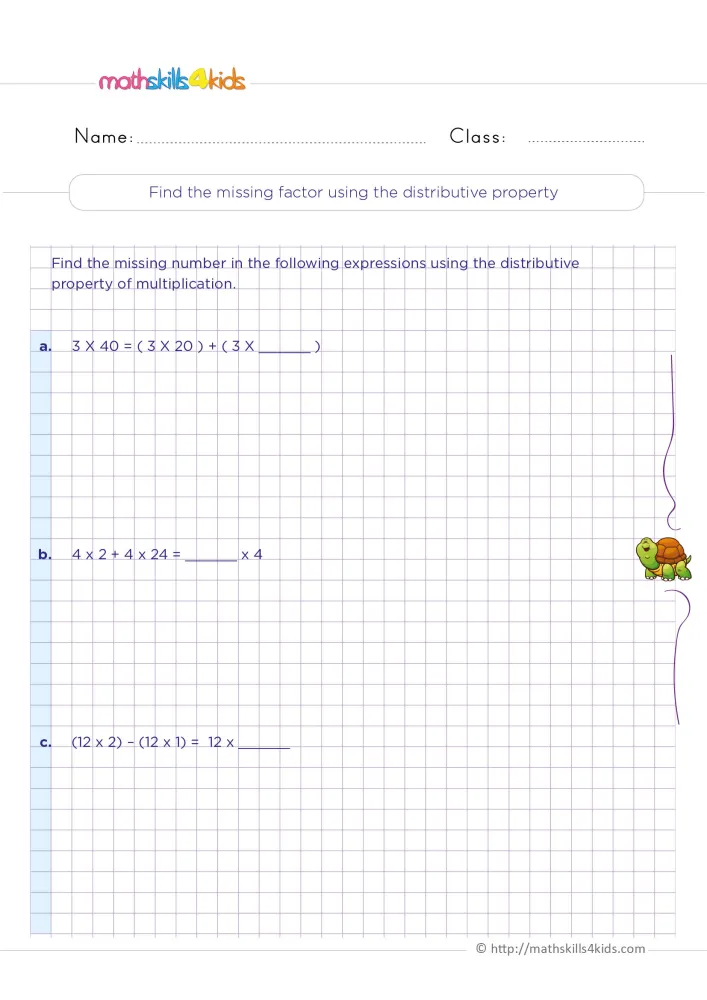
A big multiplication can be split into two small ones. This 3rd grade distributive property missing numbers worksheet uses that idea in three equations, labeled a to c. In each one, a blank replaces a factor. Item a splits 3 × 40 into 3 × 20 and 3 × something, while item b joins 4 × 2 and 4 × 24 into one product. Finally, item c takes 12 × 1 away from 12 × 2. Each item leaves a large grid space for working. A small turtle hangs from a string on the right. Page two writes out every step in pink, like a worked example.
Split, then put back together
The answers are 20, 26 and 1. In a, 40 = 20 + 20, so 3 × 40 = (3 × 20) + (3 × 20). In b, both products share the factor 4, so 4 × 2 + 4 × 24 = 26 × 4, because 2 + 24 = 26. In c, the shared factor is 12. Since 2 − 1 = 1, the missing factor is 1.
The distributive property is a third grade idea, but it is often new. So check each answer by computing both sides. For example, 3 × 40 = 120, and 60 + 60 = 120 too. Item c also shows that the rule works with subtraction, not only with addition.
At the table: draw the groups
For item a, draw 3 rows of 40 dots, or just sketch 3 long bars. Then split each bar into two parts of 20, so that your child sees that the two parts are the same size and the blank is 20.
Page two has small slips. Item c says "the common digit", but 12 is a common factor, not a digit. Item a mixes a capital X with a small x for times, so tell your child that both mean ×. Because there are only three items, you can add one more, such as 5 × 12 = (5 × 10) + (5 × __).
After the page: a split in the kitchen
Set out 3 plates with 12 grapes each. Count the grapes by tens first and then by twos: 3 × 10 and 3 × 2. Then add the two results, which gives 36. This is the same split as on the page. In the end, check the three blanks against the answer key on page two.
About this distributive property missing numbers page and its key
Download the worksheet: 3rd Grade Distributive Property Missing Numbers Worksheet: 3 Puzzles
 Worksheet3rd Grade Area with Length and Width Worksheet
 Worksheet3rd Grade Two-Step Multiply and Divide Problems: 3 Stories
 Worksheet3rd Grade Expressions for Arrays Worksheet: Write Each Product
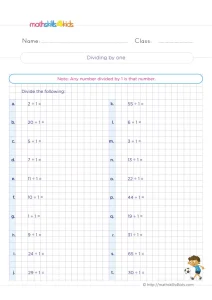 Worksheet3rd Grade Divide by 1 Worksheet: 20 Facts and the Rule of One
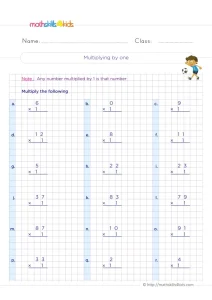 Worksheet3rd Grade 1 Times Table Worksheet: 18 Column Facts and the Identity Rule
A few related activities
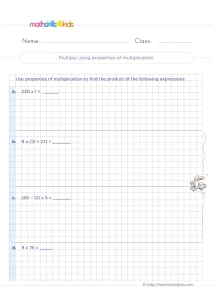 Work out four products, from 230 x 1 to 9 x 75, with the identity, distributive and commutative…See the activity3rd Grade Multiplication Properties Worksheet: Zero, Identity, Commutative
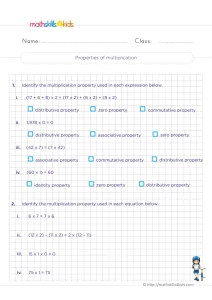 Tick the right property for four equations, from 1,978 x 0 = 0 to (60 x 1) =…See the activity3rd Grade 8 Times Table Worksheet: 12 Column Facts and a Doubling Trick
 Twelve column facts times 8, from 1 × 8 to 12 × 8, in a mixed order. Double…See the activity
