3rd Grade Division Facts True or False Practice Worksheet: 12 Facts
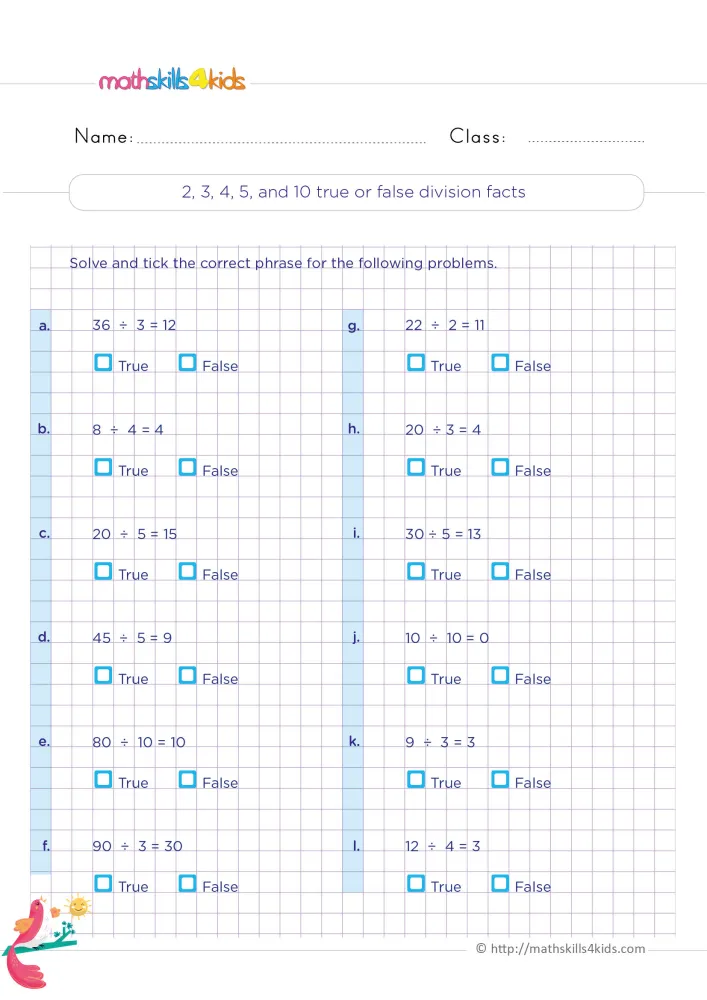
Spotting a mistake asks for a different kind of thinking than finding an answer. On this 3rd grade division facts true or false practice worksheet, twelve facts are already written out. Each one uses a divisor of 2, 3, 4, 5 or 10, and your child checks the fact before ticking True or False. Half of the facts are true and half are false, while a pink bird sings on a branch at the bottom of the page. Page two then shows every tick in red, so children can mark their own work.
Six true, six false
A true number sentence, such as 45 ÷ 5 = 9 or 22 ÷ 2 = 11, holds when you multiply back: 9 × 5 = 45. The false ones contain classic slips. In c, 20 ÷ 5 = 15 is really a subtraction, since 20 − 5 = 15.
In j, 10 ÷ 10 = 0 is false, because any number divided by itself gives 1. Item h, 20 ÷ 3 = 4, is false for a deeper reason. In fact, 20 is not in the 3 times table at all, so the answer is not even a whole number.
At the table: multiply back
The quickest check is a multiplication. For 36 ÷ 3 = 12, your child asks whether 12 × 3 makes 36. It does, so the fact is true. For 30 ÷ 5 = 13, the product 13 × 5 is 65, so that fact is false.
The instruction asks children to "tick the correct phrase", which simply means the correct word, True or False. Reading the full sentence aloud often helps a child to hear when a fact sounds wrong.
After the page: catch me out
Say a division fact out loud, sometimes true and sometimes false, like 16 ÷ 4 = 5, and your child answers "true" or "false" before fixing the false ones. After a few rounds, let your child try to catch you out instead. Finally, compare the twelve ticks with the answer key on page two.
About this division facts true or false page and its worked answer key
Download the worksheet: 3rd Grade Division Facts True or False Practice Worksheet: 12 Facts
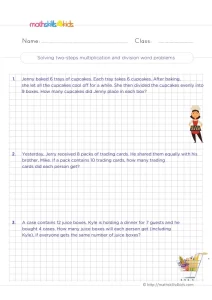 Worksheet3rd Grade Two-Step Multiply and Divide Problems: 3 Stories
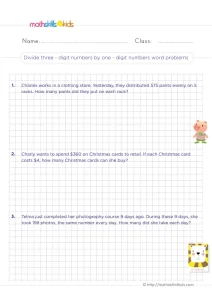 Worksheet3rd Grade Divide 3-Digit by 1-Digit Word Problems: 3 Stories
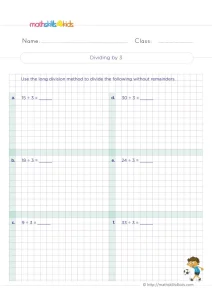 Worksheet3rd Grade Divide by 3 Worksheet: Long Division Without Remainders
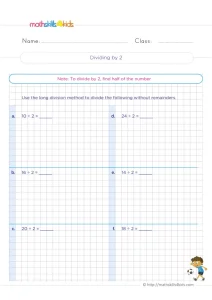 Worksheet3rd Grade Divide by 2 Worksheet: Long Division with Even Numbers
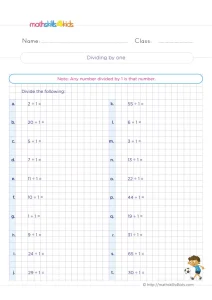 Worksheet3rd Grade Divide by 1 Worksheet: 20 Facts and the Rule of One
A few related activities
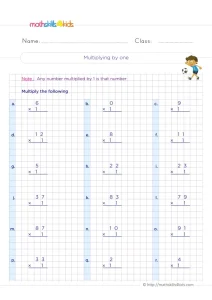 Eighteen column facts times 1, from 0 × 1 to 91 × 1. One rule solves them all:…See the activity3rd Grade Multiplication Worksheet: Find Products Using Properties
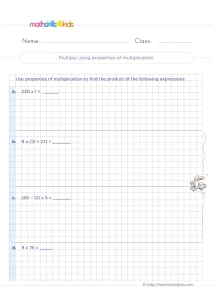 Work out four products, from 230 x 1 to 9 x 75, with the identity, distributive and commutative…See the activity3rd Grade Addition Properties Worksheet: Commutative, Associative, Identity
 Five number sentences to name, from 8 + 0 = 8 to 5 x (6 + 2). Then…See the activity
