3rd Grade Multi-Digit Subtraction Missing Digits Worksheet: Fill the Gaps
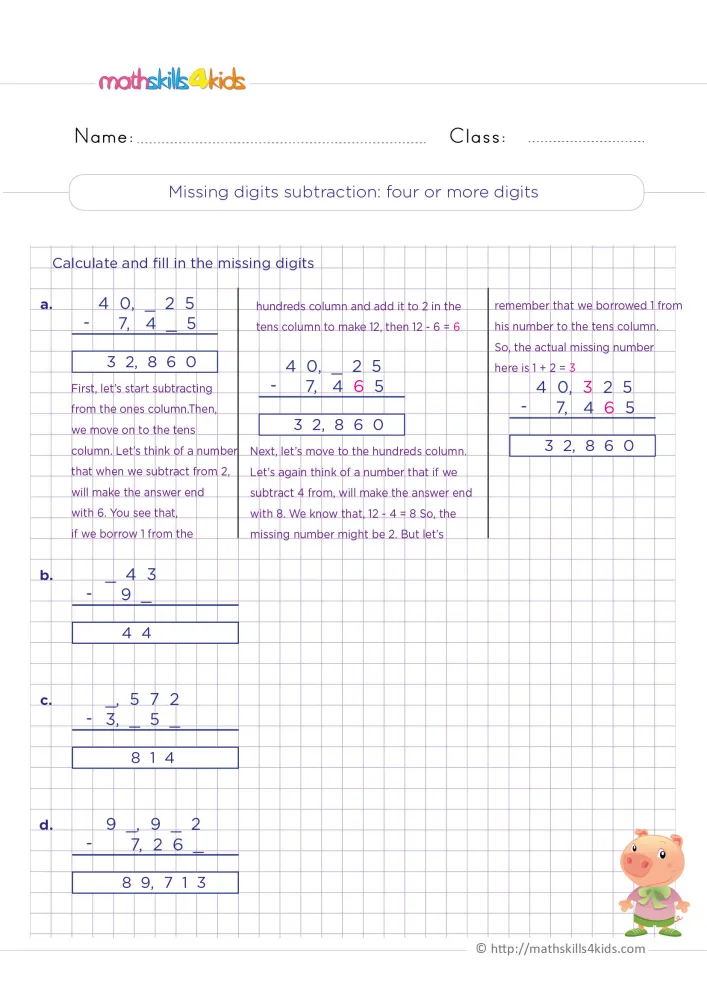
Can a subtraction still work with holes in it? This 3rd grade multi-digit subtraction missing digits worksheet turns column subtraction into a puzzle. A worked example rebuilds 40,325 − 7,465 = 32,860 one column at a time. Then three subtractions hide two or three digits each, in the top and bottom numbers. The answer box already shows the result. Your child works from the ones column to the left. A second page gives the answer key.
Work from the ones column
Start on the right. In b, the ones column reads 3 − ___ = 4. No digit works without regrouping, so your child borrows a ten: 13 − 9 = 4. Each column is one place value: ones, tens, hundreds.
That borrow changes the next column. The tens now hold 3, not 4, and 3 − 9 needs another borrow. The top number needs a 1 in the hundreds, just to lend it.
Say it aloud at each step: "Did I borrow here?"
At the table: check with addition
When the gaps are filled, add the answer to the bottom number. In c, 814 + 3,758 should give 4,572.
If the sum is wrong, the mistake sits in the first column where the digits stop matching.
Item b uses three-digit numbers. It makes a good warm-up before c and d.
Ready for a stretch?
Five-digit subtraction, like 96,982 − 7,269, usually belongs to 4th grade. Item d is a stretch for third graders.
If it feels too hard, cover the left part with a finger. Solve the last three columns first, then uncover the rest.
About this 3rd grade subtraction missing digits worksheet and its key
Download the worksheet: 3rd Grade Multi-Digit Subtraction Missing Digits Worksheet: Fill the Gaps
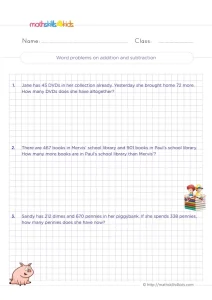 Worksheet3rd Grade Addition and Subtraction Problems: 3 Stories
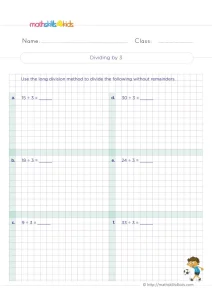 Worksheet3rd Grade Divide by 3 Worksheet: Long Division Without Remainders
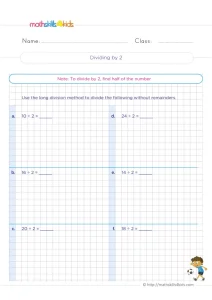 Worksheet3rd Grade Divide by 2 Worksheet: Long Division with Even Numbers
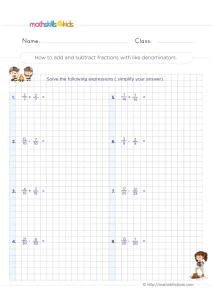 Worksheet3rd Grade Adding and Subtracting Like Fractions Worksheet: Eight Sums
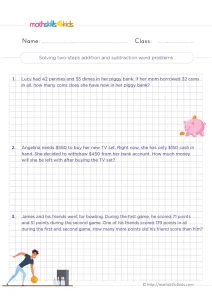 Worksheet3rd Grade Two-Step Add and Subtract Word Problems Worksheet: 3 Stories
A few related activities
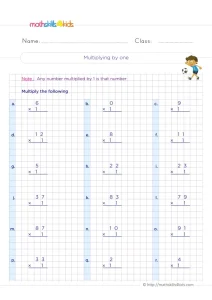 Eighteen column facts times 1, from 0 × 1 to 91 × 1. One rule solves them all:…See the activity3rd Grade Reading a Data Table Worksheet: 2 Tables
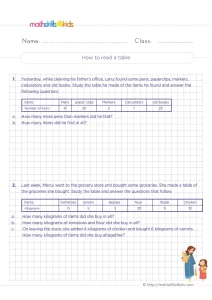 Two small tables, one of office items and one of groceries in kilograms. Your child finds the numbers,…See the activity3rd Grade Expressions for Arrays Worksheet: Write Each Product
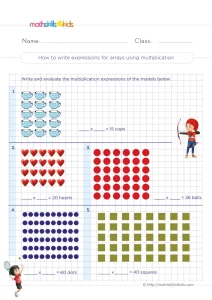 Five arrays of cups, hearts, balls, dots and squares. Your child writes the multiplication expression for each one…See the activity
