3rd Grade Sorting Division Facts by Quotient Worksheet: 4 Sets
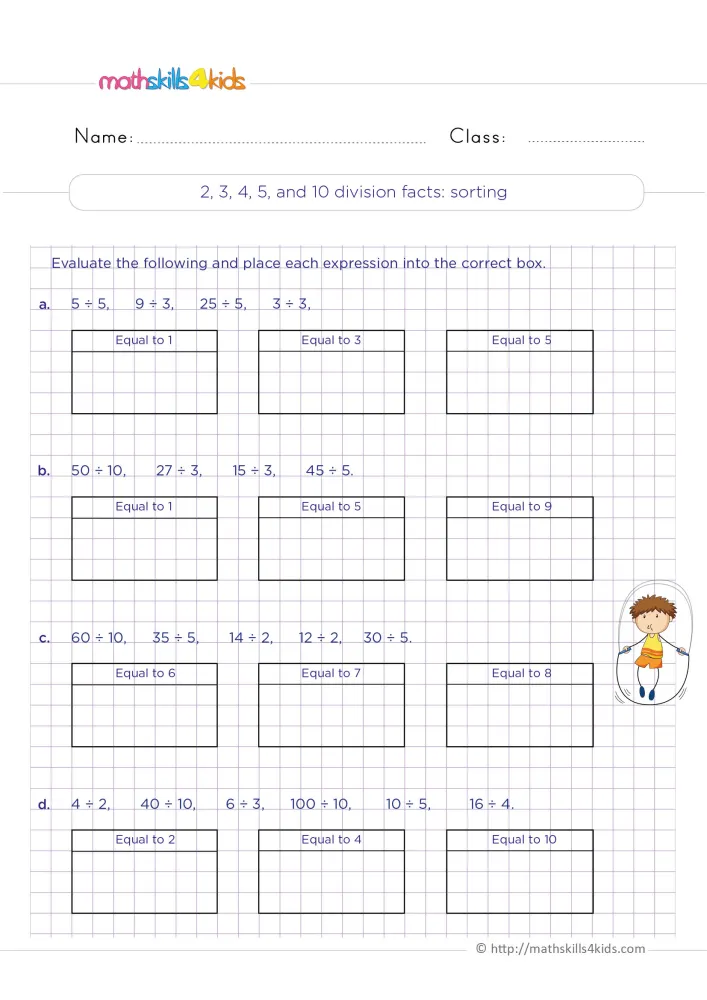
Sorting turns a list of facts into a small puzzle. This 3rd grade sorting division facts by quotient worksheet has four sets, labeled a to d, with 19 divisions in all. Under each set sit three boxes, such as "Equal to 1", "Equal to 3" and "Equal to 5". Your child works out each division and writes it in the box that matches its answer. A boy skipping rope bounces in the margin. On page two, the first set is solved step by step, and then all four sets of boxes are filled in.
Different facts, same answer
The big idea of this sorting practice is that many divisions share one quotient. In set c, 60 ÷ 10, 12 ÷ 2 and 30 ÷ 5 all equal 6, so they go in the same box. In set d, 4 ÷ 2, 6 ÷ 3 and 10 ÷ 5 all equal 2.
Two boxes stay empty on purpose: "Equal to 1" in set b and "Equal to 8" in set c. However, an empty box can puzzle a child, who may think a fact is missing. Explain beforehand that some boxes are traps.
At the table: write the answer first
Ask your child to write the quotient in small digits above each division before sorting it. For example, 27 ÷ 3 gets a small 9, and 45 ÷ 5 gets a 9 too. As a result, the sorting step becomes quick and calm.
The worked example on page two uses phrases like "placed on the box" and "Let's first of all", which sound a little odd. Read it with your child anyway, because the method is clear and every box is correct.
After the page: sticky note boxes
Write a few numbers, like 2, 5 and 9, on three sheets of paper. Then give your child sticky notes with divisions such as 18 ÷ 2 or 25 ÷ 5. Your child sticks each note on the right sheet, which links each fact family to its quotient. Last of all, check page one against the answer key.
About this sorting division facts by quotient page and its answer key
Download the worksheet: 3rd Grade Sorting Division Facts by Quotient Worksheet: 4 Sets
 Worksheet3rd Grade Two-Step Multiply and Divide Problems: 3 Stories
 Worksheet3rd Grade Divide 3-Digit by 1-Digit Word Problems: 3 Stories
 Worksheet3rd Grade Divide by 3 Worksheet: Long Division Without Remainders
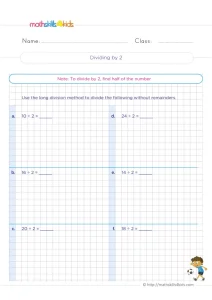 Worksheet3rd Grade Divide by 2 Worksheet: Long Division with Even Numbers
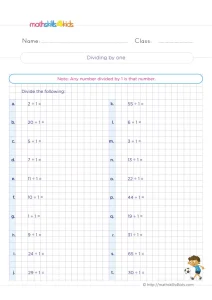 Worksheet3rd Grade Divide by 1 Worksheet: 20 Facts and the Rule of One
A few related activities
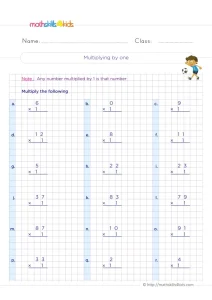 Eighteen column facts times 1, from 0 × 1 to 91 × 1. One rule solves them all:…See the activity3rd Grade Multiplication Worksheet: Find Products Using Properties
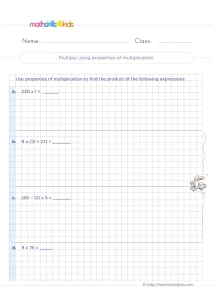 Work out four products, from 230 x 1 to 9 x 75, with the identity, distributive and commutative…See the activity3rd Grade Addition Properties Worksheet: Commutative, Associative, Identity
 Five number sentences to name, from 8 + 0 = 8 to 5 x (6 + 2). Then…See the activity
