Kindergarten Missing Addend Worksheet: Fill In Sums Up to 5
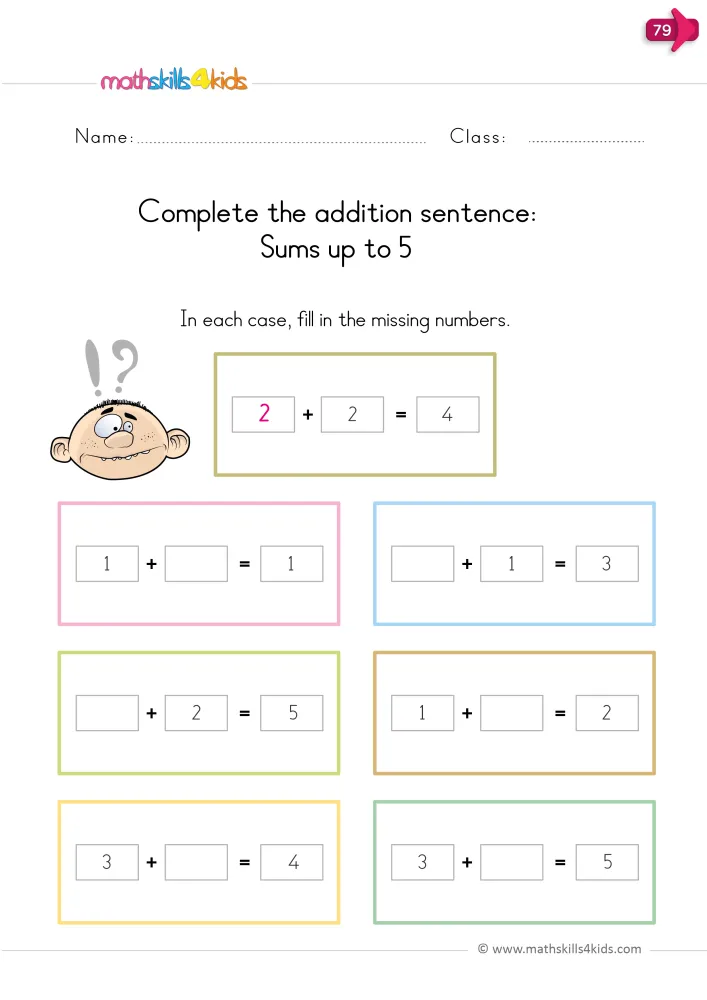
Ask a five-year-old what goes with three to make five, and you will often see fingers come up before any answer. That pause is the heart of this kindergarten missing addend worksheet. A puzzled cartoon face sits next to the example, 2 + 2 = 4, with the first 2 written in pink, while below it six colored boxes each hide one number. The blank moves around, sometimes first and sometimes second, but every total in these six sums stays at 5 or less. The PDF has two pages: the worksheet and its answer key.
Why a hidden number makes children think
Most early sums ask one thing: how many in all? This page turns the question around. The total is already written, so the child must find a missing part. That shift is a first step toward seeing that 5 is made of smaller numbers, like 3 and 2, or 4 and 1.
Teachers call these pairs number bonds to 5, and knowing them well later makes adding and subtracting feel much lighter.
The missing numbers also move around. In one box the blank comes first and in the others second, so the child cannot fill in by habit and must read each sentence. Reading first. Then thinking.
At the table: three and what make four?
Begin with the example at the top. Point to the pink 2 and say, "Two and two make four. Let's check on our fingers."
Then let your child try the yellow box, 3 + blank = 4. Hold up three fingers and ask, "How many more to get to four?" Counting on from three is the trick, and the fingers make it visible.
The pink box, 1 + blank = 1, is the likely snag, since many children write 1 because they feel something must be added. Instead of correcting, ask, "You have one cookie and I give you nothing. How many now?" Adding zero is a discovery, not a rule. For the blue box, where the blank comes first, cover it with a finger and read the rest aloud.
After the page: a game of Go Fish for five
Number bonds stick through play. Take the aces to fours from a deck of cards and play Go Fish, where a pair is two cards that make five, like a 3 and a 2. Each pair your child lays down is a fill-in-the-blank addition said out loud.
Also, try a cup game at snack time. Put five raisins on the table, hide some under a cup, and ask, "How many are hiding?" Your child sees one part and finds the other.
Finally, check the page with the answer key together. Praise the search rather than the score: "You held up your fingers and counted on. That is real thinking."
About this kindergarten missing addend worksheet with sums up to 5
Download the worksheet: Kindergarten Missing Addend Worksheet: Fill In Sums Up to 5
 Worksheet3rd Grade Addition and Subtraction Problems: 3 Stories
 Worksheet3rd Grade Addition Properties Worksheet: Commutative, Associative, Identity
 Worksheet3rd Grade Count Coins and Bills Worksheet: 8 Money Totals
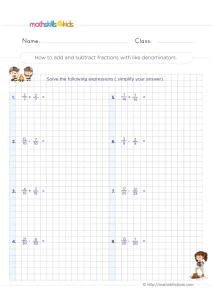 Worksheet3rd Grade Adding and Subtracting Like Fractions Worksheet: Eight Sums
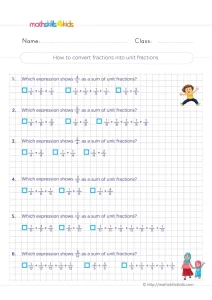 Worksheet3rd Grade Writing Fractions as Unit Fraction Sums Worksheet: Tick One
A few related activities
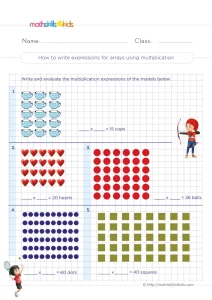 Five arrays of cups, hearts, balls, dots and squares. Your child writes the multiplication expression for each one…See the activity3rd Grade 1 Times Table Worksheet: 18 Column Facts and the Identity Rule
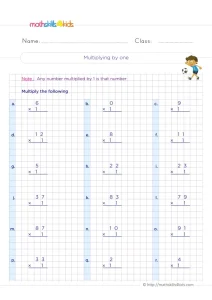 Eighteen column facts times 1, from 0 × 1 to 91 × 1. One rule solves them all:…See the activity3rd Grade Reading a Data Table Worksheet: 2 Tables
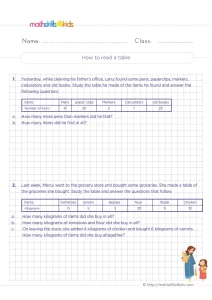 Two small tables, one of office items and one of groceries in kilograms. Your child finds the numbers,…See the activity
