Pre-K Counting 1 to 3 Worksheet: Count, Then Circle the Number
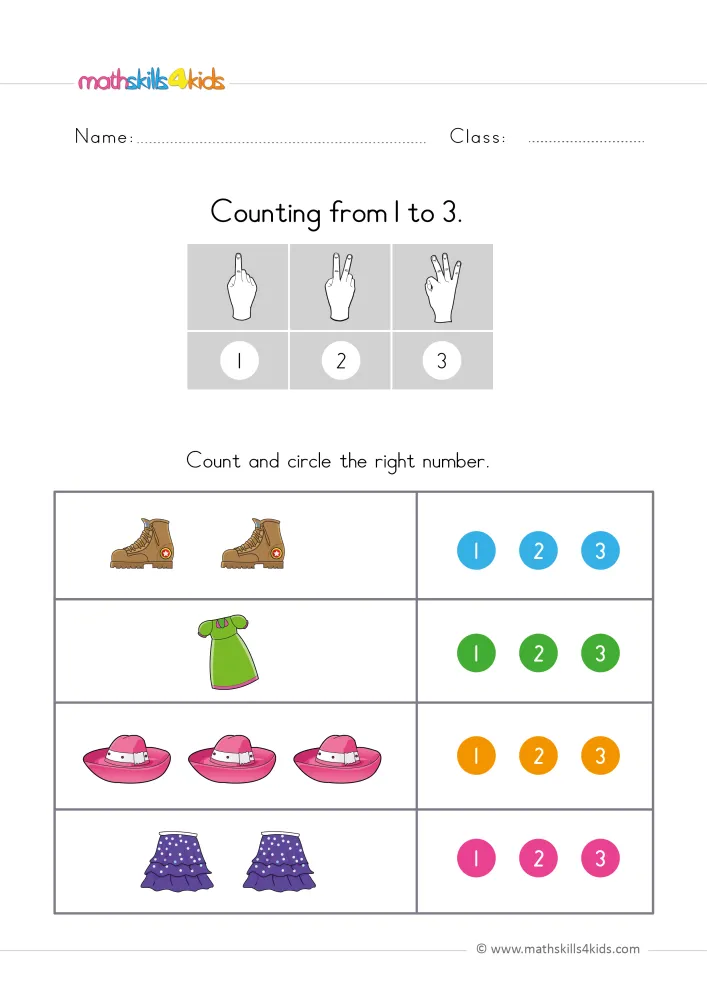
Ask a four-year-old how many boots are in the first row, and watch closely: many will answer before they have counted at all. That is because, up to three, the eyes see a quantity in a single glance. This Pre-K counting 1 to 3 worksheet builds on that strength. First, a finger chart shows one, two and three fingers above their numerals. Then four rows of clothes wait below: boots, a dress, hats and skirts. No row holds more than three objects, so every answer stays within reach of a small hand.
Why three is the right place to start
Before children count, they see. Researchers call it subitizing: recognizing a small amount at a glance, without saying "one, two, three" out loud. Most children manage it with one, two and three objects long before they can count to ten.
So this page stops at 3. The finger chart turns what the child already sees into something they can show and name. For example, hold up two fingers next to the two boots, and the link becomes physical: same amount, same word, same numeral.
Used this way, finger counting is not a crutch but a bridge. The hand holds the quantity, while the numeral gives it a name.
At the table: what to say, row by row
Sit beside your child, not across the table, so you both see the same page.
- The boots. Ask, "How many boots? Show me with your fingers first." Then find that number in the blue dots.
- The green dress. The easiest row: "Just one. You didn't even need to count, did you?"
- The pink hats. The only row with three, where a child may count the same hat twice. Instead of correcting, say, "Let's touch each hat once, slowly," and count together.
- The purple skirts. Two again, so some children notice: "Like the boots." That discovery deserves a smile.
Touching each picture once builds one-to-one correspondence. Circling a single dot then makes count and circle a finished answer.
However, your child may count the hats all over again when you ask how many there are. That is normal: the last number said is the answer, and that idea takes time.
Three socks, two spoons: counting off the page
The clothes on this sheet are already in your home, so the next step is easy. While you fold the laundry, hold up one sock and ask, "How many?" Next, add a second, then a third. Let your child answer with fingers before words.
At snack time, put out two crackers and ask for one more. In the bath, line up three toys, then let one swim away. Also, if your child likes rhymes, "One, Two, Buckle My Shoe" suits this page well: it counts, and it is about getting dressed.
These short moments support number recognition better than one long session. Moreover, they show that early math belongs to ordinary days. Finally, when the page is done, praise the effort rather than the result: "You touched every hat. That's real counting."
About this Pre-K counting 1 to 3 worksheet and its simple finger model
Download the worksheet: Pre-K Counting 1 to 3 Worksheet: Count, Then Circle the Number
 Worksheet1st Grade Ten Frame Make 10 Worksheet: How Many More?
 WorksheetKindergarten Digital Clock Worksheet: Which Clock Shows the Hour?
 WorksheetKindergarten Make a Bar Graph Worksheet: Count the Zoo, Then Draw Each Bar
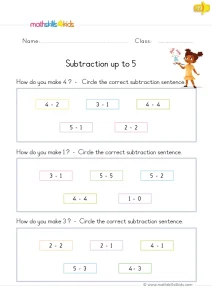 WorksheetKindergarten Choose the Right Subtraction Worksheet: Make 4, 1 and 3
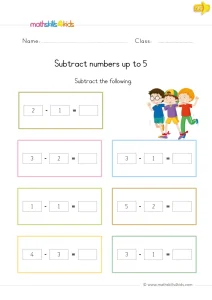 WorksheetKindergarten Subtraction Within 5 Worksheet: Fill In Each Answer
A few related activities
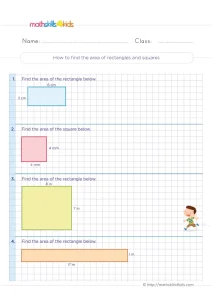 Three rectangles and one square, each with its side lengths. Your child multiplies length by width to find…See the activity3rd Grade Naming Solid Figures Worksheet: Prisms, Pyramids and More
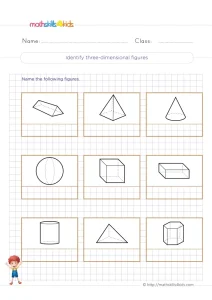 Nine drawn solids to name, from a cube and a cone to a hexagonal prism and a triangular…See the activity3rd Grade Count Edges of 3D Shapes Worksheet: Faces and Vertices Too
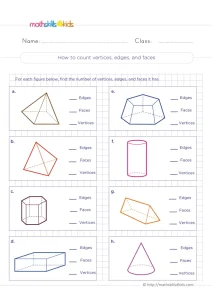 Eight drawn solids, from a square pyramid to a hexagonal prism and a cone. Count the edges, faces…See the activity
