Left or Right? Three Picture Pairs to Practice Sides in Pre-K
Ask a four-year-old to wave their right hand, and you may see the left one go up, both, or a long pause. That's normal, because left and right have no landmark in the world, only in the body. This Pre-K left and right worksheet keeps the task small. Each of its three rows holds two pictures side by side. The first two questions ask for the picture on the left, so your child looks at a cake and a gift, then at tickets and a green bin. The last question turns to the right, with a frog and an orange fox.
The one position word with no landmark
Above has the sky, and inside has a wall. Left and right have nothing outside the child. They depend on which way your child is facing, which is why they are usually among the last position words to settle. So practicing left and right discrimination early simply gives the words time to grow.
This page helps in two ways. First, the pictures are easy to name, so attention stays on the directional words rather than on the objects. Also, every row has just two boxes. There is no middle to confuse things.
Sit beside, never across
Where you sit matters here. If you face your child across the table, your right becomes their left, and your pointing will mislead them. So sit side by side, looking at the page the same way.
Before the first row, ask, "Which hand do you draw with?" Name that side together. Then let your child sweep a finger along each row, from the left box to the right one, which is also the reading direction of an English book.
The likely mistake comes at the end. After two left questions, many children point left again and answer "the frog." Rather than saying no, ask, "What did the question say? Left or right?" Then let them find the fox on their own.
Simon Says, the left-and-right edition
Left and right improve with daily use, not with long lessons. Play Simon Says with only two kinds of orders: "Simon says touch your left ear. Simon says lift your right foot." Keep the rounds short.
At the table, set a fork to the left of the plate and a spoon to the right, then let your child set the next place. Also, when shoes go on, ask, "Which foot first, left or right?" These small habits build body awareness and everyday spatial reasoning.
When your child finishes the three rows, name the effort: "You stopped and listened before you chose a side."
About this Pre-K left and right worksheet with three side-by-side pairs
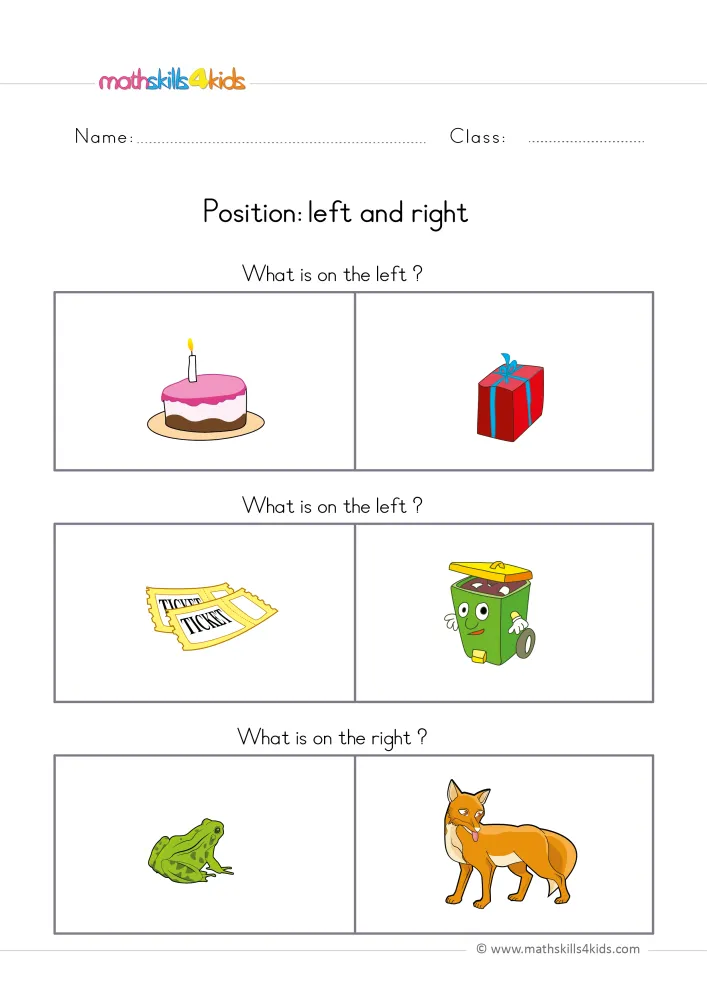
Download the worksheet: Left or Right? Three Picture Pairs to Practice Sides in Pre-K
 Worksheet3rd Grade Reading Coordinates on a Map Worksheet: Find the Places
 Worksheet1st Grade Copy the Shape Pattern Worksheet: Draw Each Row Again
 Worksheet1st Grade Top or Bottom Pictures Worksheet: Read, Then Color the Number
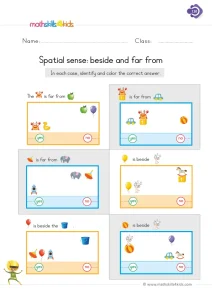 Worksheet1st Grade Beside and Far From Worksheet: Yes or No Picture Sentences
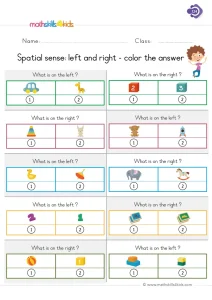 Worksheet1st Grade Left or Right Toy Pairs Worksheet: Color 1 or 2
A few related activities
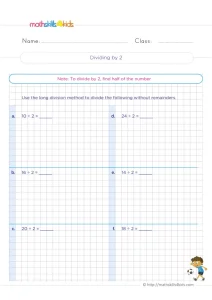 Six even numbers from 10 to 24 to divide by 2 with the long division method. Each answer…See the activity3rd Grade AM and PM Time Worksheet: 5 Daily Events
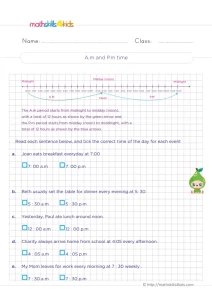 Five everyday events, from breakfast to dinner. Your child reads each time and ticks a.m. or p.m. using…See the activityGrade 1 Math — Compare numbersGrade 1 math review game (ages 6–7): compare numbers. Instructions are read aloud, and every answer is checked…See the activity
