Light or Heavy? Three Pairs of Objects to Compare by Weight in Pre-K
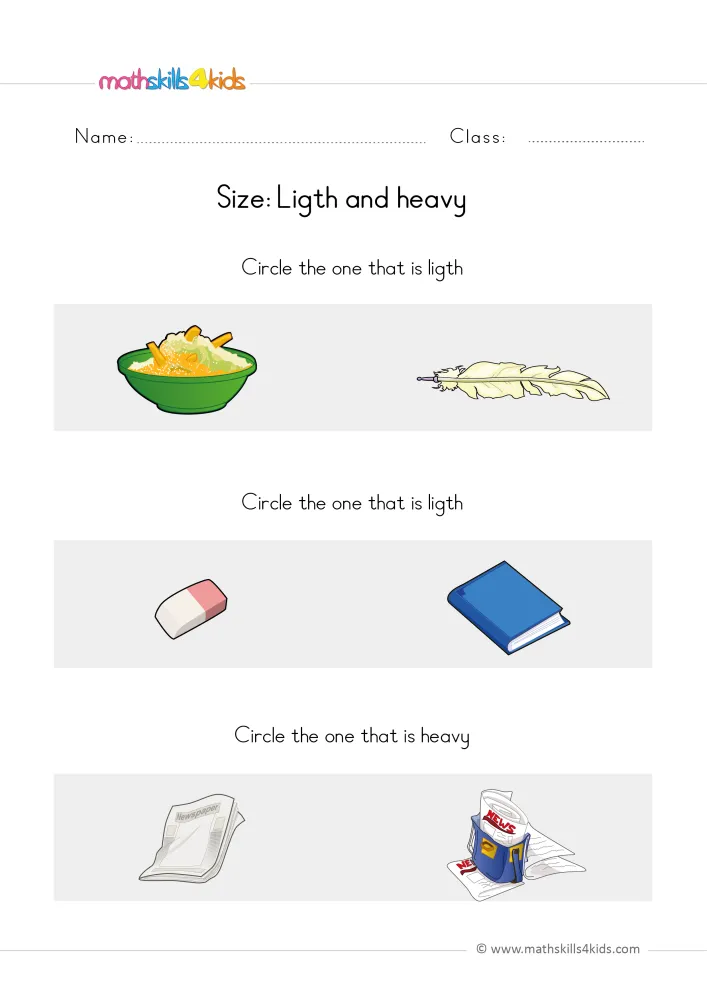
Ask a four-year-old to carry the grocery bag and you will hear the verdict in a second: "It's too heavy." Their arms know weight long before they have a word for it. This Pre-K light and heavy worksheet asks them to use that knowledge with pictures instead of hands. Three gray bands each hold a pair: a full bowl of food and a feather, an eraser and a blue book, then one newspaper and a mailbag stuffed with papers. Your child circles the light one twice, then the heavy one.
You cannot see how heavy something is
Length and height sit right there on the page. Weight does not. A child has to remember how an object felt, then picture it in their arms. That makes weight comparison a small act of imagination, built on everyday experience.
Look at the first band. The feather stretches almost as wide as the bowl, so size alone cannot decide. Your child has to think about what each thing is. However, the second band works the other way: the small eraser really is the light one.
Then the last pair adds a new idea. A single newspaper and a full mailbag hold the same thing: paper. More of it simply weighs more.
Lift it in your mind
Before the page, take a book from the shelf and an eraser from the pencil case. Let your child hold one in each hand and ask, "Which one pulls your arm down?" That short moment of sensory learning gives the pictures a meaning.
On the sheet, try lines like these:
- "Pretend to lift the bowl. Now the feather."
- "Which one would make your arms tired?"
- "What does this line ask for: light or heavy?"
The last question matters most. After two rounds of light, many children circle the single newspaper again, out of habit. Do not tell them. Instead, read the instruction once more and let them act out carrying the bulging mailbag. Usually they groan and change their circle.
Bowls, books and three bears
Daily chores are full of weights to compare. When you unpack the shopping, hand your child two bags and ask which one to carry. Next, on mail day, let them hold one letter, then the whole stack. Also, at bedtime, they can carry a pillow in one hand and a picture book in the other.
If you read Goldilocks and the Three Bears, pause at the porridge. Ask, "Which bowl would be the heaviest to carry?" Papa Bear's great big bowl, of course, and your child can tell you why. Guessing and then checking is scientific thinking at four years old, and the first step toward measurement.
Finally, praise the thinking: "You lifted both in your head before you chose. Careful work."
About this Pre-K light and heavy worksheet with three pairs of objects
Download the worksheet: Light or Heavy? Three Pairs of Objects to Compare by Weight in Pre-K
 Worksheet3rd Grade Customary Units of Weight Worksheet: Ounces, Pounds, Tons
 Worksheet1st Grade Spinner Probability Worksheet: More Likely, Less Likely or Equally Likely
 WorksheetKindergarten Comparing Length Worksheet: Longer or Shorter School Supplies?
 WorksheetKindergarten Small, Smaller, Smallest Worksheet: Circle the Tiniest Bug
 WorksheetShort or Tall? Four Pairs of People to Compare by Height in Pre-K
A few related activities
 Work out four products, from 230 x 1 to 9 x 75, with the identity, distributive and commutative…See the activity3rd Grade Count Edges of 3D Shapes Worksheet: Faces and Vertices Too
 Eight drawn solids, from a square pyramid to a hexagonal prism and a cone. Count the edges, faces…See the activity3rd Grade Naming Solid Figures Worksheet: Prisms, Pyramids and More
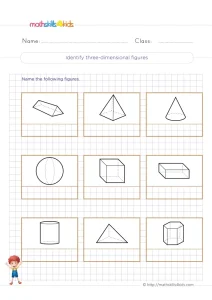 Nine drawn solids to name, from a cube and a cone to a hexagonal prism and a triangular…See the activity
