1st Grade Spinner Probability Worksheet: More Likely, Less Likely or Equally Likely
Spin a board game spinner a few times with a six-year-old and they will soon cheer for the big color, even before they can say why. This 1st grade spinner probability worksheet gives that hunch some words. Eight spinners fill the page, each cut into numbered parts of different sizes, with an arrow in the middle. For the first four, your child ticks more likely, less likely or equally likely for one number. Two more ask which number the arrow lands on most or least. The last two are true or false. No fractions are needed, only careful looking at size. A second page gives the answer key.
Why the biggest part wins most often
Probability starts as a comparison of space. A spinner stops anywhere around its circle, so a part that takes up more of the circle catches the arrow more often. That simple idea is enough for this whole page.
The questions ask for words, not numbers. Your child does not compute a chance; instead, they compare the size of one part with the others and pick the right phrase.
The last two spinners are a gentle lesson in fairness. Both ask the same question about equal chances. However, your child has to check whether every part is the same size before saying true or false. Same words, different spinners.
At the table: where the arrow points
Start with the first spinner. Ask, "Which part is the biggest?" Let your child trace around it with a finger.
The arrow is the main trap on this page. Each arrow already points somewhere, and a child may answer with the number under it. Instead of correcting, try, "Does the arrow stay there forever, or does it spin?" Then cover the arrow with a fingertip and look again.
The sixth spinner needs a slow look. Its three parts are close in size, so your child has to compare them carefully before choosing.
Finally, the true or false spinners mix shapes and sizes. Ask, "Are all the parts the same size?"
Spinners, coins and game night
Chance makes sense when you can test it. Draw a paper spinner with one big part and one small part, then spin a pencil on a paper clip ten times and keep score. Also, put five red buttons and one blue button in a bag and ask which color you are more likely to pull out.
Chutes and Ladders uses a spinner too. While you play, pause before each spin and ask which number your child hopes for, and which one is most likely.
These small tests show that a guess can be checked. When the page is done, check it with the answer key and name the effort: "You compared every part. That is good thinking."
About this 1st grade spinner probability worksheet and its answer key
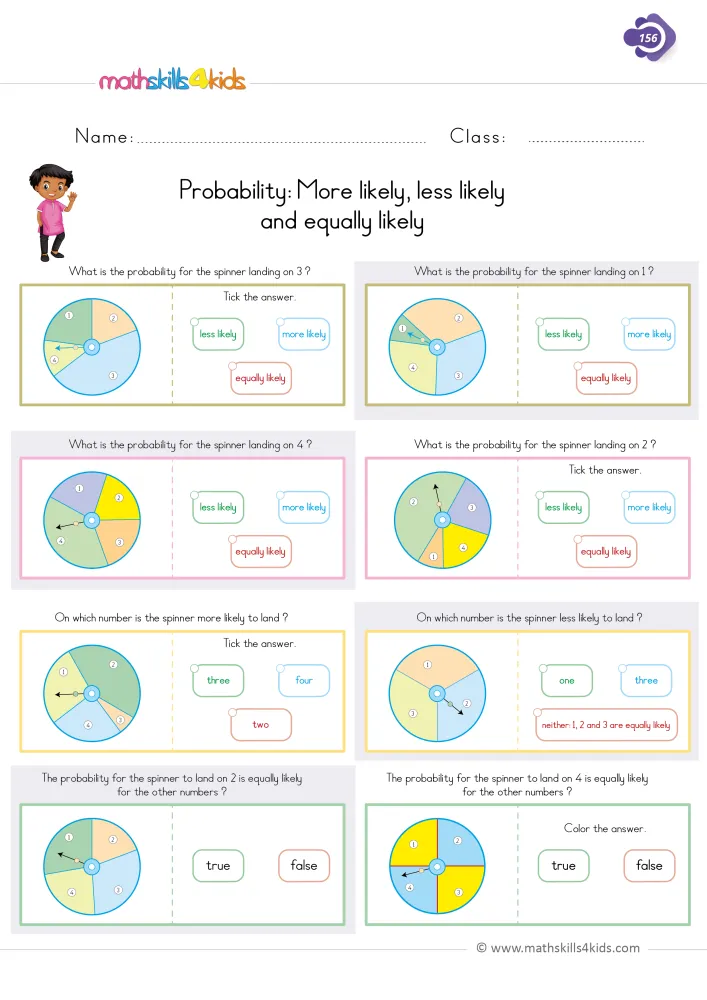
Download the worksheet: 1st Grade Spinner Probability Worksheet: More Likely, Less Likely or Equally Likely
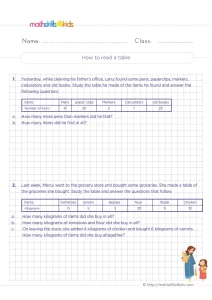 Worksheet3rd Grade Reading a Data Table Worksheet: 2 Tables
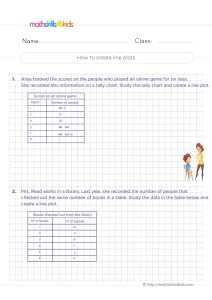 Worksheet3rd Grade Making Line Plots from Data Worksheet: Scores and Books
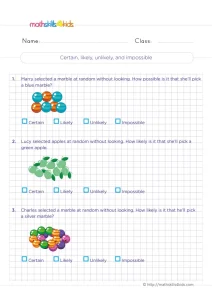 Worksheet3rd Grade Likely and Unlikely Events Worksheet: Marbles and Apples
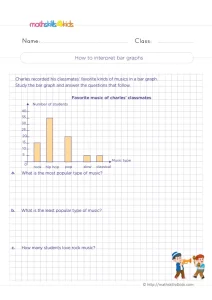 Worksheet3rd Grade Interpreting Bar Graphs Worksheet: Favorite Music
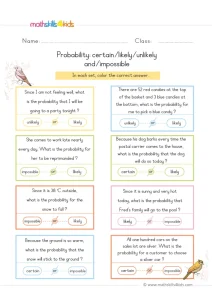 Worksheet2nd Grade Everyday Events Chance Worksheet: Color the Right Word
A few related activities
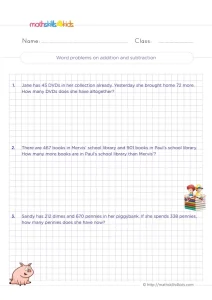 Three word problems about DVDs, school library books and pennies in a piggy bank. Your child adds or…See the activity3rd Grade Multiplication Properties Worksheet: Zero, Identity, Commutative
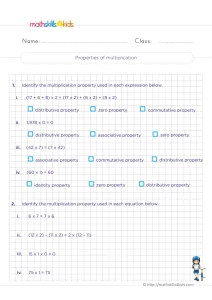 Tick the right property for four equations, from 1,978 x 0 = 0 to (60 x 1) =…See the activity3rd Grade 8 Times Table Worksheet: 12 Column Facts and a Doubling Trick
 Twelve column facts times 8, from 1 × 8 to 12 × 8, in a mixed order. Double…See the activity
