3rd Grade Interpreting Bar Graphs Worksheet: Favorite Music
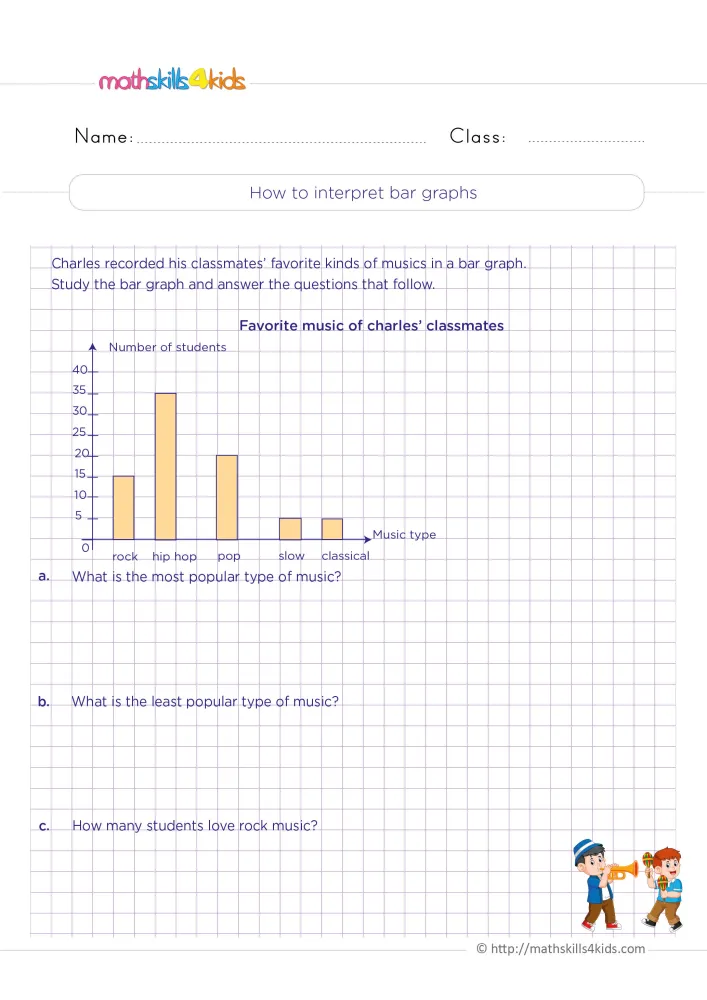
A bar graph turns a list of answers into bars that are easy to compare. This 3rd grade interpreting bar graphs worksheet shows the favorite music of Charles' classmates. There are five yellow bars standing on the grid, one for each type of music: rock, hip hop, pop, slow and classical. The scale goes from 0 to 40, counting by fives, so each line on the side is worth 5 students. Below the graph, three questions ask about the data. Question a looks for the most popular type of music, while question b looks for the least popular one in the class. Question c asks how many students love rock music. Two boys with a trumpet march at the bottom. Page two gives each answer in a pink box.
Reading the bars one by one
Hip hop has the longest bar, which stops at 35 students, so it is clearly the most popular type of music. Slow and classical have the two shortest bars, at 5 students each. That is why the key gives two answers for question b. Rock reaches 15, and pop reaches 20. All the answers in the key are right.
Question b is a nice surprise, because many children expect only one answer and stop as soon as they find the first short bar. Also, the scale counts by fives, so your child must read the side carefully. Reading a graph like this is a third grade skill.
At the table: a ruler across the bar
Lay a ruler flat on the top of each bar, then slide it to the side to read the number. This simple trick stops the eyes from slipping to the wrong line. Next, your child writes the number above each bar in pencil.
The text has a few slips to fix. The intro says "kinds of musics", but "kinds of music" is right. The graph title writes "charles'" without a capital letter. On page two, "two shortest bar of same length" should read "two shortest bars of the same length". The key also writes "15 number of students" for "15 students".
After the page: your own family graph
Ask each person at home for their favorite fruit. Then draw one bar per fruit on squared paper, with one square for each person who chose that fruit. Next, ask your child which fruit wins and which one loses. Finally, check the three answers with the answer key on page two.
About this interpreting bar graphs page and its two-page answer key
Download the worksheet: 3rd Grade Interpreting Bar Graphs Worksheet: Favorite Music
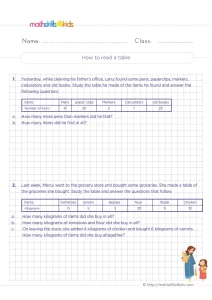 Worksheet3rd Grade Reading a Data Table Worksheet: 2 Tables
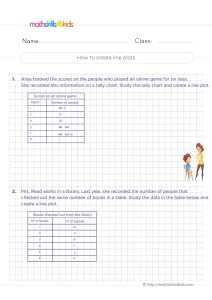 Worksheet3rd Grade Making Line Plots from Data Worksheet: Scores and Books
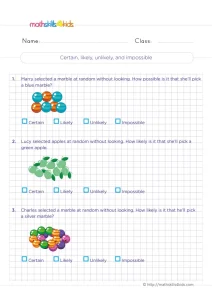 Worksheet3rd Grade Likely and Unlikely Events Worksheet: Marbles and Apples
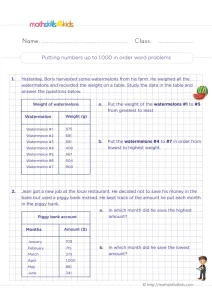 Worksheet2nd Grade 3-Digit Data Tables Worksheet: Watermelons and a Piggy Bank
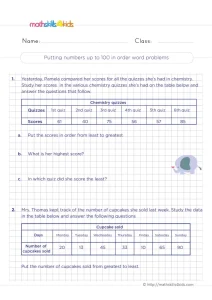 Worksheet2nd Grade Ordering Data to 100 Worksheet: Quiz Scores and Cupcake Sales
A few related activities
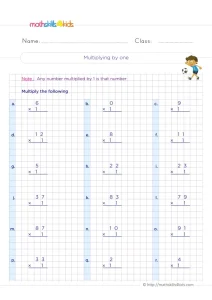 Eighteen column facts times 1, from 0 × 1 to 91 × 1. One rule solves them all:…See the activity3rd Grade Expressions for Arrays Worksheet: Write Each Product
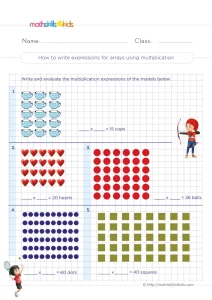 Five arrays of cups, hearts, balls, dots and squares. Your child writes the multiplication expression for each one…See the activity3rd Grade Area with Length and Width Worksheet
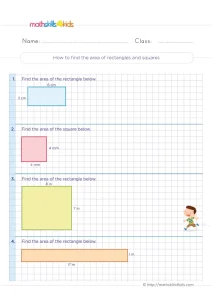 Three rectangles and one square, each with its side lengths. Your child multiplies length by width to find…See the activity
