2nd Grade Ordering Data to 100 Worksheet: Quiz Scores and Cupcake Sales
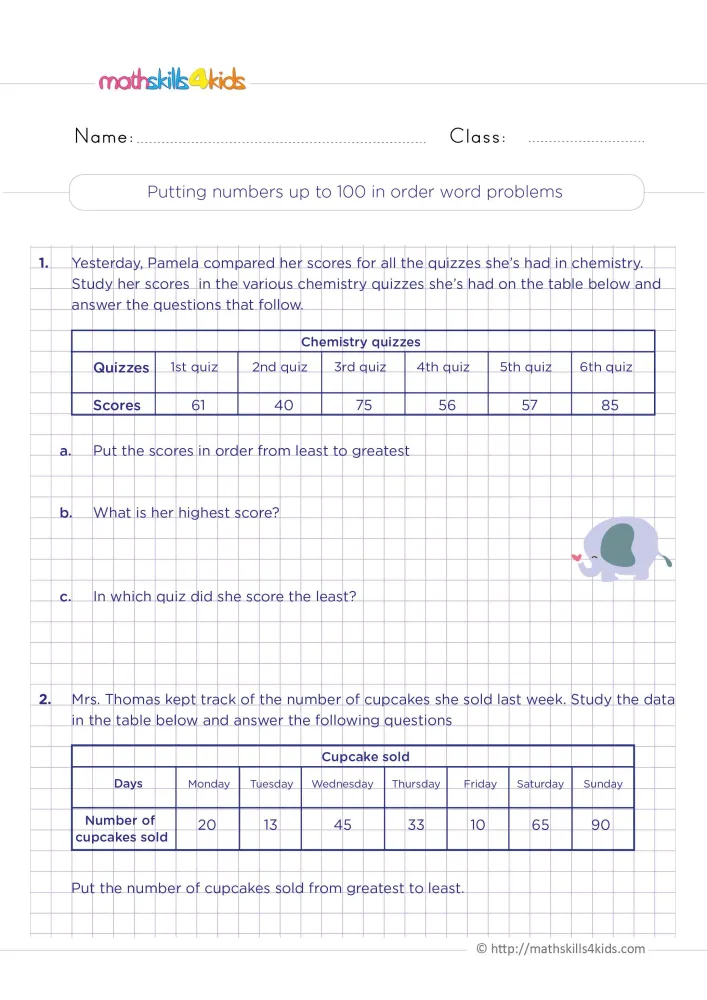
Ask a seven-year-old which day a bakery sold the most and they will scan for the biggest number before you finish the question. Putting a whole week in order is a slower kind of thinking. This 2nd grade ordering data to 100 worksheet wraps that skill in two short word problems. First, Pamela's six quiz scores, from 40 to 85, sit in a table; your child puts them from least to greatest, then finds her highest score and the quiz where she scored the least. Next, Mrs. Thomas's cupcake sales for seven days go from greatest to least. A second page gives the answer key.
Why a table makes ordering harder
Ordering a list is one skill; pulling numbers out of a table is another. On this page your child does both, so they practice to read a table before any sorting starts.
The tables also add a question that a plain list never asks: where? Finding the lowest score is only half of question 1c. Your child then has to travel back to the table and name the quiz it belongs to.
The numbers stay under 100 on purpose. For example, 56 and 57 sit side by side in the quiz table, so the ones digit has to settle the order. That small pair is the heart of the page, and the answer key walks through 1c step by step, from the lowest number back to the right quiz.
At the table: 56, 57 and the cupcake week
Start by reading the table headings aloud. Ask, "What does each number tell us?"
In question 1a, a child may copy the scores in table order: 61, 40, 75... Point to the words least to greatest and ask, "Which score is the smallest of all?" Then let them begin again from there.
Question 1c trips many children, who answer "40" instead of naming the quiz. Read the question again together, slowly: "In which quiz?"
The cupcake table flips the direction to greatest to least. Also, it holds 13 and 10 next to 20, small numbers that slip out of place easily. Tick each number in the table as your child copies it.
Scores, snacks and a card game
Real data is easy to collect at home. Keep a week of small records with your child, such as the number of pages read each night or the minutes spent outside. Then order the week together and name the best day.
Also, the card game Go Fish makes a quick table. After a few rounds, write each player's number of pairs in a row, then sort the scores from greatest to least.
Tables like these turn numbers into stories. Once you finish the page, check it with the answer key and praise the care: "You went back to the table to find the quiz. That was careful reading."
About this 2nd grade ordering data to 100 worksheet and its answer key
Download the worksheet: 2nd Grade Ordering Data to 100 Worksheet: Quiz Scores and Cupcake Sales
 Worksheet3rd Grade Like Denominator Fraction Story Problems Worksheet
 Worksheet3rd Grade Reading a Data Table Worksheet: 2 Tables
 Worksheet3rd Grade Two-Step Multiply and Divide Problems: 3 Stories
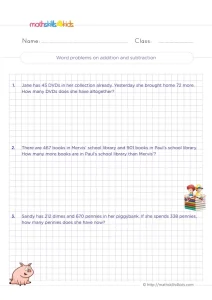 Worksheet3rd Grade Addition and Subtraction Problems: 3 Stories
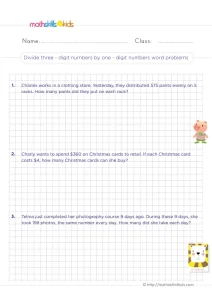 Worksheet3rd Grade Divide 3-Digit by 1-Digit Word Problems: 3 Stories
A few related activities
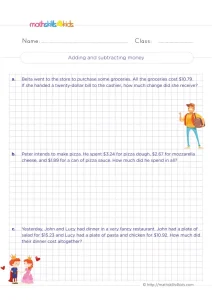 Three money word problems about groceries, a pizza and a dinner out. Children find the change from a…See the activity3rd Grade Do You Have Enough Money Worksheet: 3 Word Problems
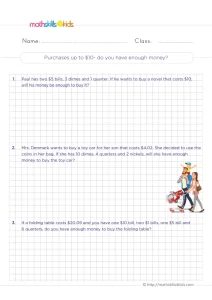 Three shopping stories with bills and coins. Children count the money, compare it with the price and decide…See the activity3rd Grade How Much Money in All Worksheet: 3 Word Problems
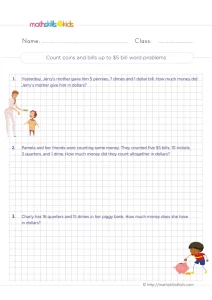 Three money word problems with pennies, nickels, dimes, quarters and $1 and $5 bills. Children find each total…See the activity
