Kindergarten Find the Symmetrical Picture Worksheet: One Match in Each Row
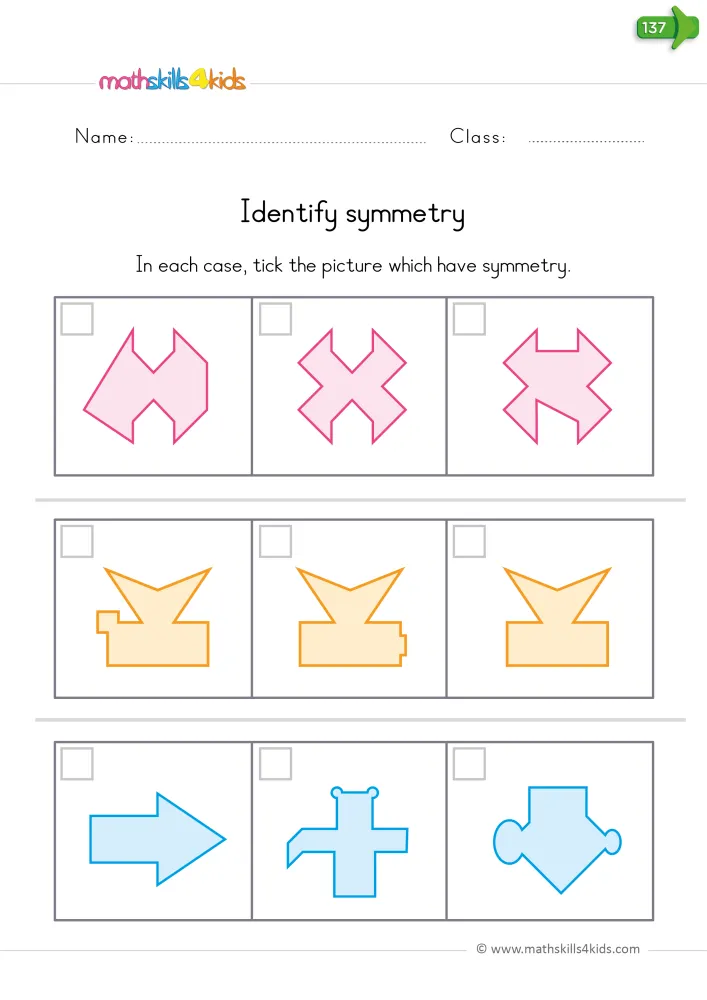
A five-year-old who has met symmetry once tends to see it everywhere, even in shapes that are only nearly balanced. This kindergarten find the symmetrical picture worksheet trains a sharper eye. It has three rows of three shapes in pink, orange and blue. In each row the shapes look alike, but small notches, bumps or a slanted edge spoil the balance of most of them. Only one shape per row has two matching halves, and the child ticks it. The PDF comes with two pages: the worksheet and its answer key.
Why nearly balanced is the real lesson
Spotting symmetry in a heart is easy. However, spotting where it breaks is harder, and it teaches more. This page asks children to compare halves closely and find the one detail that makes a shape uneven.
As a result, the page puts visual discrimination to work: holding two parts in mind and comparing them piece by piece. For example, the orange shapes share the same pointed top, so the eye must travel down to the base to see what changes.
Finally, the blue row adds a surprise. Its symmetrical shape folds along a horizontal line of symmetry, not a vertical one. So children who only look for a line going down will miss it. Lines can lie flat too.
At the table: the arrow that folds sideways
Read the instruction and look at the pink row together. Ask your child to cover the left half of each shape with a hand and describe what is left uncovered. After that, swap hands.
In the orange row, the differences hide at the bottom: a small step on one shape, a little bump on another. Therefore, let your child trace each base with a finger before choosing.
The blue row, however, is where most children get stuck. They look for a line running top to bottom, and no shape seems to work. Instead of correcting, ask, "What if we fold it the other way, like closing a book sideways?" Next, hold the page and tilt it. Many will see the arrow at once.
This kind of checking builds critical thinking in a small, friendly way.
The Very Hungry Caterpillar and a fold test
After the page, try a real fold test. Cut a simple shape from paper, fold it, and see whether the edges meet. Also cut a lopsided one, so the two results can be compared side by side.
The Very Hungry Caterpillar by Eric Carle ends with a butterfly whose wings match on both sides. Read it together, and then draw your own butterfly: your child paints one wing, folds the paper and presses to make the other.
Moreover, at home you can look for symmetry in a cookie, a leaf or a spoon. Once the worksheet is finished, check each row against the answer key together. Then praise the patience: "You checked both halves every time. That took real focus."
About this kindergarten find the symmetrical picture worksheet (2 pages)
Download the worksheet: Kindergarten Find the Symmetrical Picture Worksheet: One Match in Each Row
 Worksheet3rd Grade Shapes Cut into Equal Parts Worksheet: Tick the Fair Cuts
 Worksheet2nd Grade Is It a Line of Symmetry Worksheet: Check Each Dotted Line
 Worksheet2nd Grade Congruent Shapes Worksheet: Same Size and Same Shape?
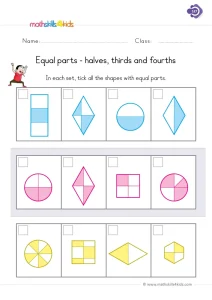 Worksheet1st Grade Equal or Unequal Parts Worksheet: Tick Every Fair Split
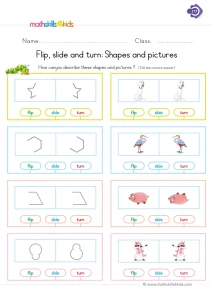 Worksheet1st Grade Flip, Slide and Turn Worksheet: Tick the Move for Each Pair
A few related activities
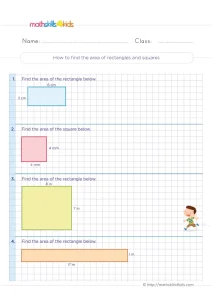 Three rectangles and one square, each with its side lengths. Your child multiplies length by width to find…See the activity3rd Grade Naming Solid Figures Worksheet: Prisms, Pyramids and More
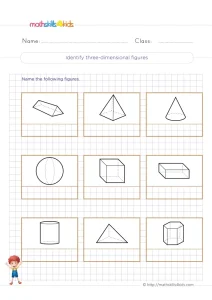 Nine drawn solids to name, from a cube and a cone to a hexagonal prism and a triangular…See the activity3rd Grade Multiplication Worksheet: Find Products Using Properties
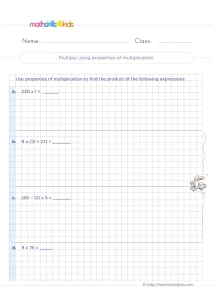 Work out four products, from 230 x 1 to 9 x 75, with the identity, distributive and commutative…See the activity
