2nd Grade Is It a Line of Symmetry Worksheet: Check Each Dotted Line
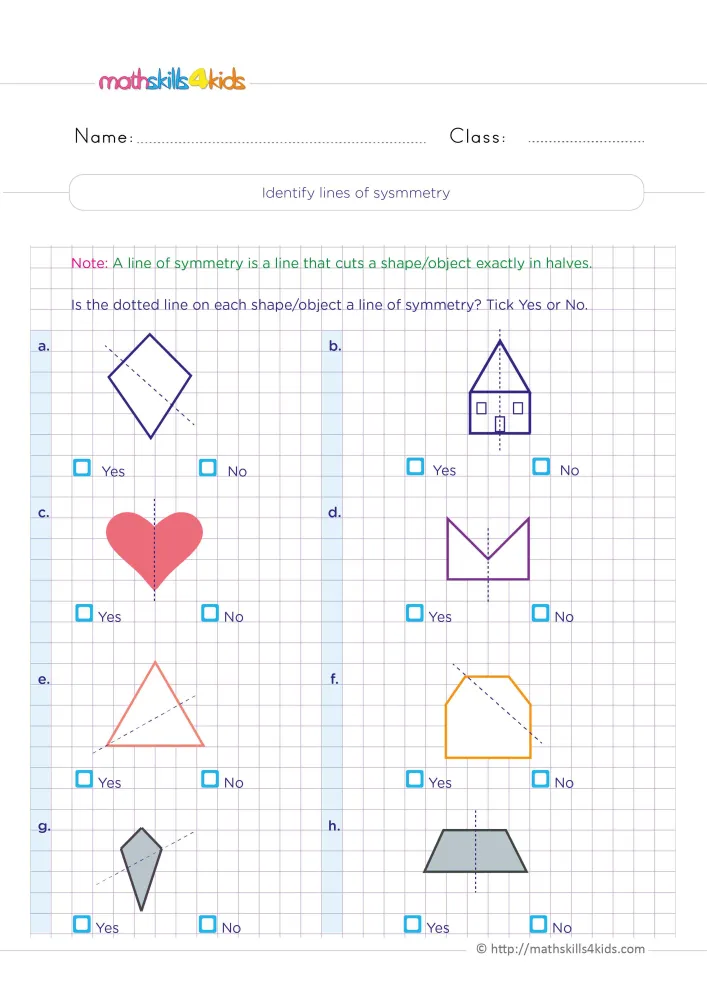
Fold a paper heart down the middle and a seven-year-old will gasp when the two sides land on top of each other. That small surprise is what symmetry is about. This 2nd grade is it a line of symmetry worksheet asks the same question without scissors. Eight figures, from a red heart and a little house to a kite, a triangle and a trapezoid, each carry a dotted line. A note at the top explains that a line of symmetry cuts a shape into two exact halves. For each figure, your child ticks Yes or No. A second page gives the answer key.
Why a line can split a shape and still fail
Children quickly learn that a line of symmetry splits a shape in two. The harder part comes next. A line can cut a shape in two and still not make matching halves.
This page plays on that difference. For example, the kite in the first figure has a slanted line that crosses it from corner to side. Two pieces, yes, but not mirror images. The house, the heart and the trapezoid have straight lines down the middle, and those halves do match.
So your child has to picture a fold, not just a cut. That mental folding is early spatial reasoning. It also prepares the eye for patterns in art and nature. Halves must mirror.
At the table: the triangle and the slanted lines
Start with the heart and the house, since those halves are easy to see. Ask, "If we folded here, would the sides land together?"
The triangle in figure e is the surprise. Its dotted line runs on a slant from one corner to the opposite side, so many children tick No straight away. Instead of correcting, invite a test. Trace the triangle on thin paper, fold along the line, and hold it to the window.
The gray kite in figure g also has a slanted line, yet this time the halves differ. Ask your child to point to the part sticking out on one side.
Finally, the paper test settles every doubt. Let your child decide which figures need it.
Folding and mirrors at home
Symmetry is easy to test at home. Fold a sheet of paper, cut half a shape along the fold, then open it. Your child will see two equal halves appear at once. Also, stand a small mirror on a drawing and slide it until the picture looks whole.
The picture book "Let's Fly a Kite" by Stuart J. Murphy follows two children who split everything into matching halves. While you read, pause on each kite and ask, "Where is the fold?"
When you check the page together, ask for a yes or no and a reason each time. Then praise the effort: "You folded the paper to prove it." Checking with your hands builds real confidence.
About this 2nd grade is it a line of symmetry worksheet and its answer key
Download the worksheet: 2nd Grade Is It a Line of Symmetry Worksheet: Check Each Dotted Line
 Worksheet3rd Grade Counting Sides and Vertices Worksheet: 8 Flat Shapes
 Worksheet3rd Grade Open and Closed Shapes Worksheet: 8 Shapes to Check
 Worksheet2nd Grade Faces of Solid Shapes Worksheet: Which Flat Faces Does It Have?
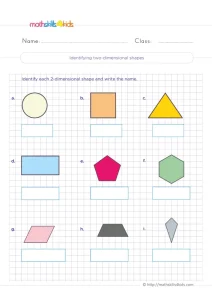 Worksheet2nd Grade Write the Shape Names Worksheet: Nine Flat Shapes on a Grid
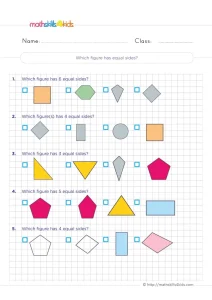 Worksheet2nd Grade Shapes With Equal Sides Worksheet: Tick the Right Figure
A few related activities
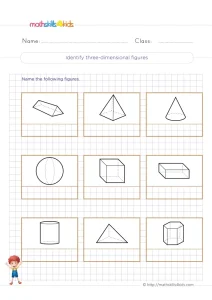 Nine drawn solids to name, from a cube and a cone to a hexagonal prism and a triangular…See the activity3rd Grade Count Edges of 3D Shapes Worksheet: Faces and Vertices Too
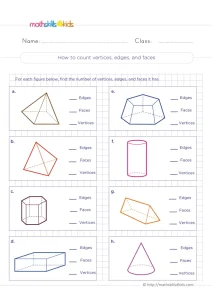 Eight drawn solids, from a square pyramid to a hexagonal prism and a cone. Count the edges, faces…See the activity3rd Grade Multiplication Worksheet: Find Products Using Properties
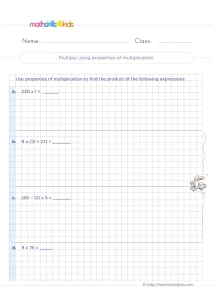 Work out four products, from 230 x 1 to 9 x 75, with the identity, distributive and commutative…See the activity
