1st Grade Ten Frame Make 10 Worksheet: How Many More?
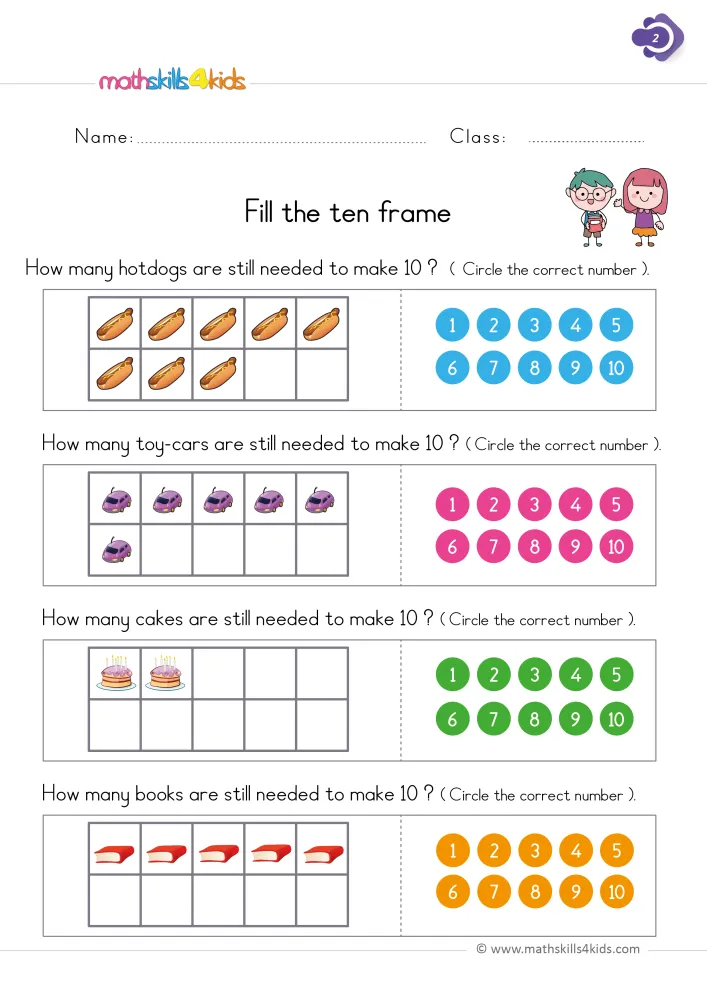
Show a six-year-old a tray of eight hot dogs with two places still empty, and they often count the hot dogs again from one instead of looking at the gaps. This 1st grade ten frame make 10 worksheet turns that habit around. Each of the four frames has two rows of five boxes. Some boxes hold hot dogs, toy cars, cakes or books, and the rest stay empty. Beside each frame, ten numbered circles wait, and your child circles how many more are needed to reach ten. The frames go from almost full to almost empty, so the page asks for real thinking by the third row. A second page gives the answer key.
Why the empty boxes tell the answer
A ten frame is a small picture of the number ten. Two rows of five make it easy to see a quantity without counting one by one: a full top row is five, at a glance.
This page uses that shape for number bonds to 10, the pairs that make ten, such as 8 and 2. The child does not need to add. Instead, they can count the empty boxes, so the missing part becomes something they can see.
The cakes are the interesting frame. Only two boxes are full, so counting the gaps takes longer than counting the cakes. Then your child may notice a shortcut. The bottom row is empty, so that is five already. Knowing these pairs by heart makes later sums much faster, because making 10 is a step children use again and again.
At the table: the cakes and the books
Start with the hot dogs. Ask your child to point to each empty box and say, "How many boxes are still empty?" Most children find this one quickly.
The toy cars come next. A common slip here is to circle 6, the number of cars, instead of the number missing. If that happens, tap the frame and ask, "Is the question about the cars, or the gaps?" Let them read it again.
The books fill exactly one row. Some children count all ten boxes, then lose track. However, a full row is a hint worth noticing. Ask, "What do you see in the bottom row?" Wait for them to explain it.
Finally, check the cakes slowly. Touch each gap together, one at a time.
Egg boxes, toy cars and ten
An egg carton with ten spaces, or an ice cube tray, works as a real ten frame. Put in a few grapes, then ask how many more would fill it. Also, line up toy cars on a shelf and ask, "How many more to make ten?"
For a story at bedtime, Ten Black Dots by Donald Crews shows the numbers from one to ten in everyday pictures. While you read, pause on a page and ask how many dots would still be missing to reach ten.
When your child finishes, compare with the answer key together. Then name the effort: "You looked at the gaps, not just the pictures. That was smart thinking." Short and kind.
About this 1st grade ten frame make 10 worksheet and its answer key
Download the worksheet: 1st Grade Ten Frame Make 10 Worksheet: How Many More?
 Worksheet1st Grade Add Three Numbers Worksheet: Doubles First, Then Make Ten
 WorksheetKindergarten Digital Clock Worksheet: Which Clock Shows the Hour?
 WorksheetKindergarten Make a Bar Graph Worksheet: Count the Zoo, Then Draw Each Bar
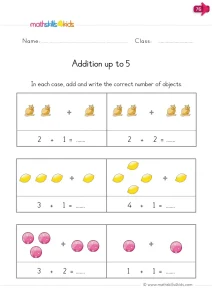 WorksheetKindergarten Picture Addition to 5 Worksheet: Cats, Lemons and Balls
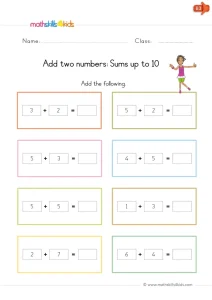 WorksheetKindergarten Sums to 10 Worksheet: Add Two Numbers in Eight Boxes
A few related activities
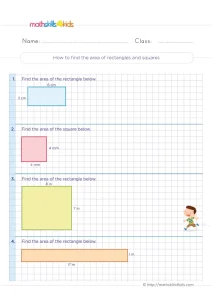 Three rectangles and one square, each with its side lengths. Your child multiplies length by width to find…See the activity3rd Grade Count Edges of 3D Shapes Worksheet: Faces and Vertices Too
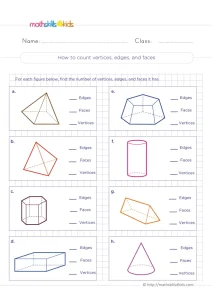 Eight drawn solids, from a square pyramid to a hexagonal prism and a cone. Count the edges, faces…See the activity3rd Grade Multiplication Worksheet: Find Products Using Properties
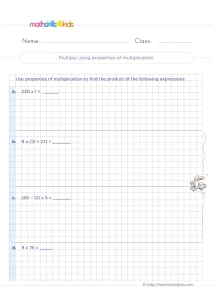 Work out four products, from 230 x 1 to 9 x 75, with the identity, distributive and commutative…See the activity
