1st Grade Read the Thermometer Worksheet: Color the Right Temperature
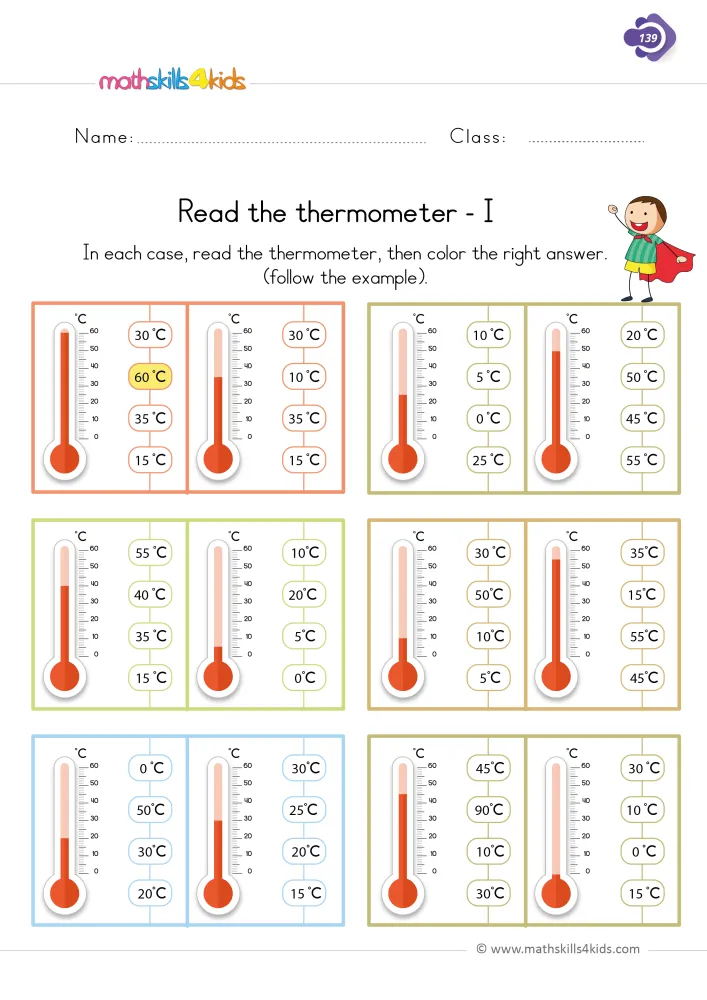
Ask a six-year-old to read a thermometer and they will often read the number closest to their eye, not the one where the red line stops. This 1st grade read the thermometer worksheet slows that moment down. Twelve thermometers fill the page, each marked from 0 to 60 in degrees Celsius, with a number every 10. Next to each one, four temperatures wait, and your child must color the right answer. The first thermometer is a worked example at 60. Several red lines stop halfway between two numbers, so the page also asks for careful looking. A second page gives the answer key.
Why a thermometer is a number line standing up
A thermometer is a measuring tool, but for a child it works like a number line turned on its end. The numbers climb by tens from the bulb at the bottom, and the red line shows how far the heat has climbed.
So reading it means two things at once. First, find the top of the red line. Then, look across to the scale on the left side and name the number there.
The lines that stop between two labels are the real lesson. A line halfway between 30 and 40 is neither, and your child has to reason about the middle. That is the start of reading any scale, from a ruler to a measuring cup. Worth the time.
At the table: the halfway lines
Start with the example. Ask, "Where does the red stop?" Let your child trace it with a finger up to 60.
The second thermometer is the first trap. Its red line stops between 30 and 40, so a child may color 30 because it sits at the top of the list. Instead of correcting, try, "Is it on a number, or between two?"
Also watch the thermometer near the bottom right. The red barely leaves the bulb, so a child may color 10 just because it looks small. Then point to the lowest label on the scale and ask what it says.
Finally, one row offers 90 as a choice. Ask your child whether this thermometer can even show 90.
Hot, cold and in between at home
Temperature becomes real when your child can feel it. If you have a thermometer at home, hang it by a window and read the temperature together in the morning and after lunch. Also, compare a cup of warm water and a cup of cold water, then ask which one would push the red line higher.
I Spy works well for this. While you walk around the kitchen, play I Spy with clues like "I spy something colder than my hand."
These small checks connect the numbers to the feeling of warm and cold. When the page is done, check it with the answer key and name the effort: "You looked at the top of every red line. That is careful reading."
About this 1st grade read the thermometer worksheet and its answer key
Download the worksheet: 1st Grade Read the Thermometer Worksheet: Color the Right Temperature
 Worksheet3rd Grade Cups, Pints and Gallons Worksheet
 Worksheet3rd Grade Choosing the Correct Measuring Tool Worksheet: 4 Tasks
 Worksheet3rd Grade Customary Units of Weight Worksheet: Ounces, Pounds, Tons
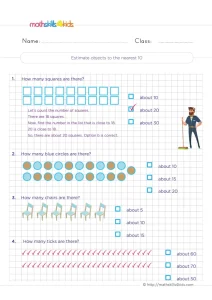 Worksheet2nd Grade Estimating Objects Worksheet: Squares, Circles, Chairs and Ticks
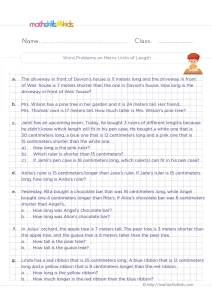 Worksheet2nd Grade Meters and Centimeters Word Problems Worksheet: Longer, Shorter, Taller
A few related activities
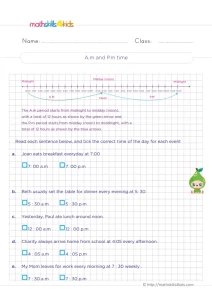 Five everyday events, from breakfast to dinner. Your child reads each time and ticks a.m. or p.m. using…See the activity3rd Grade Divide by 2 Worksheet: Long Division with Even Numbers
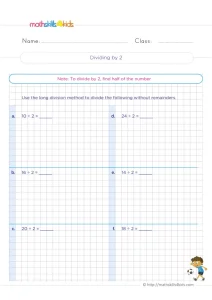 Six even numbers from 10 to 24 to divide by 2 with the long division method. Each answer…See the activity3rd Grade How Much Money in All Worksheet: 3 Word Problems
 Three money word problems with pennies, nickels, dimes, quarters and $1 and $5 bills. Children find each total…See the activity
