2nd Grade Estimating Objects Worksheet: Squares, Circles, Chairs and Ticks
Show a seven-year-old a long row of ticks and ask how many there are. Most will start counting one by one, lose their place, and start again. This 2nd grade estimating objects worksheet invites a different move: a smart guess first, then a check. The page has four pictures. A worked example counts 18 squares and picks the closest choice. Next come blue circles mixed with brown ones, a row of chairs, and finally two long rows of red ticks. Each picture has three about answers with check boxes, and your child picks the one that fits best. A second page gives the answer key.
Why a good guess is a math skill
Estimation is not careless counting. It means using what you know about numbers to land close, fast. Adults do it all day: a full parking lot, a pile of laundry, a crowd in a park.
For children, estimating builds number sense. They learn to picture 10, 20 or 50 objects and to compare a set against those landmarks. For this reason, the choices on this page are friendly numbers rather than exact counts.
The worked example shows the method clearly. There are 18 squares, and 18 sits closer to 20 than to 10, so about 20 wins. Thinking in tens like this prepares rounding to the nearest ten, which comes next in this series.
The ticks at the bottom are where estimation really pays off. Nobody wants to count fifty marks twice.
At the table: the blue circles and the ticks
The circles are the trap. The question asks for blue circles only, but brown ones sit right between them. Many children count every circle. Point to the question and ask, "Which color are we counting?"
The chairs are few, so your child may count them exactly. Exact counting is fine here. Then ask which about answer sits closest to that number, and why.
The ticks invite a shortcut. Instead of counting all of them, suggest counting one row, then thinking about two rows. However, some children forget the second row. Tap it and ask, "Did this row count too?"
Also, encourage a check once a box is ticked. For example, cover half the picture with your hand and count that part. It helps your child see whether the guess still holds.
A jar of pasta and a guessing book
Estimation games fit into any day. Fill a clear jar with dry pasta or grapes and ask for a guess, then count together, grouping the pieces into tens on the table. Next time, the guess is usually closer.
On a walk, ask about how many cars are parked on your street, or how many steps lead to the front door. Then check by counting objects one at a time.
For a story, Betcha! by Stuart J. Murphy follows two friends who estimate everything, from people on a bus to jelly beans in a jar, before checking. While you read, make your own guesses along with them.
Finally, look at the answer key together and praise the thinking: "You guessed first and then checked." Estimation grows exactly this way.
About this 2nd grade estimating objects worksheet and its answer key
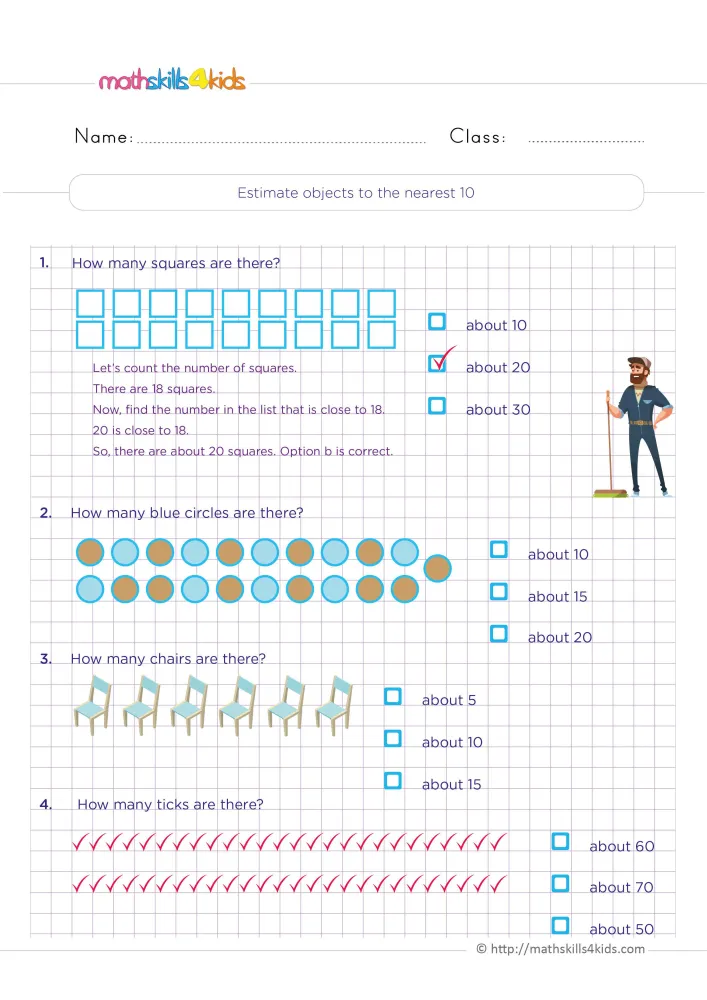
Download the worksheet: 2nd Grade Estimating Objects Worksheet: Squares, Circles, Chairs and Ticks
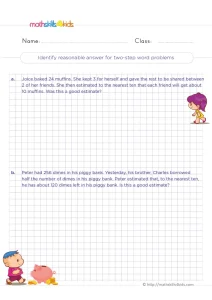 Worksheet3rd Grade Checking Reasonable Estimates Worksheet: Two-Step Problems
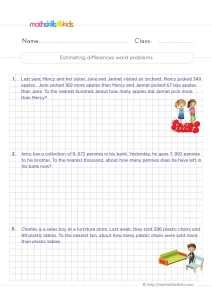 Worksheet3rd Grade Rounding to Estimate Differences Worksheet: 3 Stories
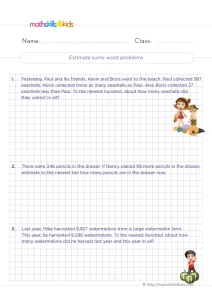 Worksheet3rd Grade Estimating Sums in Stories Worksheet: Round, Then Add
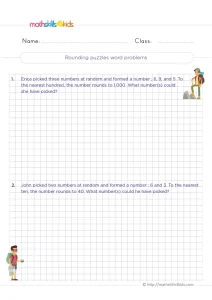 Worksheet3rd Grade Rounding Puzzles Worksheet: Which Number Was Picked?
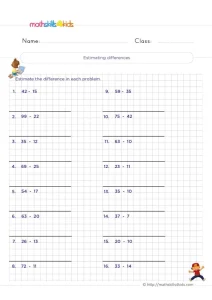 Worksheet2nd Grade Estimate the Difference Worksheet: 16 Subtractions to Round
A few related activities
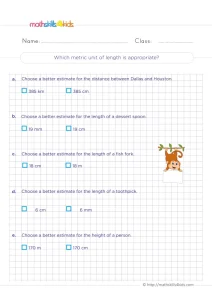 Five lengths and distances, from a toothpick to a road trip. Your child ticks the better metric estimate…See the activity3rd Grade Addition and Subtraction Problems: 3 Stories
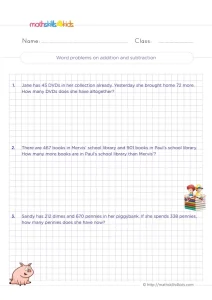 Three word problems about DVDs, school library books and pennies in a piggy bank. Your child adds or…See the activity3rd Grade Multiplication Properties Worksheet: Zero, Identity, Commutative
 Tick the right property for four equations, from 1,978 x 0 = 0 to (60 x 1) =…See the activity
