1st Grade Even or Odd Sets Worksheet: Color the Right Word
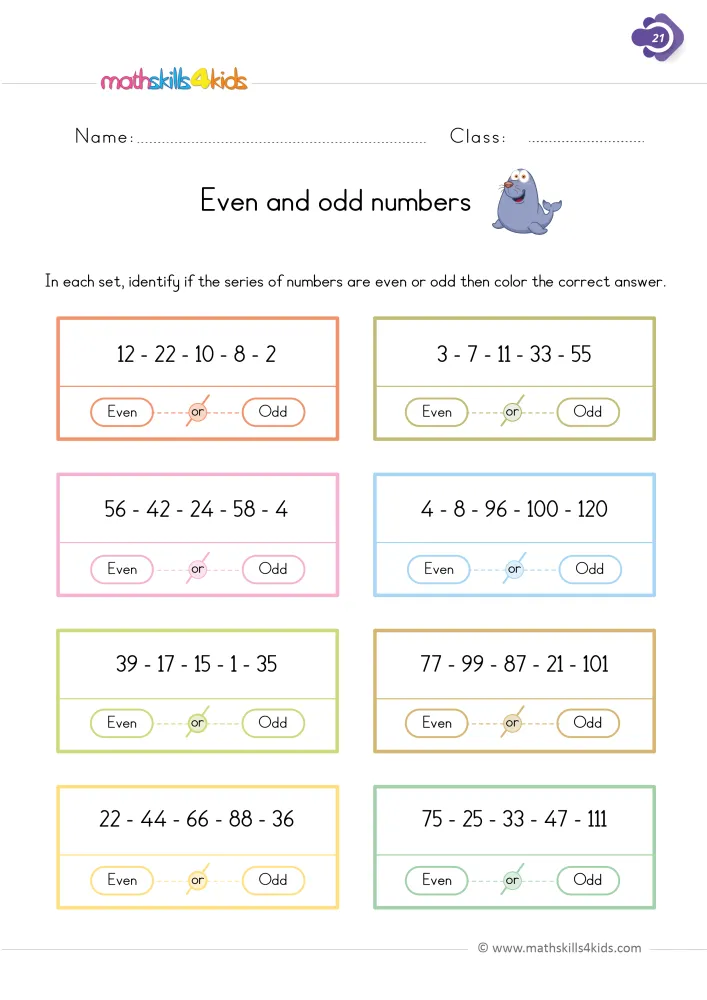
Six-year-olds often decide that 100 must be odd because it looks big and strange, while 8 feels even because it is round. Size, however, has nothing to do with it. This 1st grade even or odd sets worksheet gives your child eight boxes, each with five numbers in a row, such as 12, 22, 10, 8 and 2. All five numbers in a box belong to the same family. Under each set, your child colors the word Even or the word Odd. The numbers climb to 120, so the page rewards a rule rather than a guess. A second page gives the answer key.
Why the last digit is enough
An even number of objects can be shared into two equal groups, or lined up in pairs with no one left over. An odd number always leaves one alone. That is the idea behind even and odd.
With big numbers, nobody makes pairs one by one, so instead children learn to look at the ones digit. If it is 0, 2, 4, 6 or 8, the number is even; if it is 1, 3, 5, 7 or 9, it is odd.
This page is built for that discovery. The box with 4, 8, 96, 100 and 120 mixes tiny and large numbers on purpose. Then your child sees that only the end of a number matters. One digit decides.
At the table: the box with 101
Start with the first box, 12, 22, 10, 8 and 2. Ask your child to point to the last digit of each number, one at a time. Say, "What do you notice about these endings?"
The box with 77, 99, 87, 21 and 101 is where many children hesitate. Three digits look like a new kind of number, so if your child stops, tap the 1 at the end and ask, "Which digit tells us?"
Another common slip is reading only the first number in a box. For example, a child may see 39 and color Odd without checking the rest. That answer is right here, so ask, "Did you check all five?" Checking every number builds the habit.
Socks in pairs, steps on the stairs
Even and odd come alive with real pairs. While you sort the laundry, count socks in pairs and ask if one is left over. Also, look at house numbers on your street: often one side is even and the other is odd.
For a moving game, draw a Hopscotch grid with chalk, numbered 1 to 10. Your child hops only on the even numbers, then only on the odd numbers. Saying the numbers aloud while hopping helps the pattern stick.
When the page is complete, check it with the answer key together. Then praise the method: "You looked at the last digit every time. That is a real rule." Careful work.
About this 1st grade even or odd sets worksheet and its answer key
Download the worksheet: 1st Grade Even or Odd Sets Worksheet: Color the Right Word
 Worksheet3rd Grade Even or Odd Numbers Worksheet: Check the Last Digit
 Worksheet2nd Grade Two-Digit Number Riddles Worksheet: Use the Clues, Find the Number
 Worksheet2nd Grade Even and Odd Number Line Worksheet: Circle by the Last Digit
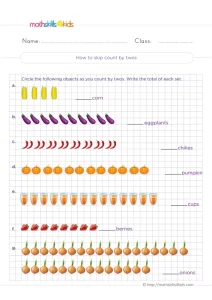 Worksheet2nd Grade Skip Count by 2 Worksheet: Circle Pairs, Write the Total
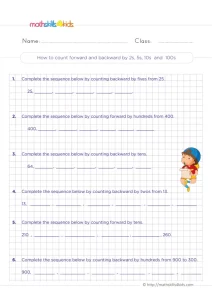 Worksheet2nd Grade Count Forward and Back Worksheet: By 2s, 5s, 10s and 100s
A few related activities
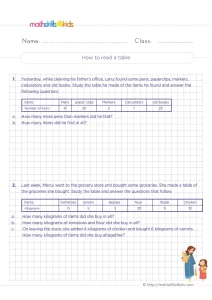 Two small tables, one of office items and one of groceries in kilograms. Your child finds the numbers,…See the activity3rd Grade 1 Times Table Worksheet: 18 Column Facts and the Identity Rule
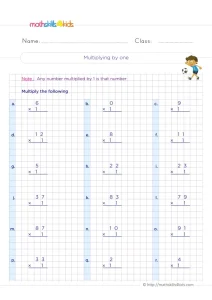 Eighteen column facts times 1, from 0 × 1 to 91 × 1. One rule solves them all:…See the activity3rd Grade Expressions for Arrays Worksheet: Write Each Product
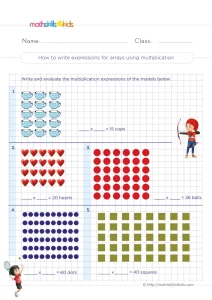 Five arrays of cups, hearts, balls, dots and squares. Your child writes the multiplication expression for each one…See the activity
