1st Grade Related Subtraction Facts Worksheet: Swap the Two Parts
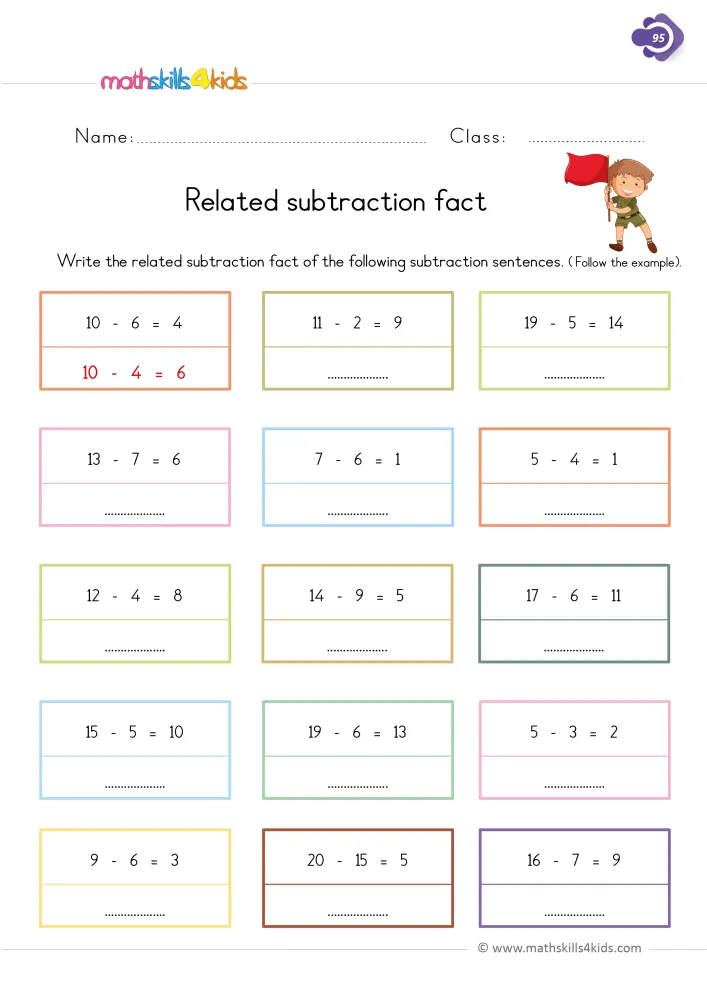
Give a six-year-old ten crayons, take away six, and four stay in the box. Then ask what happens if you take away four instead, and you can watch the idea land: six stay. This 1st grade related subtraction facts worksheet is built on that small discovery. Each of the fifteen colored boxes shows one subtraction on top, such as 11 - 2 = 9 or 19 - 6 = 13, and an empty line below. The first box is the example: 10 - 6 = 4 becomes 10 - 4 = 6. Your child writes the matching fact for the other fourteen, all within 20. A boy waving a red flag watches from the top. A second page gives the answer key.
Why one subtraction always has a partner
Every subtraction links three numbers: a whole and two parts. If 10 - 6 = 4, then 6 and 4 are the parts of 10, so taking away either part leaves the other. That is the related fact.
Understanding the whole and its parts is a big step in first grade. It means your child does not need to learn 10 - 4 as a separate fact, because it comes free with 10 - 6.
The page shows this clearly: the whole always stays first, and only the two other numbers trade places. For example, 15 - 5 = 10 turns into 15 - 10 = 5. Also, 20 - 15 = 5 checks whether the child keeps the largest number in front. Two facts, one idea.
At the table: 20 - 15 = 5 and 7 - 6 = 1
Read the example together, then ask your child to point to the number that stays first. "Which two numbers trade places in the example?"
The brown box, 20 - 15 = 5, is where a child may stumble. Some write 15 - 5 = 10, keeping the big number they see in the middle. Instead of correcting, ask, "Which number is the whole here?" Then let your child touch the 20 and start from it.
The blue box, 7 - 6 = 1, has its own trap. Children sometimes write 6 - 1 = 5, which is true but not related. Ask, "Does your new fact still start with 7?" A quick check with seven fingers lets your child find the fix alone.
Two ways to share the same snack
Related facts make sense with real things in hand. At snack time, put twelve grapes on a plate, give four to one person and eight to another, then ask which subtraction tells each part. While you tidy toys, sort nine cars into two boxes and say both facts out loud.
Also, Pete the Cat and His Four Groovy Buttons by Eric Litwin works well here. Buttons pop off one by one, so pause and ask, "Four take away one is three. What is four take away three?"
Saying both facts out loud is the start of a fact family, a habit that also makes subtraction within 20 faster. Finally, check the page with the answer key and praise the effort: "You kept the whole in front every time."
About this 1st grade related subtraction facts worksheet and its key
Download the worksheet: 1st Grade Related Subtraction Facts Worksheet: Swap the Two Parts
 Worksheet3rd Grade Addition and Subtraction Problems: 3 Stories
 Worksheet3rd Grade Adding and Subtracting Like Fractions Worksheet: Eight Sums
 Worksheet3rd Grade Unit Fraction of a Number Worksheet: 1/12 of 24 and More
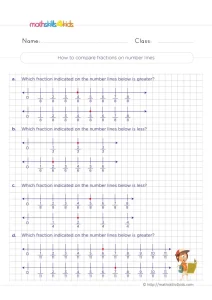 Worksheet3rd Grade Comparing Fractions Closer to Zero Worksheet: Which Dot Wins?
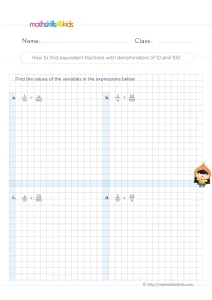 Worksheet3rd Grade Equivalent Tenths and Hundredths Worksheet: Find the Letter
A few related activities
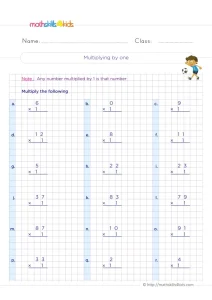 Eighteen column facts times 1, from 0 × 1 to 91 × 1. One rule solves them all:…See the activity3rd Grade Reading a Data Table Worksheet: 2 Tables
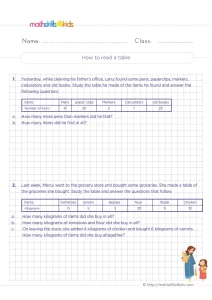 Two small tables, one of office items and one of groceries in kilograms. Your child finds the numbers,…See the activity3rd Grade Expressions for Arrays Worksheet: Write Each Product
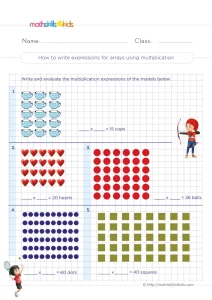 Five arrays of cups, hearts, balls, dots and squares. Your child writes the multiplication expression for each one…See the activity
