1st Grade Subtract Doubles and Tens Worksheet: Halves and Whole Tens
Ask a six-year-old what 5 + 5 makes and the answer is instant. Ask for 10 - 5, and many children start counting backward, not yet seeing that it is the same fact turned around. This 1st grade subtract doubles and tens worksheet builds that bridge in two parts. The top part lists doubles facts in two columns, such as 10 - 5, 6 - 3 and 18 - 9, with a few larger ones like 30 - 15 for a stretch. The bottom part holds nine colored boxes that subtract multiples of 10, from 30 - 10 to 90 - 20. A young explorer with a backpack runs across the top. A second page gives the answer key.
Why doubles and tens belong on one page
Both halves of this page teach the same habit: use what you already know instead of counting. Children learn doubles facts early, so 8 + 8 = 16 can unlock 16 - 8 in a second. That is think addition at work.
The tens work the same way. If 7 - 3 = 4, then 70 - 30 is 4 tens, or 40. So multiples of 10 turn a big-looking problem into a small fact.
The two parts grow in difficulty. The doubles range from small ones, like 2 - 1 and 4 - 2, to numbers like 28 - 14 and 36 - 18, which go beyond 20. Those are a stretch for first grade, so treat them as a bonus. Also, the tens boxes mix easy ones, like 70 - 10, with trickier ones, like 80 - 50. Good mental math.
At the table: 18 - 9 and 80 - 50
Start with 4 - 2 and 6 - 3. Ask, "What number plus itself makes 6?"
The right column is where children slow down. For 18 - 9, a child may count back nine steps and lose track. Instead of correcting, ask, "What is 9 + 9?" Let your child see that the question already holds the answer.
In the boxes below, 80 - 50 is a common slip. Some children write 3 instead of 30, or subtract only the zeros. Hold up eight fingers for eight tens, fold down five, and ask, "How many tens stay up?" Then let your child add the zero back. That small step makes mental math with tens feel solid.
Pairs and bundles at home
Doubles and tens are easy to find around the house. While you sort socks, lay out eight pairs, count all sixteen, then split them into two equal piles. At the store, count coins or bundles of ten, take away three bundles, and say how many tens stay.
Also, the card game Memory is built on pairs. Lay out twelve cards, and each time someone finds a match, ask how many cards are in that pair and how many are still face down.
These small moments make halving and tens feel ordinary. Finally, look over the page with the answer key and praise the effort: "You used doubles instead of counting."
About this 1st grade subtract doubles and tens worksheet and its key
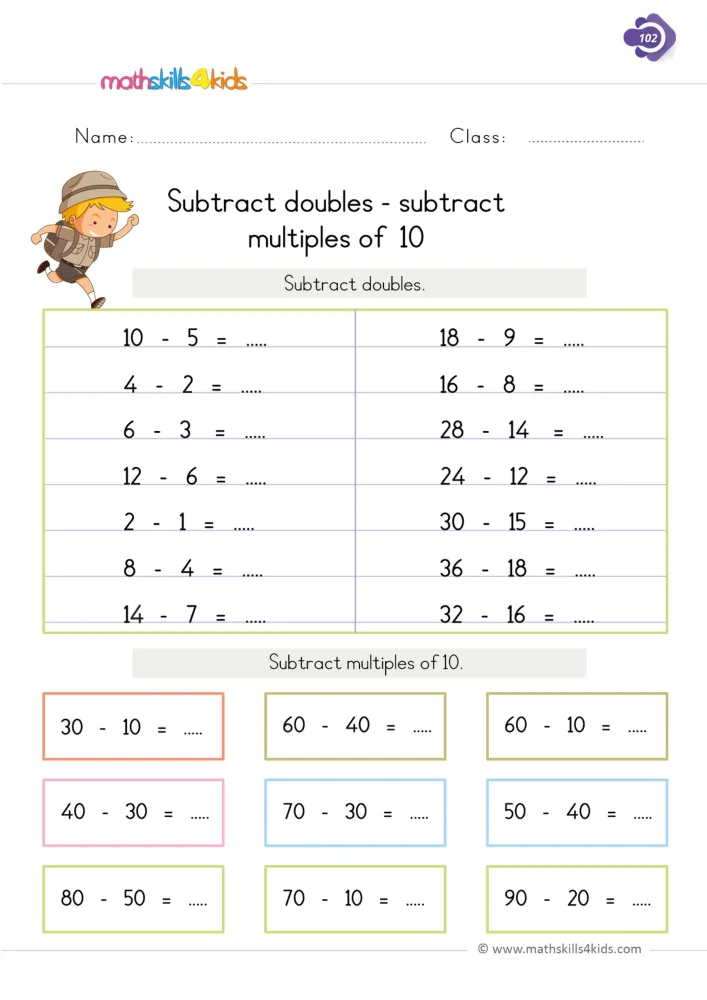
Download the worksheet: 1st Grade Subtract Doubles and Tens Worksheet: Halves and Whole Tens
 Worksheet3rd Grade Addition and Subtraction Problems: 3 Stories
 Worksheet3rd Grade Adding and Subtracting Like Fractions Worksheet: Eight Sums
 Worksheet3rd Grade Two-Step Add and Subtract Word Problems Worksheet: 3 Stories
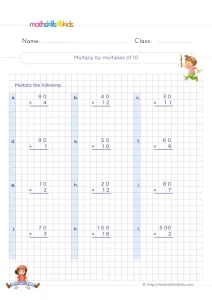 Worksheet3rd Grade Multiplying Multiples of 10 Worksheet: 12 Column Problems
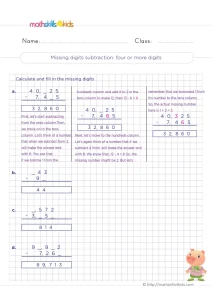 Worksheet3rd Grade Multi-Digit Subtraction Missing Digits Worksheet: Fill the Gaps
A few related activities
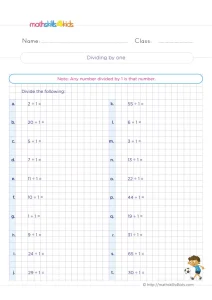 Twenty division facts by 1, from 1 ÷ 1 to 65 ÷ 1. One rule solves them all:…See the activity3rd Grade 8 Times Table Worksheet: 12 Column Facts and a Doubling Trick
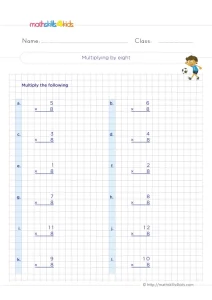 Twelve column facts times 8, from 1 × 8 to 12 × 8, in a mixed order. Double…See the activity3rd Grade Divide by 2 Worksheet: Long Division with Even Numbers
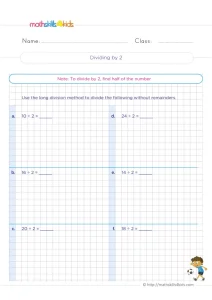 Six even numbers from 10 to 24 to divide by 2 with the long division method. Each answer…See the activity
