1st Grade Subtraction With Cubes Worksheet: Cross Out, Then Count
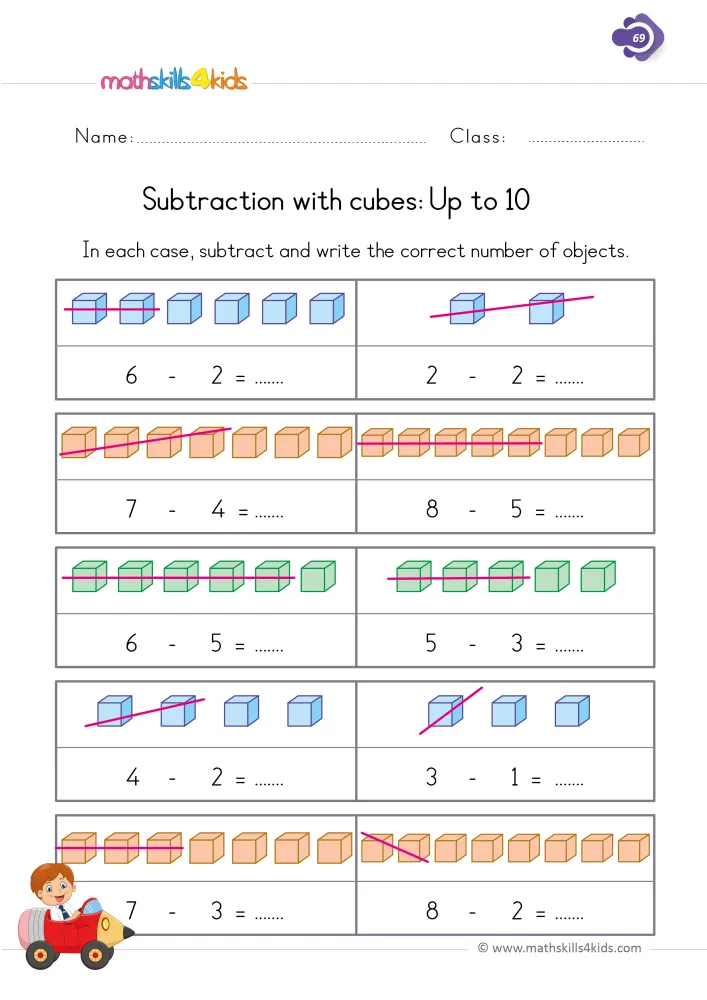
Put six blocks in front of a six-year-old, slide two away, and ask how many stay on the table. Many children start again from one and count every block, even the two you moved. This 1st grade subtraction with cubes worksheet slows that moment down. In each of the ten boxes, a row of cubes sits above a subtraction sentence such as 6 - 2 or 8 - 5, and a pink line already crosses out the cubes being taken away. Your child counts the cubes without a line and writes the number on the dotted space. Every problem stays within 10, and one box, 2 - 2, ends with no cubes at all. A second page gives the answer key.
Why the pink line does half the work
At six, subtraction still lives in the hands. The child needs to see a group, see part of it go, then count what stays. That is the meaning of take away, and it comes before any fact is memorized.
This page draws the action for your child. The pink lines cross out the cubes that are gone, so the only job is to count the cubes that remain and link that count to the written subtraction sentence.
The colors change from row to row, blue, orange, then green, which keeps each box separate. Also, the sizes vary: 3 - 1 has three cubes, while 8 - 5 has eight. So the page asks for real subtraction within 10, not one repeated pattern. The empty box, 2 - 2, then introduces zero as an answer. Small, but important.
At the table: 8 - 5 and the empty box
Start with 3 - 1. Ask your child to touch each cube without a line. "How many are still here?"
The long orange row for 8 - 5 is where counting slips. Five cubes sit under one line, and a child may count all eight, or count the crossed ones and write 5. Instead of correcting, point to the line and ask, "Are these still on the table?" Then let your child tap the other cubes one by one.
The box for 2 - 2 often stops a child cold. Both cubes are crossed out, and the dotted space looks wrong to leave empty. Ask, "If I take both, what do I have?" Your child can hold up two fingers, fold them down, and find the answer alone.
Snack time take away
Subtraction feels real when something actually disappears. At snack time, line up seven crackers, eat three together, and ask how many stay on the plate. While you tidy the toy box, pull eight blocks into a row, then hand four back and count the rest.
Also, Ellen Stoll Walsh's picture book Mouse Count works well here. A snake collects ten mice in a jar, then the mice escape, so the story ends with a count back down from ten.
Finally, check the page with the answer key and name the effort, not the score: "You touched every cube that stayed. That is careful counting."
About this 1st grade subtraction with cubes worksheet and its answer key
Download the worksheet: 1st Grade Subtraction With Cubes Worksheet: Cross Out, Then Count
 Worksheet3rd Grade Addition and Subtraction Problems: 3 Stories
 Worksheet3rd Grade Adding and Subtracting Like Fractions Worksheet: Eight Sums
 Worksheet3rd Grade Two-Step Add and Subtract Word Problems Worksheet: 3 Stories
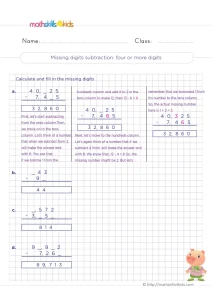 Worksheet3rd Grade Multi-Digit Subtraction Missing Digits Worksheet: Fill the Gaps
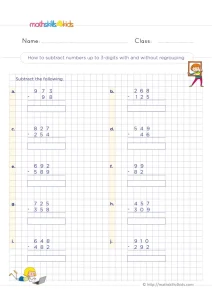 Worksheet3rd Grade Subtracting 3-Digit Numbers Worksheet: With and Without Regrouping
A few related activities
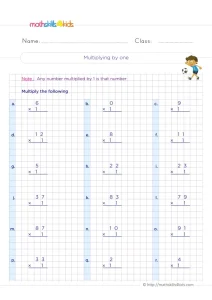 Eighteen column facts times 1, from 0 × 1 to 91 × 1. One rule solves them all:…See the activity3rd Grade Reading a Data Table Worksheet: 2 Tables
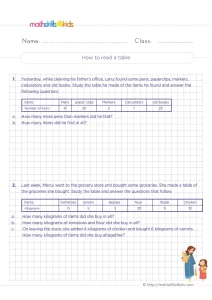 Two small tables, one of office items and one of groceries in kilograms. Your child finds the numbers,…See the activity3rd Grade Expressions for Arrays Worksheet: Write Each Product
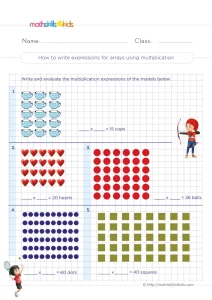 Five arrays of cups, hearts, balls, dots and squares. Your child writes the multiplication expression for each one…See the activity
