1st Grade Tick the Named 3D Shapes Worksheet: Cones, Cubes and More
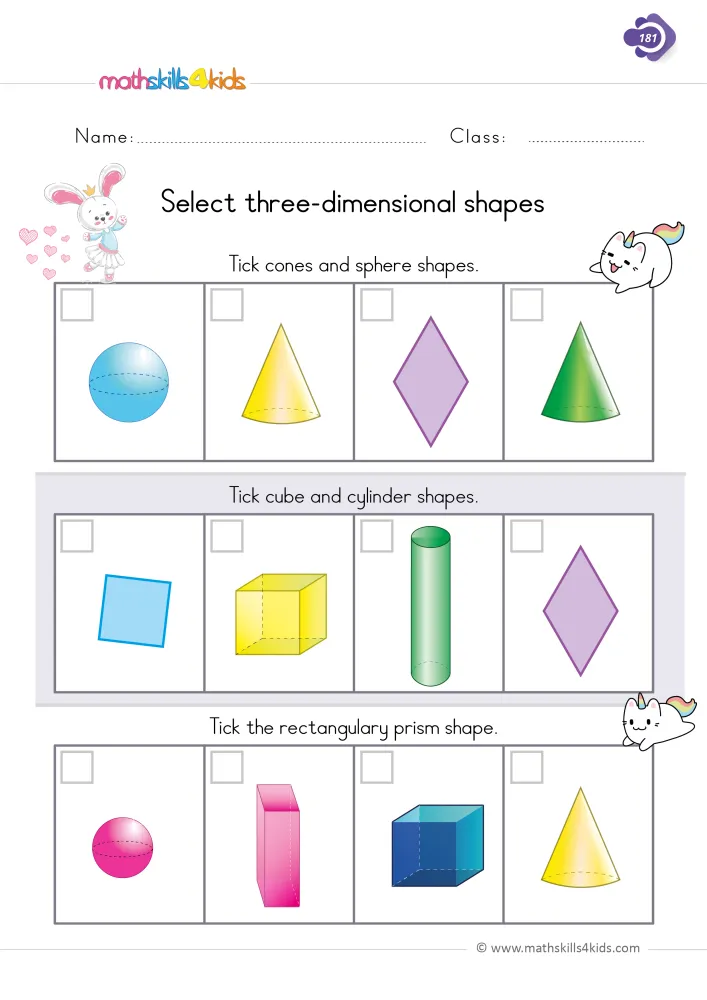
Hand a six-year-old an ice cream cone and a ball, and they know at once which one rolls straight and which one spins in a circle. Naming those shapes is another step. This 1st grade tick the named 3D shapes worksheet asks for the names. Each of the three rows shows four pictures, and a short instruction says which solids to tick. The first row asks for cones and spheres among a blue ball, two cones and a purple diamond. The second asks for a cube and a cylinder, next to a tilted square and another diamond. The last row asks for a rectangular prism among four solids. A second page gives the answer key.
Why flat shapes sit among the solids
A solid has depth: it has faces, edges and often corners you can touch. A flat shape has none of that depth. Children often mix the two, because a square and the face of a cube look the same in a drawing.
This page places flat shapes on purpose next to solid shapes. In the second row, for example, a blue square sits beside a yellow cube. The child must notice the shading and the hidden edges drawn as dotted lines to tell them apart.
Then the names do their work. Spotting cones and spheres, a cube and cylinder, or a rectangular prism turns a vague sense of shape into precise words. That precision helps later.
At the table: read the row, then tick
Read each instruction aloud with your child, and ask them to say which shapes the row wants before they tick anything.
The likely slip comes in the second row, where the blue square may get a tick for "cube." Instead of correcting, ask, "Could you pick it up and hold it like a box?"
The last row deserves a conversation. A rectangular prism is a box shape with six flat faces, and the tall pink box clearly is one. Your child may also tick the blue cube. A cube is a special kind of rectangular prism, so that choice has a reason behind it. Ask them to explain, then compare with the answer key together: "What makes it a box shape?"
After the page: a solid shape hunt
Kitchens are full of solids. Line up a can, a cereal box, a sugar cube, an orange and a party hat if you have one, and ask your child to name each shape. Then sort them: which ones roll, which ones stack, which ones do both?
Cubes, Cones, Cylinders, & Spheres by Tana Hoban is a photo book with no words, showing these shapes in city streets and everyday objects. Point to a photo, and let your child find the shape and name it.
Finally, praise the looking more than the score: "You checked for the shading before you ticked." Names stick when hands and eyes work together.
About this 1st grade tick the named 3D shapes worksheet and its answer key
Download the worksheet: 1st Grade Tick the Named 3D Shapes Worksheet: Cones, Cubes and More
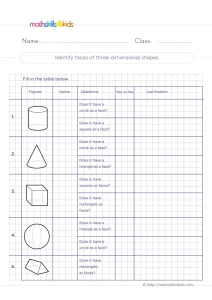 Worksheet3rd Grade Flat and Curved Faces Worksheet: Circles, Squares, Triangles
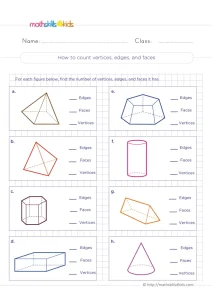 Worksheet3rd Grade Count Edges of 3D Shapes Worksheet: Faces and Vertices Too
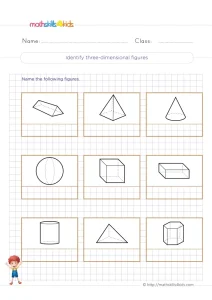 Worksheet3rd Grade Naming Solid Figures Worksheet: Prisms, Pyramids and More
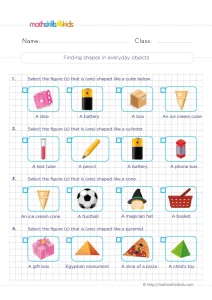 Worksheet3rd Grade Finding Shapes in Everyday Objects Worksheet: 16 Pictures
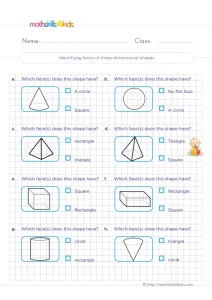 Worksheet2nd Grade Faces of Solid Shapes Worksheet: Which Flat Faces Does It Have?
A few related activities
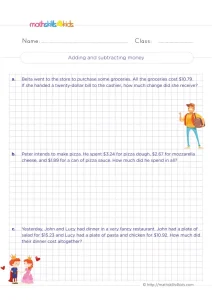 Three money word problems about groceries, a pizza and a dinner out. Children find the change from a…See the activity3rd Grade Two-Step Multiply and Divide Problems: 3 Stories
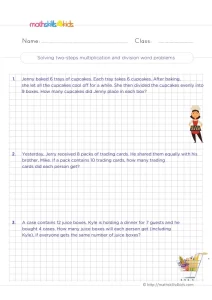 Three stories about cupcakes, trading cards and juice boxes. Your child multiplies to find a total, then divides…See the activity3rd Grade Cups, Pints and Gallons Worksheet
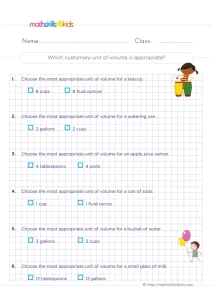 Six everyday containers, from a teacup to a bucket of water. Your child ticks the more sensible unit…See the activity
