2nd Grade Division Facts to 49 Worksheet: 24 Problems with the Bracket
Ask a seven-year-old how many fives make twenty, and you may hear them count on their fingers: five, ten, fifteen, twenty. Four. So that counting already holds the answer to 20 ÷ 5. This 2nd grade division facts to 49 worksheet builds on it. Twenty-four problems fill the page in three columns, labeled a to x, with numbers from 6 up to 49 and divisors from 2 to 10. Every one comes out even, with nothing left over. The instructions ask for the long division method, so your child sets each problem in the bracket, finds the answer, subtracts to check, and writes the result on the line. A second page gives the answer key.
Why every division hides a multiplication
Division facts are multiplication facts read backward. If your child knows that 4 × 6 is 24, then 24 ÷ 4 is already solved. That is why the times table is the best tool for this page.
The answer key shows the bracket method on the first nine problems. Each one follows the same steps: write the number inside, find how many times the divisor fits, write that above, multiply and subtract to reach zero. For example, 12 ÷ 3 gives 4, because 3 × 4 is 12 and nothing remains.
That final zero is a built-in check. These are all division with no remainder problems, so any other result means it is time to look again. Short and reliable.
At the table: think times, then divide
Before the bracket, ask a multiplication question. For 18 ÷ 3, say, "Three times what makes 18?" As a result, many children find the answer faster.
Problem n, 7 ÷ 7, is a classic slip. However, some children write 0, while others write 7. Instead of correcting, ask, "How many sevens fit into seven?" and let them hold up fingers.
The larger facts near the end, like 45 ÷ 5 or 49 ÷ 7, need patience. If your child gets stuck, suggest counting by the divisor on fingers, tapping one finger for each jump. Then let them place the answer in the bracket and subtract to see the zero.
Also, keep a times table nearby. Using it is not cheating.
Counting by fives and Hide and Seek
Skip counting is the engine behind division facts, and it fits into play easily. In Hide and Seek, ask the seeker to count to 40 by fives instead of ones. Afterward, ask, "How many fives did you say?" That is 40 ÷ 5 in disguise.
At home, use real objects. Share 24 grapes onto 4 plates, or line 30 blocks into rows of 6, and say the division out loud. Also, while you wait in a queue, play a quick fact game: you say a multiplication, your child says the matching division.
When the page is done, praise the persistence: "You kept going all the way to x. That took real focus."
About this 2nd grade division facts to 49 worksheet and its answer key
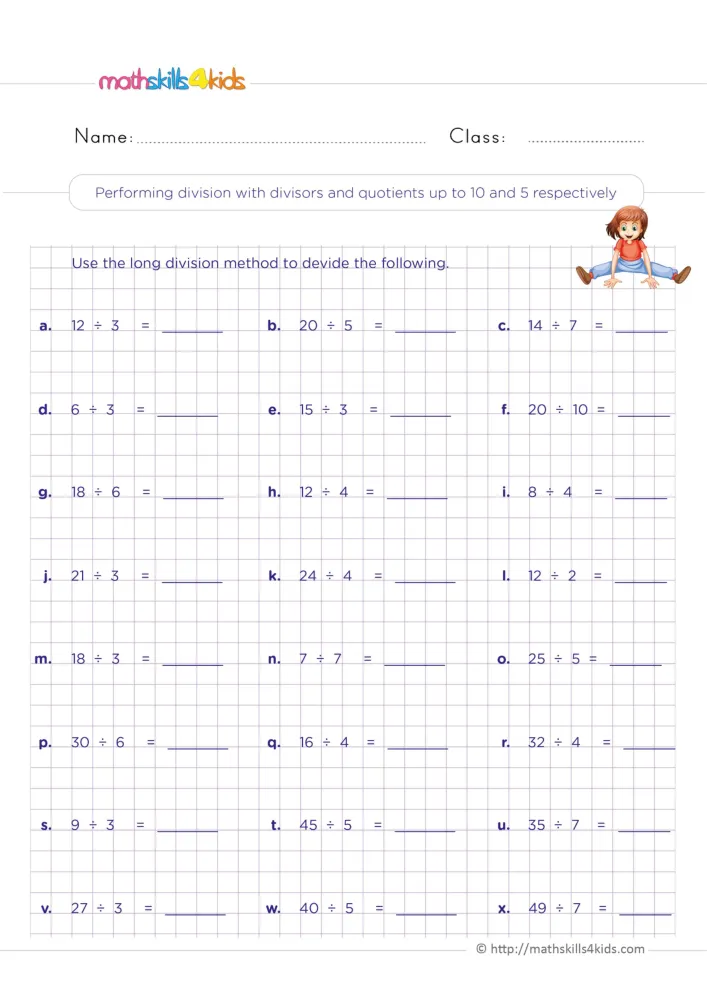
Download the worksheet: 2nd Grade Division Facts to 49 Worksheet: 24 Problems with the Bracket
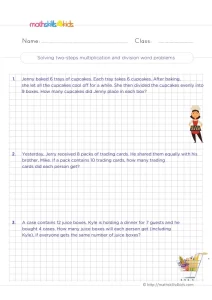 Worksheet3rd Grade Two-Step Multiply and Divide Problems: 3 Stories
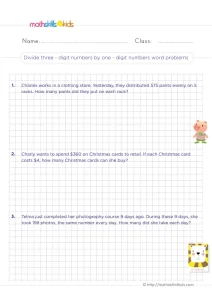 Worksheet3rd Grade Divide 3-Digit by 1-Digit Word Problems: 3 Stories
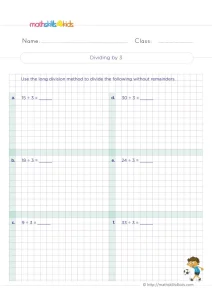 Worksheet3rd Grade Divide by 3 Worksheet: Long Division Without Remainders
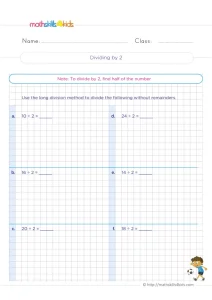 Worksheet3rd Grade Divide by 2 Worksheet: Long Division with Even Numbers
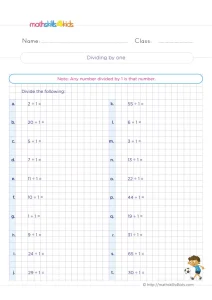 Worksheet3rd Grade Divide by 1 Worksheet: 20 Facts and the Rule of One
A few related activities
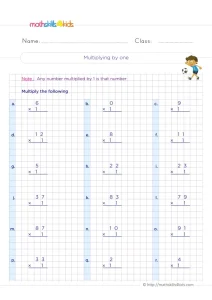 Eighteen column facts times 1, from 0 × 1 to 91 × 1. One rule solves them all:…See the activity3rd Grade 8 Times Table Worksheet: 12 Column Facts and a Doubling Trick
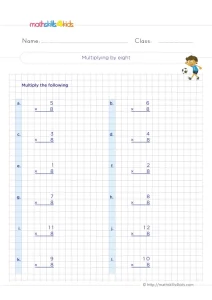 Twelve column facts times 8, from 1 × 8 to 12 × 8, in a mixed order. Double…See the activity3rd Grade Count Edges of 3D Shapes Worksheet: Faces and Vertices Too
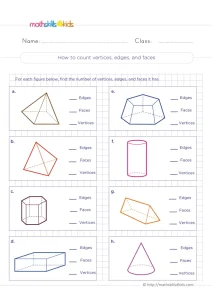 Eight drawn solids, from a square pyramid to a hexagonal prism and a cone. Count the edges, faces…See the activity
