2nd Grade Expanded Form to Standard Form Worksheet: 14 Sums to Rewrite
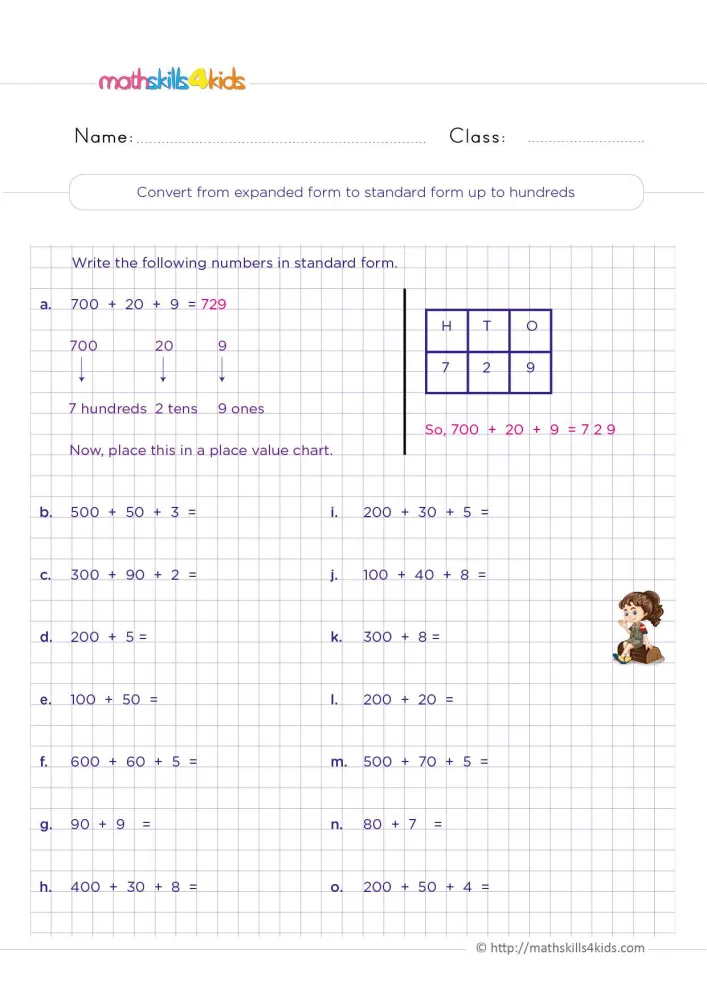
Write 300 + 8 for a seven-year-old and ask for the number. A surprising number of children answer 38, or even 3008, because they copy what they see. This 2nd grade expanded form to standard form worksheet trains the eye to read place before digits. A worked example opens the page: 700 + 20 + 9 is split into 7 hundreds, 2 tens and 9 ones, then placed in a small chart to give 729. Fourteen sums follow in two columns, labeled b to o. Most have three parts, but a few skip the tens or the ones, and two have no hundreds at all. A second page gives the answer key.
Why the missing parts are the real lesson
Expanded form spells out what each digit is worth: 500 + 50 + 3. Standard form packs that into three digits: 553. Going from one to the other is a direct test of place value.
When all three parts are there, the job is easy. The interesting items are the ones with a gap. In 200 + 5 there are no tens, so the tens digit must be a zero. In 100 + 50 there are no ones.
The worked example gives the tool for these cases. The place value chart has one box for hundreds, one for tens and one for ones. Every box must hold a digit, even when that digit is zero.
So a zero in the tens place is not an empty space. It is a promise that the place exists.
At the table: 200 + 5 and 300 + 8
Begin with the full sums like 500 + 50 + 3 to build confidence. Then move to item d, 200 + 5. If your child writes 25, ask, "Is 25 bigger than 200?" Let the size of the number guide them back.
Item k, 300 + 8, brings the same trap. Some children write 3008 instead. Point to the chart and ask, "How many boxes does a hundreds number fill?"
Items g and n, 90 + 9 and 80 + 7, have no hundreds at all. That is a nice moment to discover that a two-digit answer is fine here.
Also, invite your child to draw the three boxes for any tricky item. For example, tap each box and say hundreds, tens, ones before filling it.
Dollars, dimes and a Memory game
Money is expanded form in your pocket. Lay out 3 one-dollar bills, 4 dimes and 2 pennies, and ask your child to write the total in cents. Then remove the dimes and see what happens to the middle digit.
You can also build a Memory game. On index cards, write pairs such as 400 + 30 + 8 and 438, or 200 + 20 and 220. Turn them face down and take turns finding the matches. Pairs with a zero make the best challenge.
Short rounds work well. Five minutes before dinner is plenty.
Finally, check the page with the answer key and praise the attention: "You put a zero in every empty place." That careful habit will help in every calculation ahead.
About this 2nd grade expanded form to standard form worksheet and key
Download the worksheet: 2nd Grade Expanded Form to Standard Form Worksheet: 14 Sums to Rewrite
 Worksheet3rd Grade Subtraction Patterns Worksheet: Over Increasing Place Values
 Worksheet3rd Grade Writing Numbers from Expanded Form Worksheet: Up to Six Digits
 Worksheet3rd Grade Thousands and Hundreds Digits Worksheet: Name Each Place
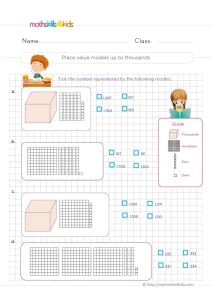 Worksheet3rd Grade Place Value Blocks Matching Worksheet: Cubes, Flats, Rods and Ones
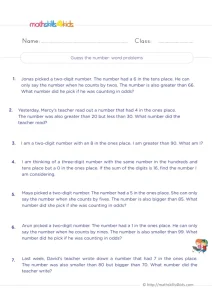 Worksheet2nd Grade Two-Digit Number Riddles Worksheet: Use the Clues, Find the Number
A few related activities
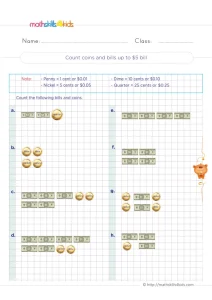 Eight sets of $1 and $5 bills with pennies, nickels, dimes and quarters. Children find each total in…See the activity3rd Grade Do You Have Enough Money Worksheet: 3 Word Problems
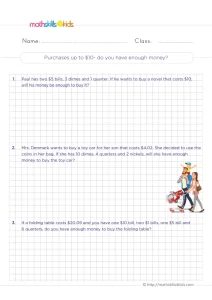 Three shopping stories with bills and coins. Children count the money, compare it with the price and decide…See the activity3rd Grade Cups, Pints and Gallons Worksheet
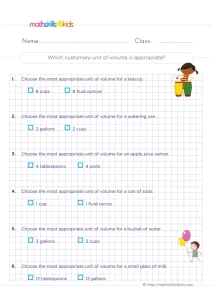 Six everyday containers, from a teacup to a bucket of water. Your child ticks the more sensible unit…See the activity
