2nd Grade Fair Sharing Sentences Worksheet: Total, Groups and Each
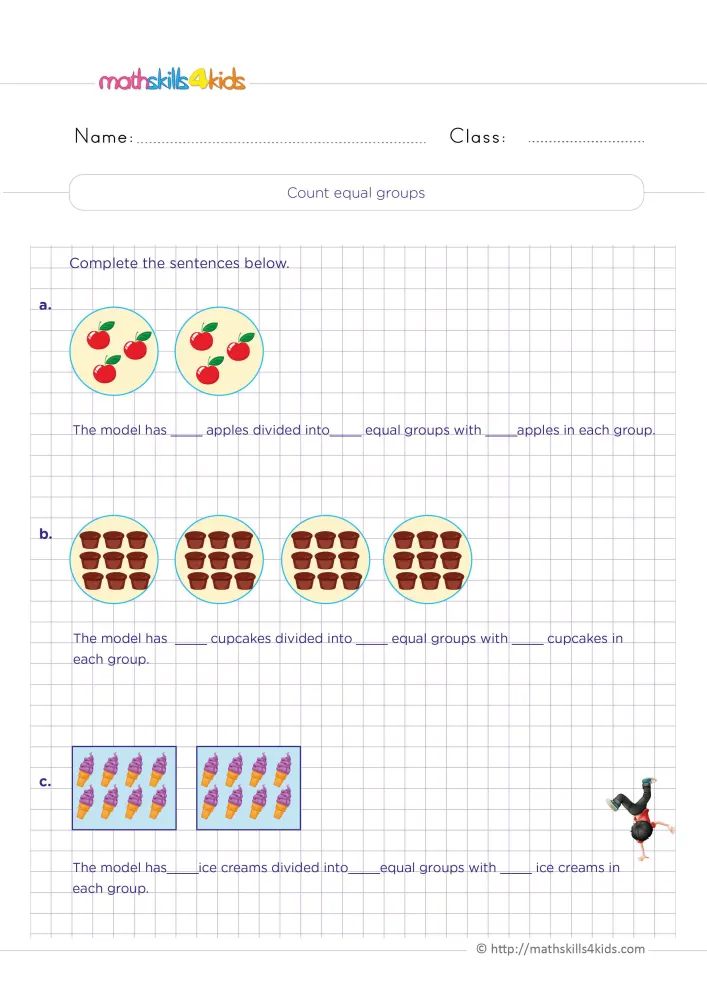
Give two seven-year-olds a bag of cupcakes to share and they will deal them out, one for you, one for me, until the bag is empty. That dealing is division, long before the symbol appears. This 2nd grade fair sharing sentences worksheet helps your child describe it in words. Three models sit on the page: apples on two plates, cupcakes on four plates and purple ice cream cones in two boxes. Under each model, one sentence has three blanks: how many items in all, how many equal groups, and how many in each group. A second page gives the answer key.
Why three numbers tell the whole story
Every sharing situation has three numbers: the total, the number of groups, and the amount in each group. Division is the question of finding one of them when you know the other two.
This page asks your child to name all three, which is the best preparation there is. The answer key shows the order on the apples: first count the plates, then all the apples, then the apples on one plate. Six apples, two equal groups, three in each.
That is fair sharing made visible, and it also connects to multiplication. Two groups of three make six, and six shared into two groups gives three. So the same picture works in both directions. That link is worth saying aloud.
At the table: which number goes where?
Read the sentence aloud before your child writes anything. Then ask, "Which number do we need first?" Pointing to each blank in turn helps.
The cupcake model is where most children slip. Four plates of nine is a lot to count, and some children write 9 in the first blank because it is the number they see on one plate. Instead of correcting, read their sentence back: "The model has 9 cupcakes divided into 4 groups?" Then let them look at all four plates.
For the ice creams, encourage a light tick on each cone while counting the total. Next, ask, "Do both boxes have the same number?" Check that the share really is fair. Count once more.
Dealing cards and sharing snacks
Sharing happens every day, so let your child run it. At snack time, hand over a pile of crackers and ask them to share it equally among the family, then say the sentence: "Twelve crackers, three people, four each." Also, when you put away groceries, line up the apples in equal rows and describe them together.
Card games give great practice in division as sharing. Before a game of Go Fish, let your child deal all the cards. Afterward, count how many each player received and check that everyone has the same.
When the page is done, praise the care: "You checked every group before you wrote. That is how fair sharing works."
About this 2nd grade fair sharing sentences worksheet and its answer key
Download the worksheet: 2nd Grade Fair Sharing Sentences Worksheet: Total, Groups and Each
 Worksheet3rd Grade Two-Step Multiply and Divide Problems: 3 Stories
 Worksheet3rd Grade Divide 3-Digit by 1-Digit Word Problems: 3 Stories
 Worksheet3rd Grade Divide by 3 Worksheet: Long Division Without Remainders
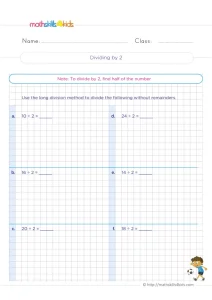 Worksheet3rd Grade Divide by 2 Worksheet: Long Division with Even Numbers
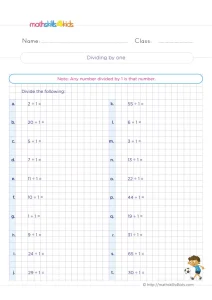 Worksheet3rd Grade Divide by 1 Worksheet: 20 Facts and the Rule of One
A few related activities
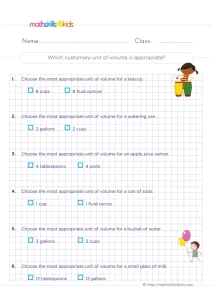 Six everyday containers, from a teacup to a bucket of water. Your child ticks the more sensible unit…See the activity3rd Grade Change and Total Cost Worksheet: Money Word Problems
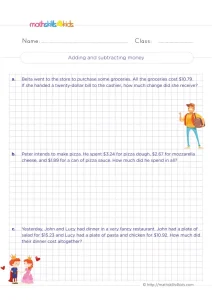 Three money word problems about groceries, a pizza and a dinner out. Children find the change from a…See the activity3rd Grade Do You Have Enough Money Worksheet: 3 Word Problems
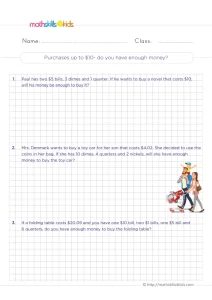 Three shopping stories with bills and coins. Children count the money, compare it with the price and decide…See the activity
