2nd Grade More or Less Likely Worksheet: Marbles and Cookies
Put a hand in a bag of mixed candies and a seven-year-old will tell you which color is coming before you even look. Sometimes that guess is just a favorite color talking. This 2nd grade more or less likely worksheet shows your child how to back the guess with a count. There are three questions. Clara picks a marble from a bag of white and blue ones. A boy reaches into a jar of oval cookies and star cookies without looking. Finally, a bag holds white, green and red marbles, and your child chooses the color they are most likely to pick. A second page gives the answer key.
Why counting beats guessing
Chance feels mysterious to young children, but the first idea behind it is simple: the more of something there is, the more likely you are to pick it. Two colors with the same count are equally likely. One color with more items is more likely, and one with fewer is less likely.
This page makes that idea visible. The marbles in question 1 sit in two neat rows, so your child can count each color. The cookies in question 2 are mixed, which forces a careful tally of ovals and stars.
So the page links probability to something second graders already do well, counting and comparing. The words come from the numbers. No guessing needed.
At the table: the cookie jar
Start with Clara's marbles. Ask, "How many white? How many blue?" Let your child touch each marble while counting. When the counts match, the answer word follows.
The cookie jar is where children slip. The two shapes are scattered across two rows, so it is easy to count one cookie twice or skip one. Instead of correcting, suggest a light pencil mark: "Put a dot on each star as you count." Then do the same for the ovals.
Question 3 has its own trap. Some children pick red because red marbles stand out on the page. Ask, "Which color has the most marbles?" and wait while they recount. The bright color is not always the likely one.
Socks, cards and a game of Memory
Chance is everywhere at home. Drop a few red and blue socks into a pillowcase, more of one color than the other, and ask, "Which color will come out first?" Pull one out, put it back, and try ten times. Also, at snack time, mix two kinds of crackers in a bowl and let your child predict before picking with eyes closed.
A game of Memory works too. Lay out the cards face down, then ask whether a matching pair is more likely early in the game or near the end.
When the page is done, praise the method: "You counted before you answered. That is how scientists decide."
About this 2nd grade more or less likely worksheet and its answer key
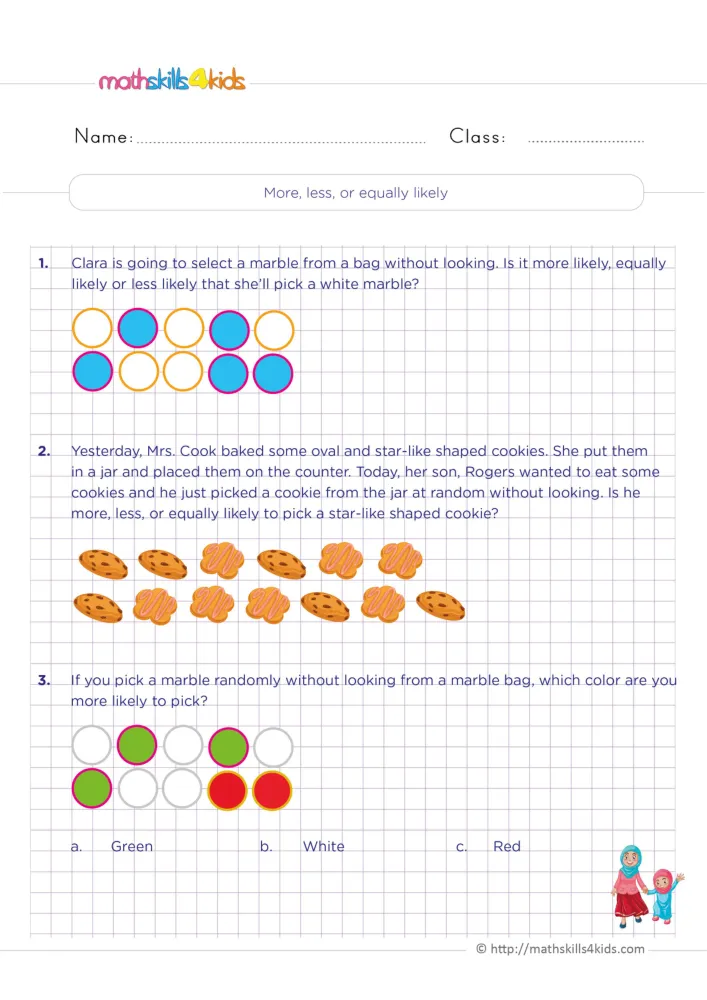
Download the worksheet: 2nd Grade More or Less Likely Worksheet: Marbles and Cookies
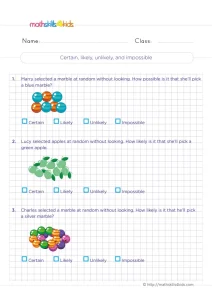 Worksheet3rd Grade Likely and Unlikely Events Worksheet: Marbles and Apples
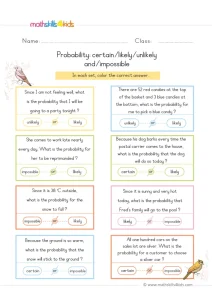 Worksheet2nd Grade Everyday Events Chance Worksheet: Color the Right Word
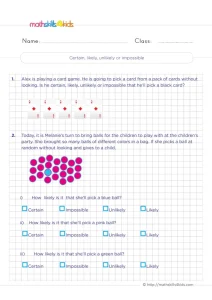 Worksheet2nd Grade Certain or Impossible Worksheet: Cards and Party Balls
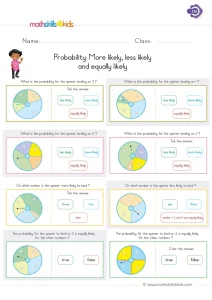 Worksheet2nd Grade Spinner Chances Worksheet: Compare the Sections
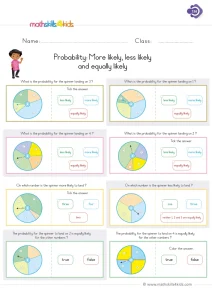 Worksheet1st Grade Spinner Probability Worksheet: More Likely, Less Likely or Equally Likely
A few related activities
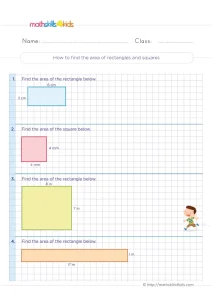 Three rectangles and one square, each with its side lengths. Your child multiplies length by width to find…See the activity3rd Grade Count Edges of 3D Shapes Worksheet: Faces and Vertices Too
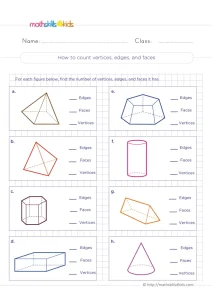 Eight drawn solids, from a square pyramid to a hexagonal prism and a cone. Count the edges, faces…See the activity3rd Grade Multiplication Worksheet: Find Products Using Properties
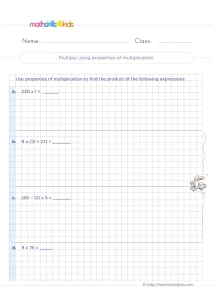 Work out four products, from 230 x 1 to 9 x 75, with the identity, distributive and commutative…See the activity
