2nd Grade Number Sequence Rule Worksheet: Find the Rule, Solve the Riddles
Show a seven-year-old the row 47, 46, 44, 41 and they will often say 40 next, because numbers usually go down by one. This 2nd grade number sequence rule worksheet asks them to look closer. The top half holds three rows of five numbers with an empty box at the end. Each row hides a step that changes as it goes. The bottom half has four riddles. One asks for a three-digit number with a 4 in the tens place and a 1 in the ones place. Another hides a number whose four equal digits add up to 16. A second page gives the answer key.
Why a changing step is worth the effort
Most early patterns grow by the same amount each time. Here the jumps themselves follow a rule. In row b the numbers drop by 1, then 2, then 3, so your child has to track two things at once: the numbers and the gaps between them.
That is the heart of a pattern with a changing step. Writing the gap above each pair of boxes makes the hidden rule visible.
The riddles work on a different muscle. A clue about the hundreds place or the sum of the digits asks your child to treat each digit as its own piece. For example, four equal digits that add up to 16 can only be one thing. Small clue, big idea.
At the table: row c and riddle 5
Start with row b. Ask, "How much did it go down each time?" Then let your child write the small jumps above the boxes.
Row c is where most children stall. The jumps from 75 to 150 keep doubling, and a child who expects plus 40 again will miss it. Instead of telling, point to the gaps and ask, "What happens to the jump each time?"
Riddle 5 looks easy but trips many readers. The tens digit must be less than two, and a two-digit number cannot start with 0. If your child writes 3, ask, "Is that a two-digit number?" Also, read what comes next aloud slowly; the words matter as much as the numbers.
Patterns in the stairs and the calendar
Growing patterns hide at home. On the stairs, take one step, then two, then three, and ask how many steps you have climbed after each turn. At the kitchen table, stack coins in towers of 1, 3, 6 and let your child build the next one.
The calendar works too. Start on the 2nd, jump 2 days, then 4, then 6, and see where you land.
The book Pattern Fish by Trudy Harris shows the same idea with colors and sounds, a nice change from numbers.
Once you finish the page, praise the search, not the answer: "You found the rule by looking at the gaps. That is careful thinking."
About this 2nd grade number sequence rule worksheet and its answer key
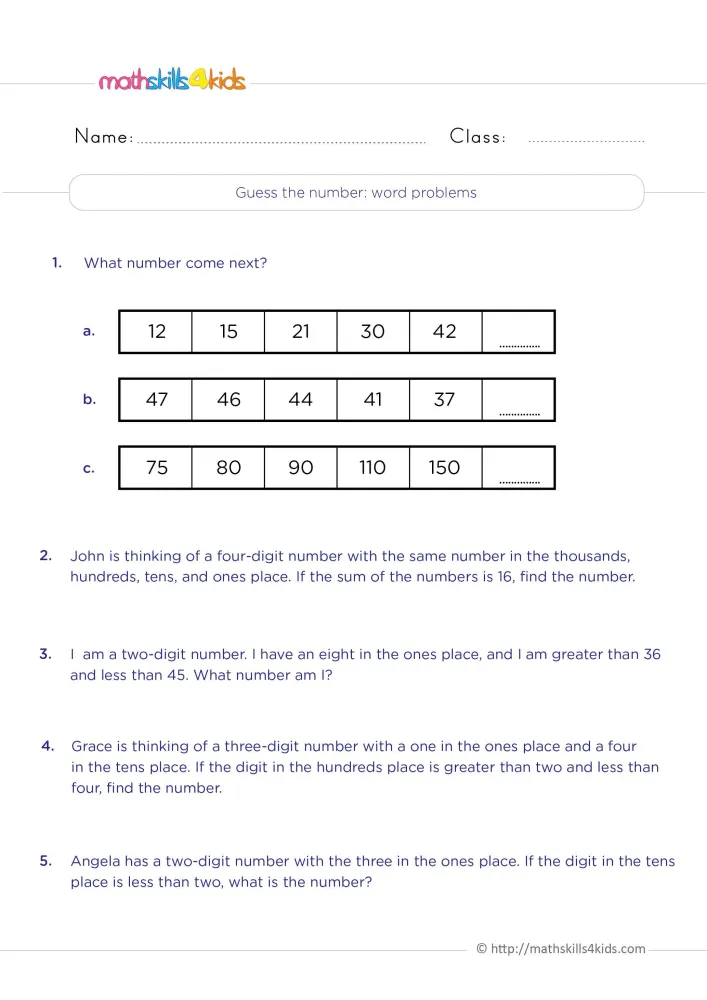
Download the worksheet: 2nd Grade Number Sequence Rule Worksheet: Find the Rule, Solve the Riddles
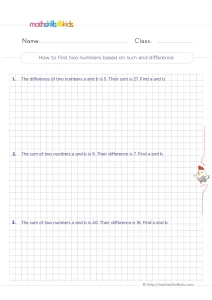 Worksheet3rd Grade Two Numbers from Sum and Difference Worksheet: 3 Puzzles
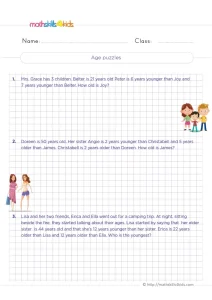 Worksheet3rd Grade Age Riddles Worksheet: Who Is Older, Who Is Younger?
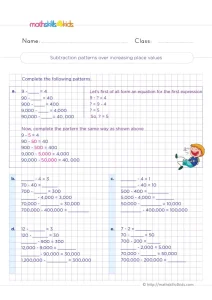 Worksheet3rd Grade Subtraction Patterns Worksheet: Over Increasing Place Values
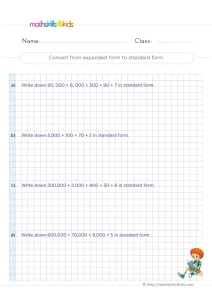 Worksheet3rd Grade Writing Numbers from Expanded Form Worksheet: Up to Six Digits
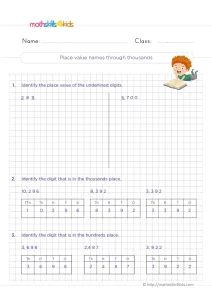 Worksheet3rd Grade Thousands and Hundreds Digits Worksheet: Name Each Place
A few related activities
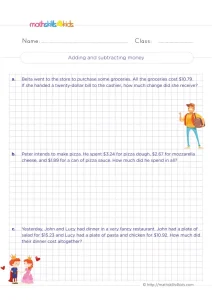 Three money word problems about groceries, a pizza and a dinner out. Children find the change from a…See the activity3rd Grade Cups, Pints and Gallons Worksheet
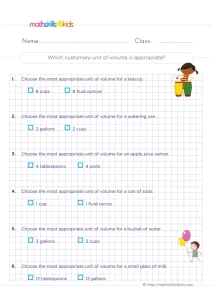 Six everyday containers, from a teacup to a bucket of water. Your child ticks the more sensible unit…See the activity3rd Grade Two-Step Multiply and Divide Problems: 3 Stories
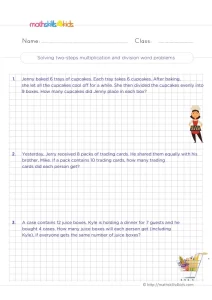 Three stories about cupcakes, trading cards and juice boxes. Your child multiplies to find a total, then divides…See the activity
