2nd Grade Regrouping Tens and Ones Worksheet: Trade Extra Ones for Tens
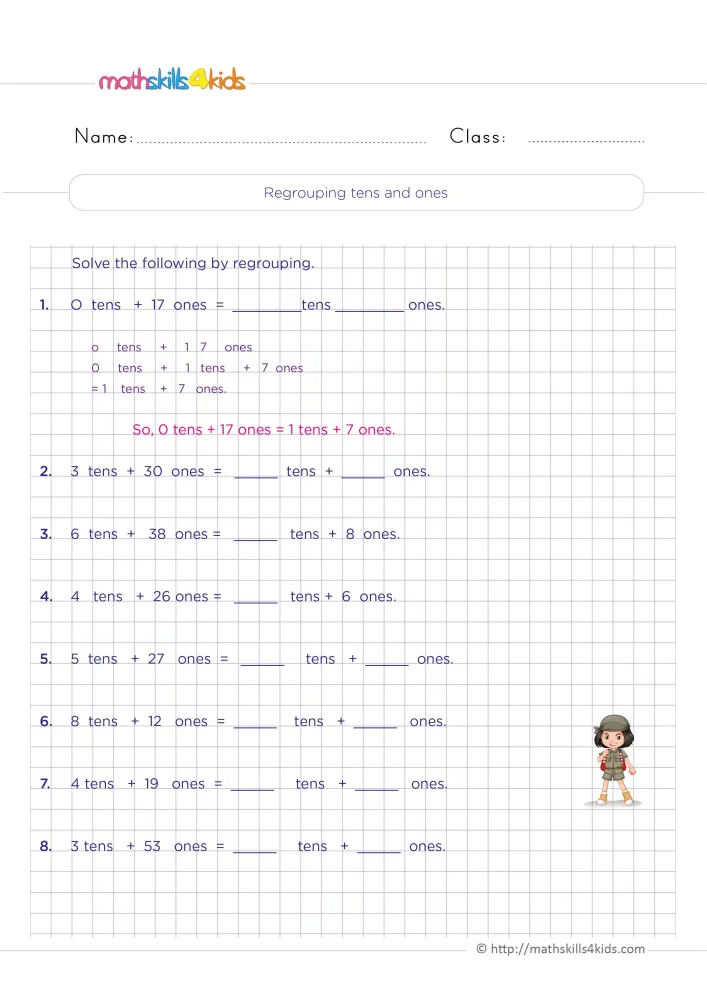
Give a seven-year-old 3 tens and 53 ones and ask for the number. Many will say 83 without trouble, yet still write "3 tens and 53 ones" when asked to show it in tens and ones. This 2nd grade regrouping tens and ones worksheet works on that gap. The first item walks through it step by step: 0 tens + 17 ones becomes 1 ten + 7 ones. Seven more follow, each with more than nine ones to sort out, from 3 tens + 30 ones to 8 tens + 12 ones. In two of them, the page already gives the ones, so your child only finds the tens. A second page gives the answer key.
Why ten ones must become a ten
In our number system, a place can hold at most nine. As soon as ten ones gather, they turn into one ten. We call that trade regrouping, and it is exactly what happens when your child carries in an addition.
This page isolates the trade so it can be seen. In 6 tens + 38 ones, the 38 ones hide 3 more tens. Add them to the 6, and the number becomes 9 tens + 8 ones.
The worked first item shows the move in three lines: split 17 ones into 1 ten and 7 ones, then gather the tens. The idea that ten ones make one ten sounds simple, but it is the reason 98 is written with two digits, not three.
Once this feels natural, column addition stops being a trick.
At the table: item 2 and item 8
Start with item 2, 3 tens + 30 ones. Some children write 33 tens. Instead of correcting, ask, "How many tens are hiding in 30 ones?"
Item 8, 3 tens + 53 ones, is the most common slip. A child may break 53 into 5 tens and 3 ones, then forget to add the 3 tens from the start. Point to the first 3 and ask, "Where did these tens go?"
Items 3 and 4 already show the ones. That is a helpful clue, so let your child use it to check their thinking.
Also, real objects make the trade visible. For example, line up 53 dry beans, then group them into cups of ten. Touching each full cup while counting tens builds the picture behind the numbers.
Straw bundles, dimes and pennies
Regrouping is easy to feel with your hands. Collect drinking straws or craft sticks and tie bundles of ten with rubber bands. Then hand your child 2 bundles and 15 loose straws, and ask them to tidy up.
Coins work the same way. Ten pennies trade for one dime, so a pile of 4 dimes and 26 pennies can become 6 dimes and 6 pennies. While you sort, say the trade out loud.
For a story, Earth Day-Hooray! by Stuart J. Murphy follows a class collecting cans for recycling and grouping them into tens and hundreds. It shows why regrouping makes counting faster.
Finally, check the page with the answer key and praise the work: "You traded every ten ones." That is real understanding of tens and ones.
About this 2nd grade regrouping tens and ones worksheet and its key
Download the worksheet: 2nd Grade Regrouping Tens and Ones Worksheet: Trade Extra Ones for Tens
 Worksheet3rd Grade Subtraction Patterns Worksheet: Over Increasing Place Values
 Worksheet3rd Grade Writing Numbers from Expanded Form Worksheet: Up to Six Digits
 Worksheet3rd Grade Thousands and Hundreds Digits Worksheet: Name Each Place
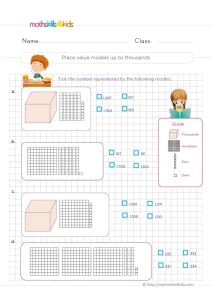 Worksheet3rd Grade Place Value Blocks Matching Worksheet: Cubes, Flats, Rods and Ones
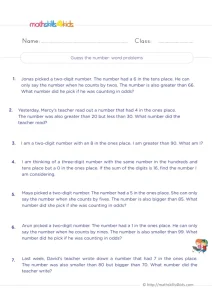 Worksheet2nd Grade Two-Digit Number Riddles Worksheet: Use the Clues, Find the Number
A few related activities
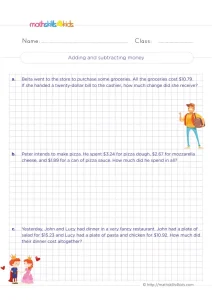 Three money word problems about groceries, a pizza and a dinner out. Children find the change from a…See the activity3rd Grade Two-Step Multiply and Divide Problems: 3 Stories
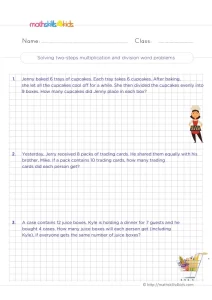 Three stories about cupcakes, trading cards and juice boxes. Your child multiplies to find a total, then divides…See the activity3rd Grade Cups, Pints and Gallons Worksheet
 Six everyday containers, from a teacup to a bucket of water. Your child ticks the more sensible unit…See the activity
