2nd Grade Start and End Time Word Problems Worksheet: Count the Hours
Tell a seven-year-old that a party starts in three hours and they will ask, "So when is that?" every few minutes. This 2nd grade start and end time word problems worksheet gives them the tool to answer it themselves. Nine short stories fill the page. Henry starts basketball practice at four in the afternoon and plays for 3 hours. Then birds stop chirping at dawn, Derrick mows the lawn from noon and Lucy babysits in the evening. Some stories give the start and ask for the end; others give the end and ask when it began. Every gap is a whole number of hours. A second page gives the answer key.
Why a time line beats a guess
Elapsed time is hard because a clock goes round in circles, while the hours themselves keep moving forward. A time number line straightens that circle out, and each jump is one hour, so your child can see the hours pile up.
The answer key shows exactly that: for Henry, three little arcs hop from 4 to 7 on an afternoon line. In fact, it is the same skill as adding on a number line, only with hours.
The page also asks for both directions: finding an end time means you count forward; finding a start time means you count backward. Children who practice both start to see time as something they can measure.
At the table: the birds and the long workday
Start with Henry and ask, "Where does practice start on the line? Now hop three hours." The arcs make it concrete.
However, the birds in story b are tricky because the time ends in 30, so many children drop the half hour and write a time on the hour. Instead of correcting, ask, "What time did the birds stop? Does the half hour disappear?"
Story c has four pieces: work, lunch, a meeting and the drive home. For example, a child may add only the work hours, so suggest, "Draw one hop for every hour he was busy." Also, saying "morning" or "evening" aloud at each step keeps the morning and afternoon from mixing.
Counting hours on an ordinary day
Real days are full of elapsed time. Before a trip, say, "We leave at 9 and the drive takes 2 hours, so when do we arrive?" and check the clock together when you get there. At bedtime, count the hours of sleep until the alarm on your fingers.
The rhyme "Ten in the Bed" counts down one by one, which is the same move as counting back the hours, so sing it once and then count back from bedtime to dinner.
Also, a paper strip marked from early morning to late evening makes a home time line for the fridge.
Once you finish the page, praise the method: "You drew every hop. That kept the hours in order."
About this 2nd grade start and end time word problems worksheet and key
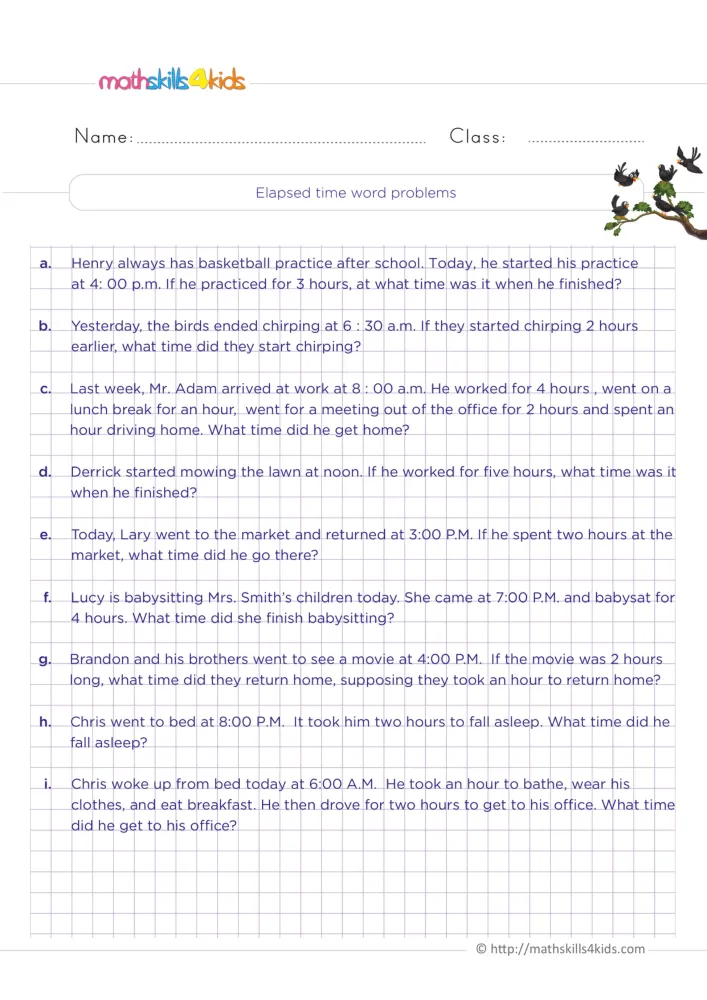
Download the worksheet: 2nd Grade Start and End Time Word Problems Worksheet: Count the Hours
 Worksheet3rd Grade Like Denominator Fraction Story Problems Worksheet
 Worksheet3rd Grade Reading a Data Table Worksheet: 2 Tables
 Worksheet3rd Grade AM and PM Time Worksheet: 5 Daily Events
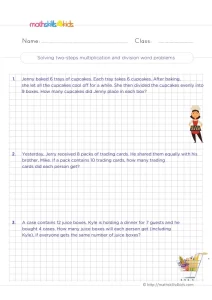 Worksheet3rd Grade Two-Step Multiply and Divide Problems: 3 Stories
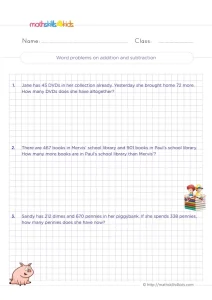 Worksheet3rd Grade Addition and Subtraction Problems: 3 Stories
A few related activities
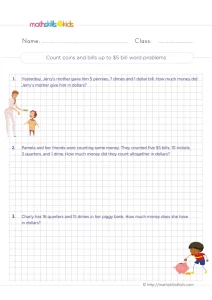 Three money word problems with pennies, nickels, dimes, quarters and $1 and $5 bills. Children find each total…See the activity3rd Grade Change and Total Cost Worksheet: Money Word Problems
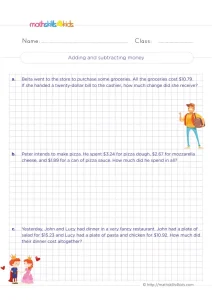 Three money word problems about groceries, a pizza and a dinner out. Children find the change from a…See the activity3rd Grade Do You Have Enough Money Worksheet: 3 Word Problems
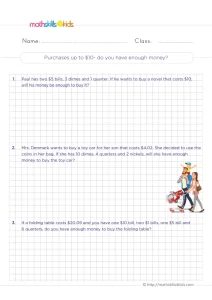 Three shopping stories with bills and coins. Children count the money, compare it with the price and decide…See the activity
