2nd Grade True or False Subtraction Worksheet: Tick, Then Fix
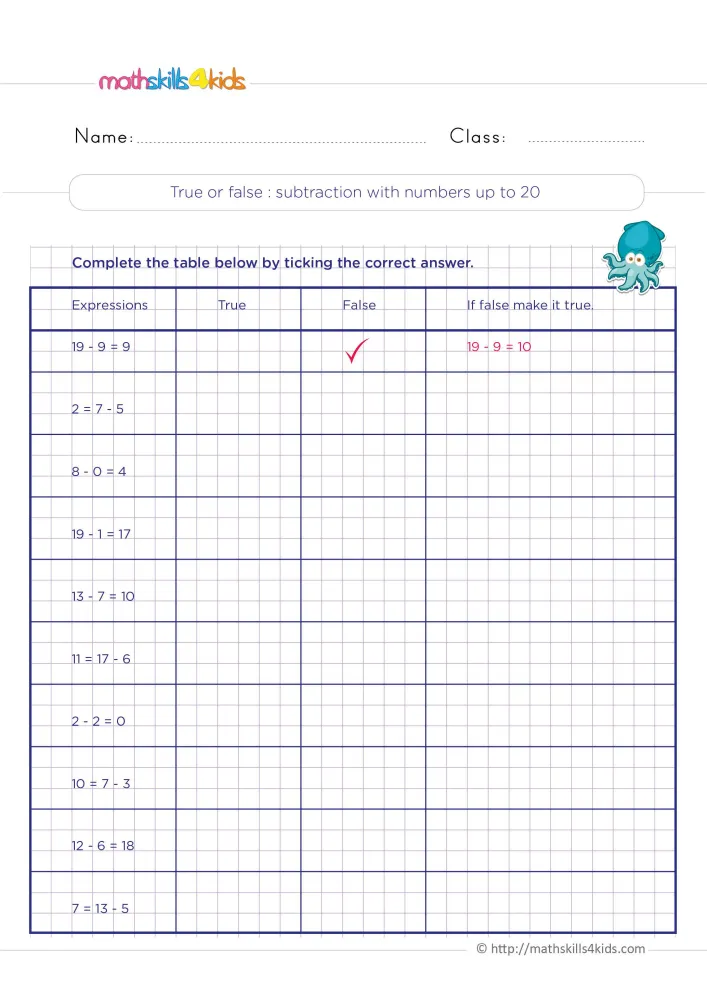
Show a seven-year-old 2 = 7 - 5 and you may hear that it is written backwards. Many children think the answer must always come after the equal sign. This 2nd grade true or false subtraction worksheet gently challenges that idea. A table lists ten equations, each a subtraction within 20. Some follow the usual order, while others flip it, like 11 = 17 - 6. Your child ticks True or False, and in the last column rewrites each false equation to make it true. The first row is already done as a model: 19 - 9 = 9 is false, so the fix reads 19 - 9 = 10. A second page gives the answer key.
Why the equal sign works like a balance
Children often read the equal sign as an instruction: do the sum, then write the answer. That reading works until they meet 10 = 7 - 3 or 7 = 13 - 5, where the single number comes first.
The more useful meaning is the same as, so both sides of the sign must name the same amount. True or false questions force that check. Your child computes one side, then compares it with the other. Each line asks your child to check an equation instead of producing one.
The page mixes both layouts on purpose. For example, 2 = 7 - 5 is true even though it looks unusual, while 12 - 6 = 18 looks normal and is false. Judging them side by side builds a sturdier idea of equality. Layout is not truth.
At the table: the rows that trick the eye
Start with 2 = 7 - 5. Ask your child to work out seven take away five, then compare the result with the 2.
The row 12 - 6 = 18 catches children who add by habit. If your child calls it true, ask, "Did we take away or put together?"
The row 8 - 0 = 4 is the opposite trap: taking away zero seems like it should change something. Hold up eight fingers, fold down none, and count.
For the fixes, there may be more than one good answer. For 19 - 1 = 17, your child might change the answer to 18, or change the 1 to a 2. Both work. Accept either, then ask your child to explain the choice.
Coins in two hands and Simon Says
Equality lives in everyday fair sharing. Put five coins in each hand. Then move one from the left to the right and ask whether both sides still match. At dinner, compare two plates and decide together whether they hold the same amount.
Also, play a quick round of Simon Says with equations. Call out a line such as Simon says 9 - 3 = 6. Your child then gives a thumbs up for true or a thumbs down for false. Leave out Simon now and then to keep everyone alert.
Once you finish the worksheet, check it with the answer key. Then praise the thinking: "You fixed every false row in your own way."
About this 2nd grade true or false subtraction worksheet and its answer key
Download the worksheet: 2nd Grade True or False Subtraction Worksheet: Tick, Then Fix
 Worksheet3rd Grade Addition and Subtraction Problems: 3 Stories
 Worksheet3rd Grade Divide by 1 Worksheet: 20 Facts and the Rule of One
 Worksheet3rd Grade 1 Times Table Worksheet: 18 Column Facts and the Identity Rule
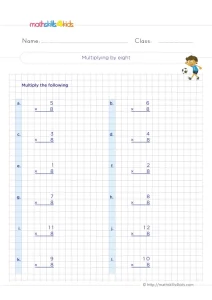 Worksheet3rd Grade 8 Times Table Worksheet: 12 Column Facts and a Doubling Trick
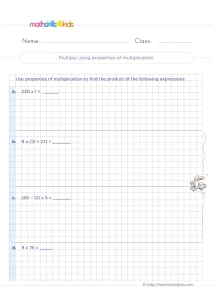 Worksheet3rd Grade Multiplication Worksheet: Find Products Using Properties
A few related activities
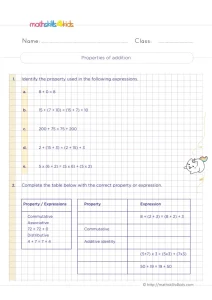 Five number sentences to name, from 8 + 0 = 8 to 5 x (6 + 2). Then…See the activity3rd Grade Multiplication Properties Worksheet: Zero, Identity, Commutative
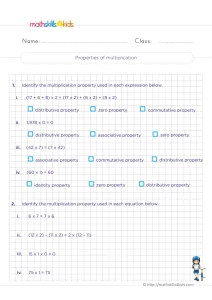 Tick the right property for four equations, from 1,978 x 0 = 0 to (60 x 1) =…See the activity3rd Grade Reading a Data Table Worksheet: 2 Tables
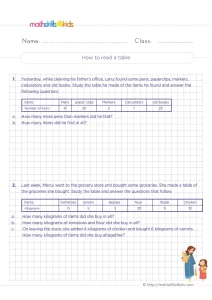 Two small tables, one of office items and one of groceries in kilograms. Your child finds the numbers,…See the activity
