2nd Grade Vertices Edges and Faces Worksheet: Which Solid Has the Most?
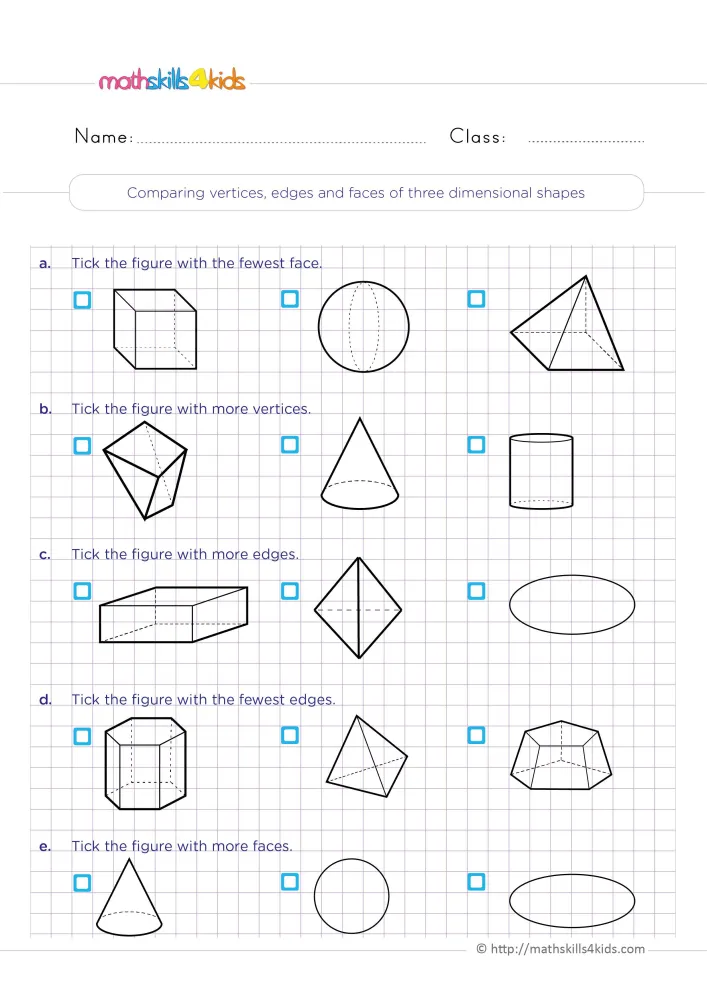
Hand a seven-year-old a cereal box and ask how many corners it has, and they will usually count only the ones they can see. Turning the box over is the lesson. This 2nd grade vertices edges and faces worksheet puts that counting into five short rows. Each row shows three figures, such as a cube, a ball, a pyramid, a cone, a cylinder, a long box or a hexagonal prism. A line above tells your child what to look for: the fewest faces, the most vertices, the most edges, the fewest edges or the most faces. They tick one figure per row. A second page gives the answer key.
Why the hidden side counts too
A drawing of a solid shows only part of it. The dotted lines stand for the edges at the back, the ones you would feel if you held the shape. Counting vertices, edges and faces forces a child to imagine that hidden part.
The three words are worth learning early. A face is a flat surface. An edge is where two faces meet. A vertex is a corner where edges meet. Many children mix up edges and vertices, so this page gives them practice on both.
The page also uses comparison words. So your child must count, then compare three numbers, then decide. For example, "the most vertices" means more than both of the others. Three counts, one choice.
At the table: the box and the pyramid
Start with the row that asks for the fewest faces. Let your child count the faces of the cube first, then talk about the ball. Ask, "Can you find a flat part on it?"
In the row about edges, the long box is the strong candidate. A child may count only the solid lines and forget the dotted ones. Instead of correcting, say, "Trace every line with your finger, dotted ones too." A light pencil tick on each edge helps.
The row asking for the fewest edges can surprise. The pyramid with a triangle base looks busy, yet it has few edges. Have your child count, write the number beside each figure, then compare. Writing the numbers makes the choice easy.
Counting corners around the house
Real objects make these words stick. Take a tissue box or a cereal box and count the faces together, turning it in your hands. Then put a small sticker on each corner and count the stickers. Also, run a finger along each edge of a dice or a sugar cube.
A quick game of Simon Says works well with solids. Say, "Simon says touch a vertex," then "Simon says slide along an edge." Let your child lead the next round.
When you compare two solid shapes, ask which has the most vertices and why. Finally, praise the counting: "You turned the box to find the hidden corners." That patience is the real skill.
About this 2nd grade vertices edges and faces worksheet and its answer key
Download the worksheet: 2nd Grade Vertices Edges and Faces Worksheet: Which Solid Has the Most?
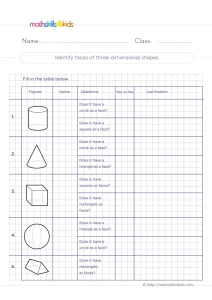 Worksheet3rd Grade Flat and Curved Faces Worksheet: Circles, Squares, Triangles
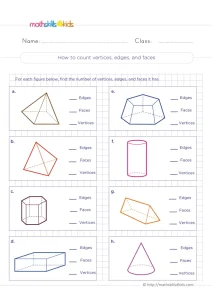 Worksheet3rd Grade Count Edges of 3D Shapes Worksheet: Faces and Vertices Too
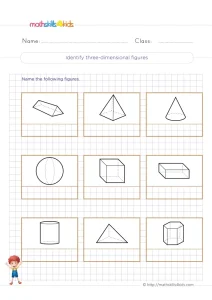 Worksheet3rd Grade Naming Solid Figures Worksheet: Prisms, Pyramids and More
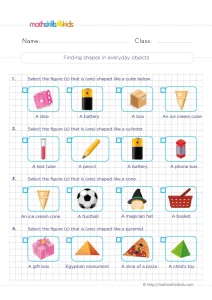 Worksheet3rd Grade Finding Shapes in Everyday Objects Worksheet: 16 Pictures
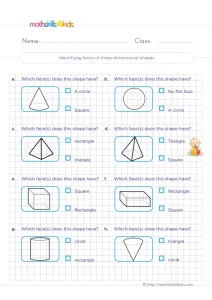 Worksheet2nd Grade Faces of Solid Shapes Worksheet: Which Flat Faces Does It Have?
A few related activities
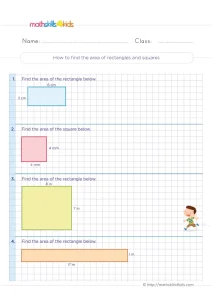 Three rectangles and one square, each with its side lengths. Your child multiplies length by width to find…See the activity3rd Grade Multiplication Worksheet: Find Products Using Properties
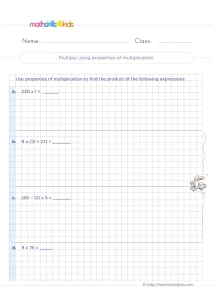 Work out four products, from 230 x 1 to 9 x 75, with the identity, distributive and commutative…See the activity3rd Grade Like Denominator Fraction Story Problems Worksheet
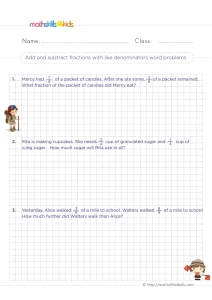 Three short stories about candies, cupcakes and a walk to school. Your child adds or subtracts fractions with…See the activity
