3rd Grade Comparing Division Expressions Worksheet: True or False
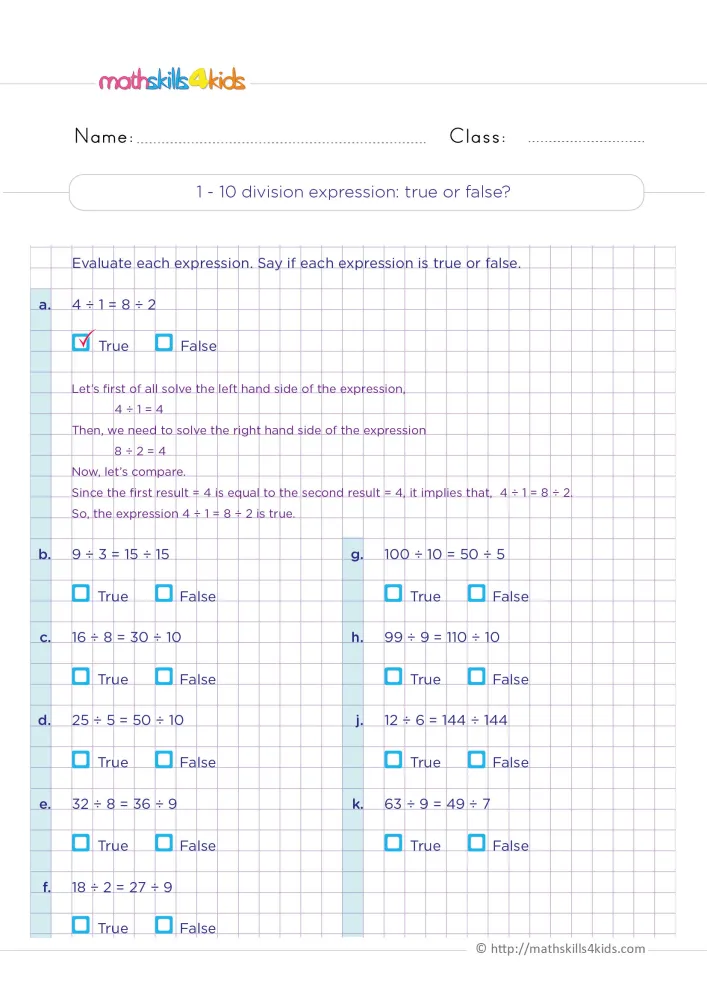
An equal sign means "the same value as", not "the answer comes next". This 3rd grade comparing division expressions worksheet builds that idea with ten equations, each with a division on both sides. For example, item k reads 63 ÷ 9 = 49 ÷ 7. Your child works out the left side, then the right side, and ticks True or False. Item a is already solved step by step, so children can follow its model. There is no picture here, only a clean purple grid. Page two ticks every answer in red.
Six true, four false
Comparing expressions is easier when your child solves each side on its own. In e, 32 ÷ 8 = 4 and 36 ÷ 9 = 4, so the equation is true. In c, 16 ÷ 8 = 2 but 30 ÷ 10 = 3, so it is false. Four items are false: b, c, f and j.
Two items go past the usual range, namely 110 ÷ 10 in h and 144 ÷ 144 in j. Yet both are friendly, because dividing by 10 removes a zero and any number divided by itself gives 1. Note also that the letters jump from h to j, since there is no item i.
At the table: write the two answers
Ask your child to write the result above each side, as item a shows. For 18 ÷ 2 = 27 ÷ 9, that gives 9 on the left and 3 on the right. Since 9 and 3 differ, the equation is false.
The worked example uses long sentences, such as "it implies that". Read it aloud together and restate it simply: work out both sides, then compare. This routine prepares children for balanced equations in later grades.
After the page: the balance game
Write a division on the left of a sheet, for example 20 ÷ 4. Your child then writes a different division with the same value on the right, such as 10 ÷ 2. Take turns and see who finds the most pairs. Last of all, check the ten ticks against the answer key on page two.
About this comparing division expressions page and its answer key
Download the worksheet: 3rd Grade Comparing Division Expressions Worksheet: True or False
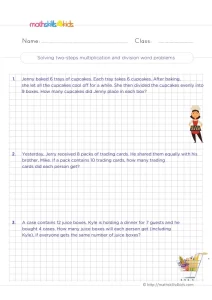 Worksheet3rd Grade Two-Step Multiply and Divide Problems: 3 Stories
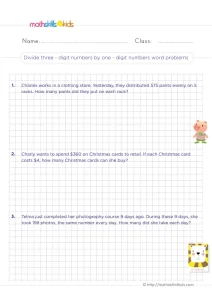 Worksheet3rd Grade Divide 3-Digit by 1-Digit Word Problems: 3 Stories
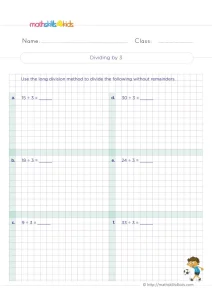 Worksheet3rd Grade Divide by 3 Worksheet: Long Division Without Remainders
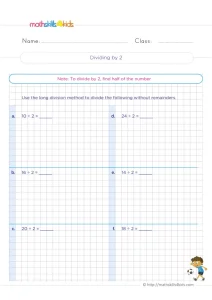 Worksheet3rd Grade Divide by 2 Worksheet: Long Division with Even Numbers
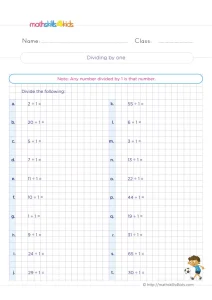 Worksheet3rd Grade Divide by 1 Worksheet: 20 Facts and the Rule of One
A few related activities
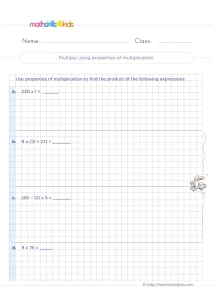 Work out four products, from 230 x 1 to 9 x 75, with the identity, distributive and commutative…See the activity3rd Grade 1 Times Table Worksheet: 18 Column Facts and the Identity Rule
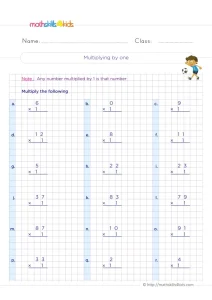 Eighteen column facts times 1, from 0 × 1 to 91 × 1. One rule solves them all:…See the activity3rd Grade 8 Times Table Worksheet: 12 Column Facts and a Doubling Trick
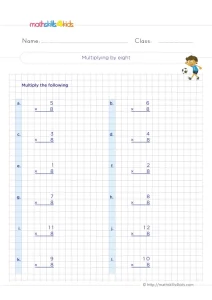 Twelve column facts times 8, from 1 × 8 to 12 × 8, in a mixed order. Double…See the activity
