3rd Grade Division Patterns with Place Value Worksheet: 4 Patterns
Zeros make big numbers look hard, but they follow a simple rule. This 3rd grade division patterns with place value worksheet has four patterns, labeled a to d, with six lines each. Every line moves one place to the left, so 5 ÷ 5 = 1 becomes 50 ÷ 5 = 10, then 500 ÷ 5 = 100. Your child fills in the missing number on each line, either the divisor, the number divided or the answer. A small reindeer waves from the right margin. Page two fills in all 24 blanks and explains the first two patterns.
One fact, many zeros
Each pattern grows from one basic fact. In a, the divisor is always 5. In b, children find the first number, 2, then 20, 200 and so on up to 200,000. In c, they divide by 10 each time. Finally, d divides by 12 and ends with 1,200,000 ÷ 12 = 100,000.
This is a great place value pattern. One extra zero in the first number adds one zero to the answer. Numbers in the millions and dividing numbers that end in zeros usually come in fifth grade, so this page is a stretch. Use it with a child who already enjoys big numbers.
At the table: cover the zeros
Show your child how to cover the zeros with a finger. Then 12,000 ÷ 12 looks like 12 ÷ 12 = 1, and the three hidden zeros come back in the answer, which gives 1,000. Saying the numbers aloud, such as "twelve thousand", helps too.
Page two explains a and b with an equation, "5 ÷ ? = 1", and solves it with a multiplication. However, it spells pattern as "parttern" four times, so point out the right spelling.
After the page: zero towers
Write 6 ÷ 3 = 2 at the bottom of a sheet. Your child adds one zero to the first number and to the answer on each new line, to build a tower: 60 ÷ 3 = 20, 600 ÷ 3 = 200. Then check each line with a multiplication. Finally, compare the four patterns with the answer key on page two.
About this division patterns with place value page and its answer key
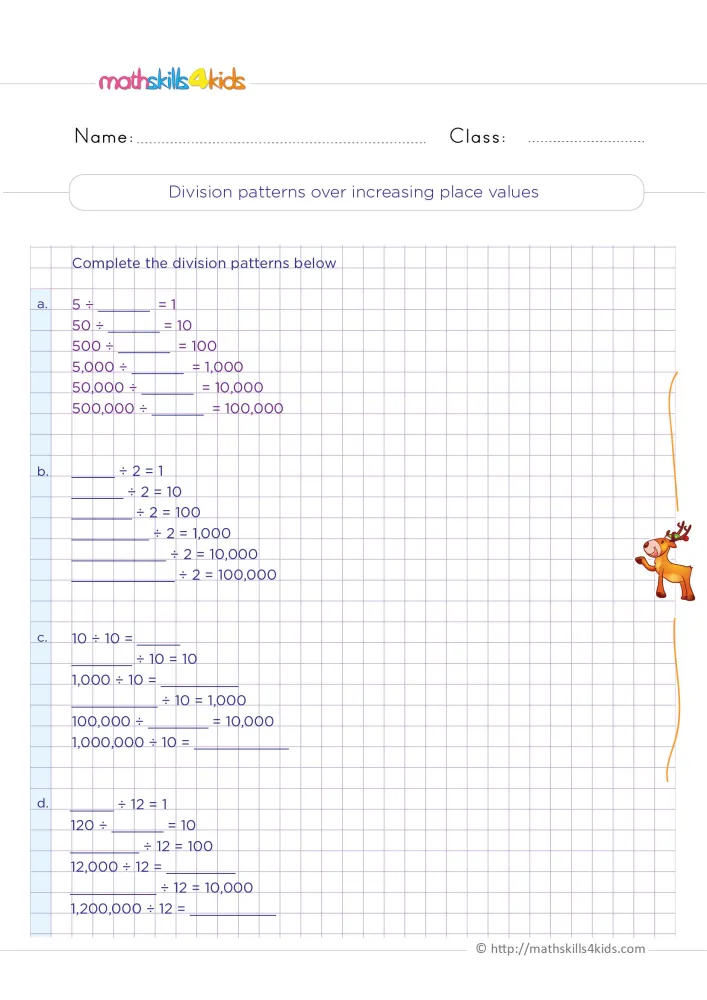
Download the worksheet: 3rd Grade Division Patterns with Place Value Worksheet: 4 Patterns
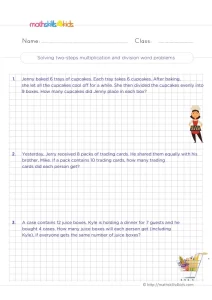 Worksheet3rd Grade Two-Step Multiply and Divide Problems: 3 Stories
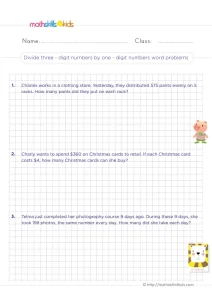 Worksheet3rd Grade Divide 3-Digit by 1-Digit Word Problems: 3 Stories
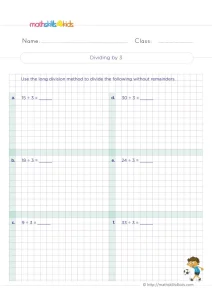 Worksheet3rd Grade Divide by 3 Worksheet: Long Division Without Remainders
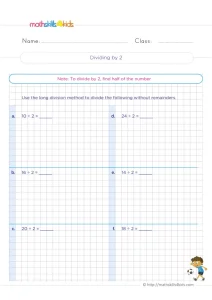 Worksheet3rd Grade Divide by 2 Worksheet: Long Division with Even Numbers
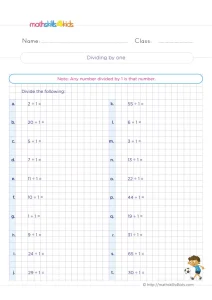 Worksheet3rd Grade Divide by 1 Worksheet: 20 Facts and the Rule of One
A few related activities
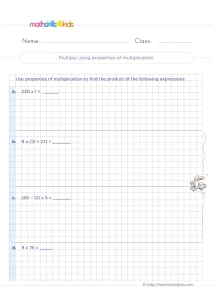 Work out four products, from 230 x 1 to 9 x 75, with the identity, distributive and commutative…See the activity3rd Grade 1 Times Table Worksheet: 18 Column Facts and the Identity Rule
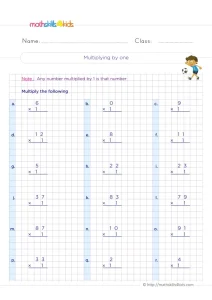 Eighteen column facts times 1, from 0 × 1 to 91 × 1. One rule solves them all:…See the activity3rd Grade 8 Times Table Worksheet: 12 Column Facts and a Doubling Trick
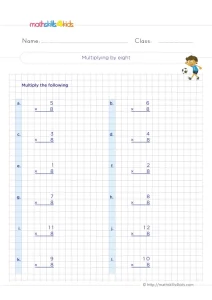 Twelve column facts times 8, from 1 × 8 to 12 × 8, in a mixed order. Double…See the activity
