Kindergarten Inside and Outside Shapes Worksheet: Tick the Right Picture
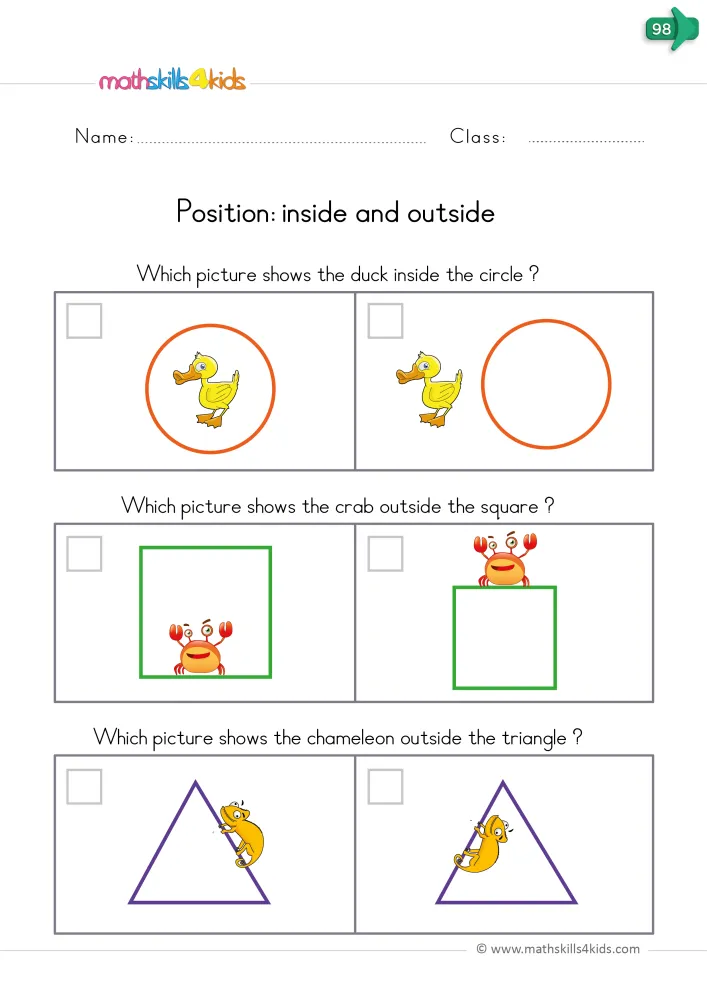
Put a toy duck in a mixing bowl and ask where it is, and most five-year-olds say "in" at once. Now balance it on the rim, and the answer gets slippery. This kindergarten inside and outside shapes worksheet works on that slippery spot. Three questions each show two pictures side by side: a yellow duck with an orange circle, a red crab with a green square, then a chameleon with a purple triangle. The child ticks the picture that matches the words. The pairs get harder as you go down, so the last one asks for real looking. The PDF has two pages: the worksheet, then its answer key.
Why the line around a shape matters
Inside and outside sound simple, and with the duck they are. The real idea is a boundary. A closed line, the edge of a shape, splits the page into two zones, and every animal belongs to one of them.
That idea comes before counting sides or naming shapes. A child who can say which zone the crab is in is also building spatial vocabulary for later words like between and around.
The page grows harder on purpose. The duck stands well clear of its circle, while the crab touches the top of its square. Finally, the chameleon grips a side of the triangle in both pictures. Each step asks the child to look a little closer. Same words, finer looking.
At the table: the crab on the roof
Read each question aloud and let your child point before ticking. For the duck, try this: "Where is the duck? Show me with your finger."
The crab is the first trap, since in one picture it sits on top of the square, touching the green line. Some children call that inside, because it touches. Instead of correcting, ask, "Could the crab walk in from there?" After that, trace the line together.
The chameleon is harder still. It clings to a side in both pictures, so your child has to check where its body is. Cover its head with a fingertip and ask about its tummy, because the tummy is what counts. Slow down here.
These small talks build position words. They also train comparing two pictures before choosing, which is a habit worth having.
Hide and Seek, boxes and bath time
Home is full of chances to practice. At bath time, drop one rubber duck in the tub and one on the mat, and ask your child to tap the duck that is inside. While you tidy up, hold a toy on the rim of a box and ask, "In or out?"
A game of Hide and Seek also helps. Once your child finds you, ask whether you were inside the closet or outside it. Let them explain how they know, even if the reason is a little wobbly.
Afterwards, open the answer key together and check the three ticks. Then praise the looking, not the score: "You traced the line before you ticked. That was careful."
About this kindergarten inside and outside shapes worksheet (2 pages)
Download the worksheet: Kindergarten Inside and Outside Shapes Worksheet: Tick the Right Picture
 Worksheet3rd Grade Reading Coordinates on a Map Worksheet: Find the Places
 Worksheet1st Grade Top or Bottom Pictures Worksheet: Read, Then Color the Number
 Worksheet1st Grade Beside and Far From Worksheet: Yes or No Picture Sentences
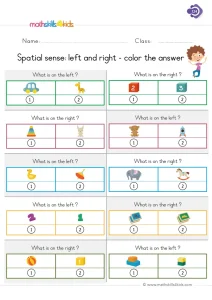 Worksheet1st Grade Left or Right Toy Pairs Worksheet: Color 1 or 2
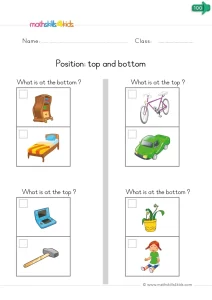 WorksheetKindergarten Top or Bottom Worksheet: Bed, Bike, Hammer and Doll
A few related activities
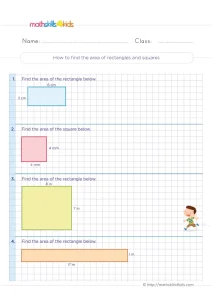 Three rectangles and one square, each with its side lengths. Your child multiplies length by width to find…See the activity3rd Grade Naming Solid Figures Worksheet: Prisms, Pyramids and More
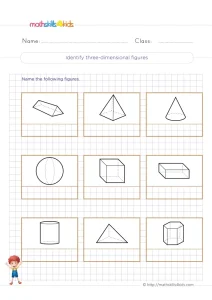 Nine drawn solids to name, from a cube and a cone to a hexagonal prism and a triangular…See the activity3rd Grade Multiplication Worksheet: Find Products Using Properties
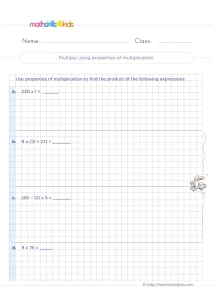 Work out four products, from 230 x 1 to 9 x 75, with the identity, distributive and commutative…See the activity
