Kindergarten Top or Bottom Worksheet: Bed, Bike, Hammer and Doll
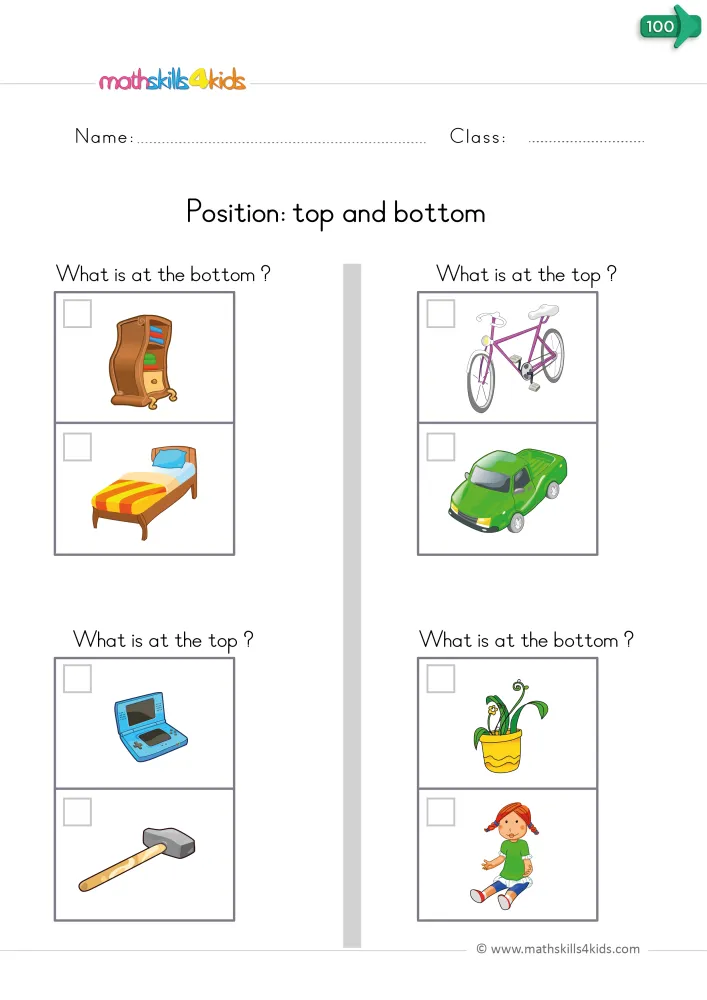
Ask a five-year-old to fetch the book on the bottom shelf, and you may get the one at eye level. Top and bottom feel obvious to adults, yet children often mix them up when the question changes. This kindergarten top or bottom worksheet with everyday objects plays on exactly that. It shows four boxes, each with two stacked pictures: a bookcase over a bed, a bike over a green car, a game console over a hammer, and a potted plant over a doll. The questions switch between top and bottom, so the child must listen every time. The PDF holds two pages, the worksheet and its answer key.
Why the switching questions matter
A child who knows the words top and bottom can still fail this page. The difficulty is not the vocabulary itself. It is holding the question in mind while the eyes look at the pictures.
The page asks "bottom" first, then "top" twice, then "bottom" again. That order breaks any easy habit. It builds vertical orientation: reading a picture from the top down and naming each level.
There is a second idea. The objects come from daily life, such as a bed, a bike, a hammer and a doll. So naming objects becomes part of the task, and talking about them gives the child positional language in full sentences. Words first, ticks second.
At the table: the doll at the bottom
Start by naming the eight pictures together. Point to the bookcase and ask, "What is this? And what is under it?"
Next, read the first question slowly, stressing the last word. Many children tick the top picture in every box, because the top is where the eye lands first. If your child ticks the plant for the last question, do not say no. Ask instead, "Which one is lower down? Touch it."
You can also turn the page into a game of fingers. Your child puts one finger on the top picture and one on the bottom one, then lifts the finger the question asks for. That small movement turns top and bottom into something the hand feels.
Simon Says, shelves and the stairs
Top and bottom live all around the house. When you put away the shopping, ask your child to place the cereal on the top shelf and the rice at the bottom. On the stairs, stop on a middle step and ask, "Who is at the top?"
A round of Simon Says also fits well. Try "Simon says touch the top of your head," then "Simon says touch the bottom of your shoe." Mix the two quickly, as the page does.
Once the four ticks are in, check them with the answer key side by side. Then name the effort: "You listened to every question before you ticked. Well done."
About this kindergarten top or bottom worksheet with everyday objects
Download the worksheet: Kindergarten Top or Bottom Worksheet: Bed, Bike, Hammer and Doll
 Worksheet3rd Grade Reading Coordinates on a Map Worksheet: Find the Places
 Worksheet1st Grade Top or Bottom Pictures Worksheet: Read, Then Color the Number
 Worksheet1st Grade Beside and Far From Worksheet: Yes or No Picture Sentences
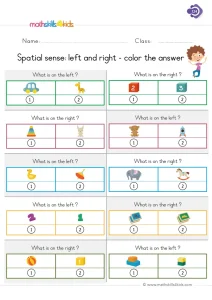 Worksheet1st Grade Left or Right Toy Pairs Worksheet: Color 1 or 2
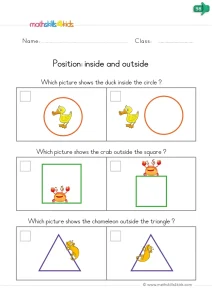 WorksheetKindergarten Inside and Outside Shapes Worksheet: Tick the Right Picture
A few related activities
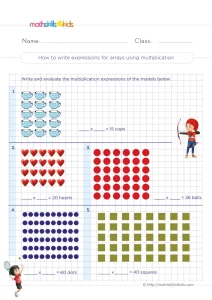 Five arrays of cups, hearts, balls, dots and squares. Your child writes the multiplication expression for each one…See the activity3rd Grade Reading a Data Table Worksheet: 2 Tables
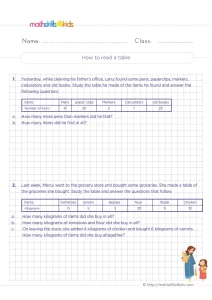 Two small tables, one of office items and one of groceries in kilograms. Your child finds the numbers,…See the activity3rd Grade 1 Times Table Worksheet: 18 Column Facts and the Identity Rule
 Eighteen column facts times 1, from 0 × 1 to 91 × 1. One rule solves them all:…See the activity
