Kindergarten Shape Classification Worksheet: Four Alike, One That Does Not Fit
Hand a five-year-old a box of mixed blocks, and the sorting usually starts on its own: squares here, triangles over there. This kindergarten shape classification worksheet turns that urge into five quick rows. Every row shows five gray outlines drawn from squares, stars, pentagons, triangles and hearts. Four shapes in a row belong together and one does not, so the rule changes from row to row. Your child circles the shape that is different. There is no color to help, only the outline. The PDF includes an answer key on its second page.
Why plain outlines and no color
Sorting is one of the first ways children organize the world. To find the shape that does not belong, your child must first spot what the other four share, then check each shape against that rule. That two-step thinking is the heart of classifying shapes.
The page uses plain gray outlines on purpose. With no color to lean on, the child has to look at corners, sides and curves. That is real geometry, even at five.
There is also a twist. A shape that is the odd one in one row becomes the group in another. So the rule is never "circle the pentagon." It is always "find what is same and different right here."
At the table: what do these four share?
Start each row with the same question: "Which ones look the same?" Let your child touch the four matching shapes before circling anything.
The star row needs a slower look. A star and a pentagon both come with five points or five sides, so at a glance the two outlines can seem alike. If your child hesitates, ask, "Run your finger around this one. Is it pointy between the corners?" The finger often finds the difference before the eyes do.
After each circle, ask your child to say the rule in a sentence, such as "These are all triangles, and this one is not." Saying the sorting rule out loud turns a lucky guess into a reason.
Mouse Shapes and the toy box
Back home, sorting is everywhere. Ask your child to sort a handful of blocks or puzzle pieces into piles. Then hide one wrong piece in a pile and see if they can spot the odd one out.
Also, read Mouse Shapes by Ellen Stoll Walsh. Three mice build pictures from squares, triangles, circles and other shapes while they hide from a cat. Pause on a page and ask, "Which shape here is not a triangle?"
Finally, check the page with the answer key together. Praise the looking: "You traced each shape before you chose. That is how good sorters work."
About this kindergarten shape classification worksheet and its key
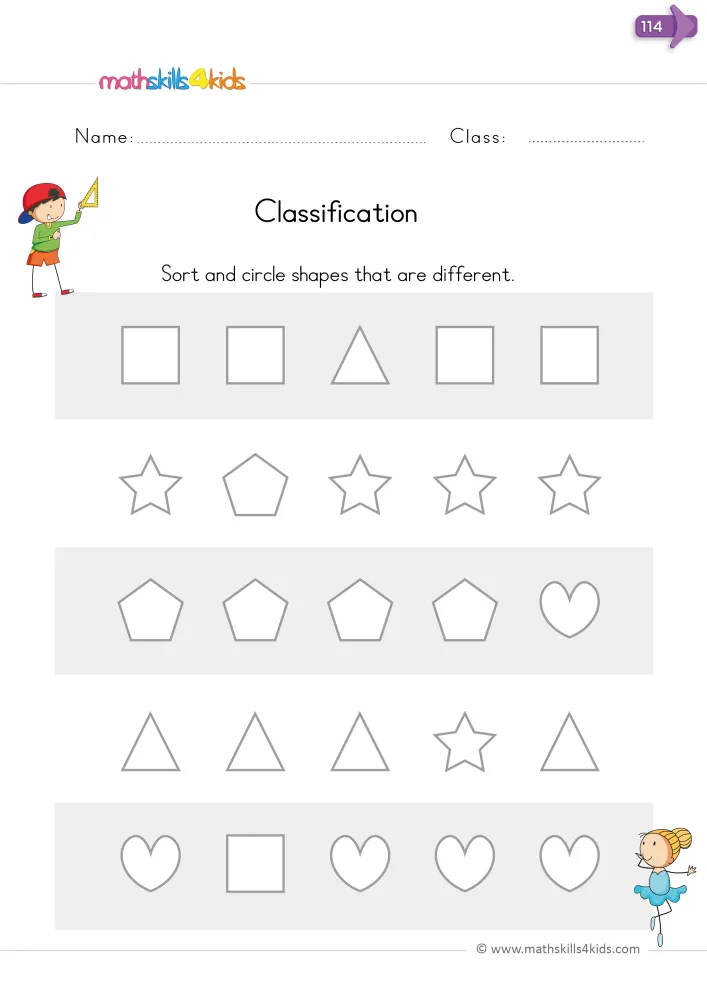
Download the worksheet: Kindergarten Shape Classification Worksheet: Four Alike, One That Does Not Fit
 Worksheet3rd Grade Open and Closed Shapes Worksheet: 8 Shapes to Check
 Worksheet2nd Grade Faces of Solid Shapes Worksheet: Which Flat Faces Does It Have?
 Worksheet2nd Grade Write the Shape Names Worksheet: Nine Flat Shapes on a Grid
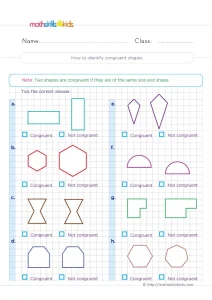 Worksheet2nd Grade Congruent Shapes Worksheet: Same Size and Same Shape?
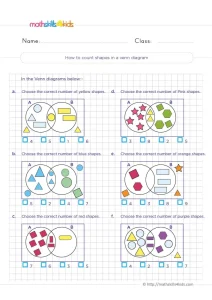 Worksheet2nd Grade Venn Diagram Color Counting Worksheet: Find Every Shape of One Color
A few related activities
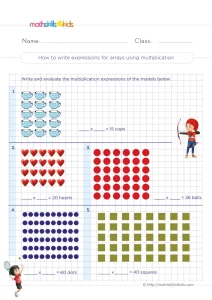 Five arrays of cups, hearts, balls, dots and squares. Your child writes the multiplication expression for each one…See the activity3rd Grade 1 Times Table Worksheet: 18 Column Facts and the Identity Rule
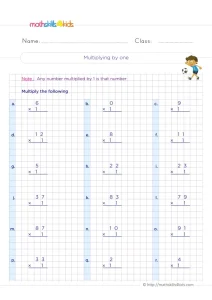 Eighteen column facts times 1, from 0 × 1 to 91 × 1. One rule solves them all:…See the activity3rd Grade Reading a Data Table Worksheet: 2 Tables
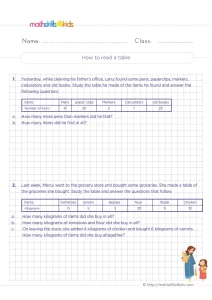 Two small tables, one of office items and one of groceries in kilograms. Your child finds the numbers,…See the activity
