Fill Four Empty Bags: Draw 10 Circles, 4 Squares, 8 Triangles and 7 Moons
An empty shape on paper is an invitation most children cannot resist: they want to fill it. This Pre-K counting to 10 worksheet to draw shapes in bags uses that urge, then adds a rule. Four large bags are empty, and each one has a small tag. The tags ask for 10 pink circles, 4 blue squares, 8 green triangles and 7 orange moons. So your child must draw exactly that many, no more. Nothing on the page can be counted until your child creates it.
When the child makes the number
Most counting pages show objects and ask how many. This one turns the question around. Your child starts from a numeral and has to build a quantity that matches it. In other words, the number comes first and the objects follow.
That reversal matters for number sense. A child who can count seven moons has learned the counting words. However, a child who can draw seven, then stop, shows they know what seven means.
The tags also vary on purpose. Four squares is a quick win. Ten circles, on the other hand, takes planning, because the bag must hold all of them. Even so, the circle is the easiest shape to draw, which keeps the effort on counting.
Seven moons, one whisper at a time
Begin by asking your child to read the tag aloud, number first, then shape. Next, hold up seven fingers together, so the number has a shape before any drawing starts.
As your child draws, have them whisper each number with each shape. The probable slip on this page is in the pink bag. Ten circles take a while, so many children lose their place around six or seven. Then they simply keep drawing until the bag looks full. If you see twelve circles, don't cross any out. Instead, ask, "Let's count them together. Did we match the tag?" Your child will find the answer, and usually the fix too.
The moon is the newest shape here, and a curve is harder than a line. So invite your child to draw simple shapes, even wobbly ones. A rough crescent counts too.
Fill a real bag, then empty it
The bags on this page lead straight to the kitchen. While you unpack groceries, ask your child to put exactly four apples in the fruit bowl. Later, give them a paper bag with a sticky note marked 8, and ask them to fill it with blocks. Moving from counting on paper to real objects lets your child feel the amount.
For a story, read Mouse Count by Ellen Stoll Walsh. A snake counts ten mice into a jar, one by one, and then the clever mice escape. Your child can count along as the jar fills up.
Finally, name the hard part: "You stopped at eight triangles, exactly like the tag." Stopping on time is real work.
About this Pre-K counting to 10 worksheet to draw shapes in bags (PDF)
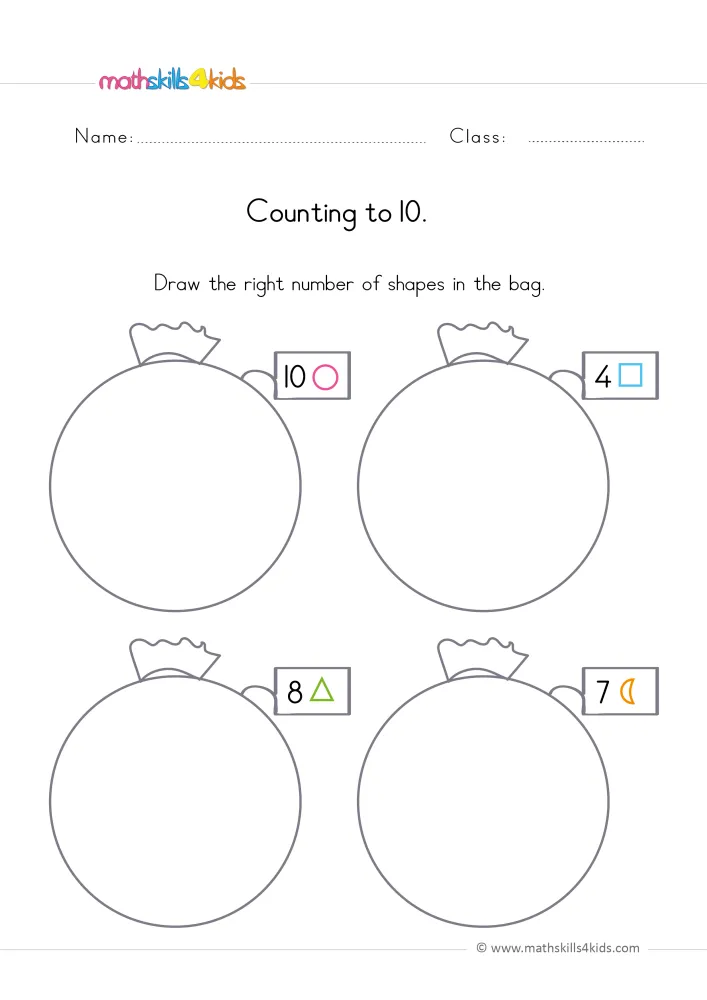
Download the worksheet: Fill Four Empty Bags: Draw 10 Circles, 4 Squares, 8 Triangles and 7 Moons
 Worksheet3rd Grade Open and Closed Shapes Worksheet: 8 Shapes to Check
 Worksheet2nd Grade Congruent Shapes Worksheet: Same Size and Same Shape?
 Worksheet1st Grade 2D or 3D Shapes Yes or No Worksheet: Read Each Question Twice
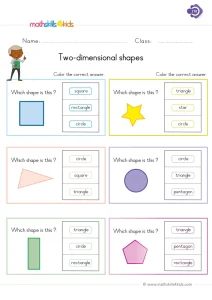 Worksheet1st Grade Name the 2D Shape Worksheet: Color the Word That Fits
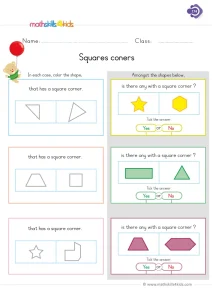 Worksheet1st Grade Find the Square Corners Worksheet: Color, Then Tick Yes or No
A few related activities
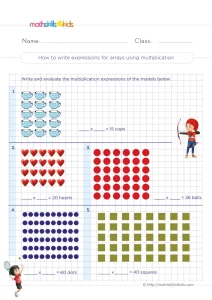 Five arrays of cups, hearts, balls, dots and squares. Your child writes the multiplication expression for each one…See the activity3rd Grade 1 Times Table Worksheet: 18 Column Facts and the Identity Rule
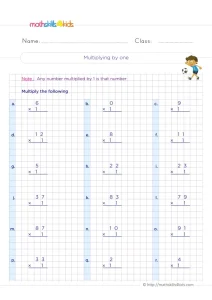 Eighteen column facts times 1, from 0 × 1 to 91 × 1. One rule solves them all:…See the activityGrade 2 Math — Time to the half hourGrade 2 math review game (ages 7–8): time to the half hour. Instructions are read aloud, and every…See the activity
