1st Grade Name the 2D Shape Worksheet: Color the Word That Fits
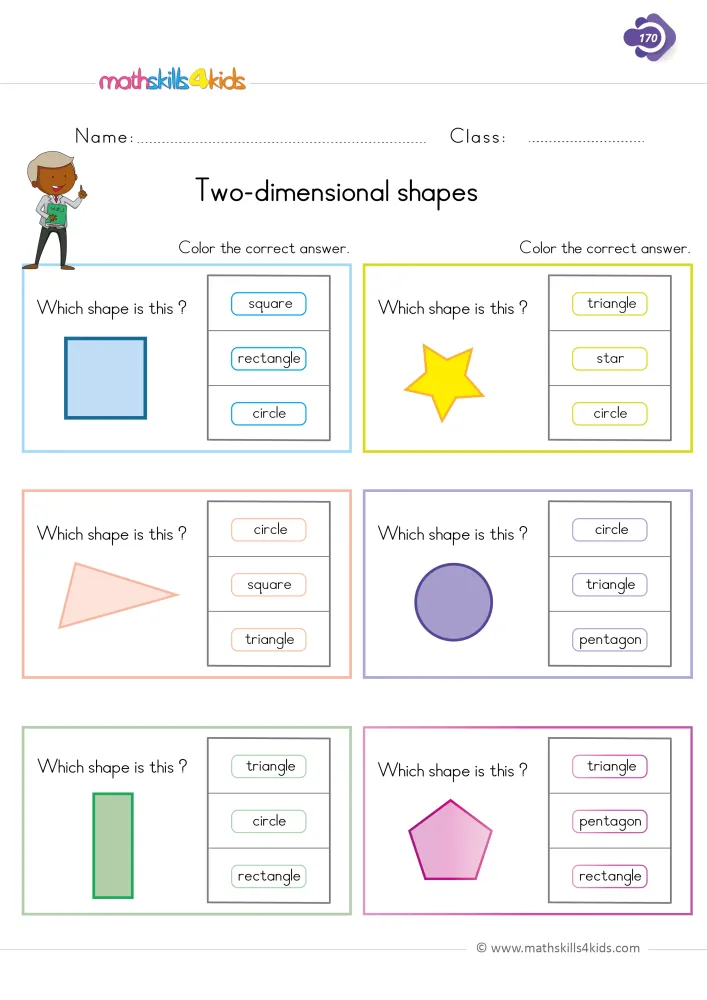
Ask a six-year-old to name a triangle lying on its side and you may hear a pause, or even "a slice of pizza." Shapes are easy to spot in their usual pose and harder once they turn. This 1st grade name the 2D shape worksheet works on that gap. Each of the six boxes shows one flat shape: a blue square, a yellow star, an orange triangle pointing sideways, a purple circle, a tall green rectangle and a pink pentagon. Beside it, three shape words sit in a column. The child colors the word that names the shape. So the page asks for reading as well as seeing. A second page gives the answer key.
Why the name comes from the sides, not the look
Young children often name shapes by their overall look: a triangle is pointy, a circle is round. By first grade, the goal shifts to properties. A triangle has three straight sides, wherever it points.
This page nudges that shift. The orange triangle lies on its side, so the usual picture of a triangle does not help. The pentagon sits next to the words triangle and rectangle, so the child has to count its sides to choose.
The first box asks the subtle question of the page: a square and rectangle appear together among the choices. Counting sides is not enough there. The child also has to compare their lengths. Words then follow the looking.
At the table: count, then read
Before your child reads the choices, ask them to trace the edge of each shape with a finger and count the sides out loud. Then let them read the three words.
The blue square in the first box is the one to watch. A child may hesitate between square and rectangle, and that hesitation is a good sign. Instead of telling the answer, ask, "Are all four sides the same length?" A strip of paper held against each side can settle it.
At the pink pentagon, a child who rushes may color triangle because of the pointed top. Point to the corners and let them count again. Close the session with a short question: "How did you know?"
After the page: shapes on the street
Flat shapes are everywhere once you start looking. On a walk, point to a stop sign, a window or a road sign. Ask your child to name each shape and count its sides. At home, cut a slice of toast in half across the corners and ask what shape each piece makes.
Mouse Shapes by Ellen Stoll Walsh follows three mice who hide from a cat among squares, triangles and circles, then build pictures with them. While you read, pause and let your child call out the shape names and other geometry words they know.
When you check the page with the answer key, praise the strategy: "You counted the sides before you chose."
About this 1st grade name the 2D shape worksheet and its answer key
Download the worksheet: 1st Grade Name the 2D Shape Worksheet: Color the Word That Fits
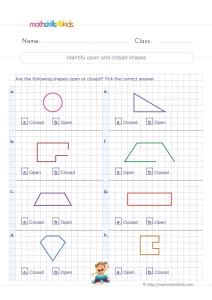 Worksheet3rd Grade Open and Closed Shapes Worksheet: 8 Shapes to Check
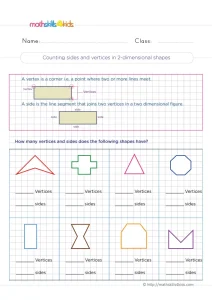 Worksheet3rd Grade Counting Sides and Vertices Worksheet: 8 Flat Shapes
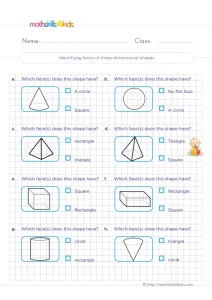 Worksheet2nd Grade Faces of Solid Shapes Worksheet: Which Flat Faces Does It Have?
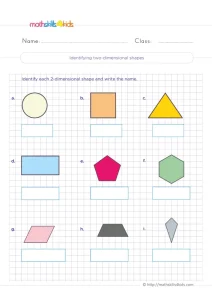 Worksheet2nd Grade Write the Shape Names Worksheet: Nine Flat Shapes on a Grid
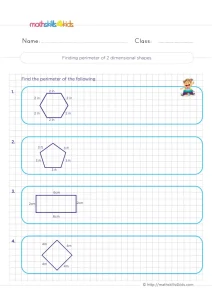 Worksheet2nd Grade Perimeter of Polygons Worksheet: Add Up Every Side
A few related activities
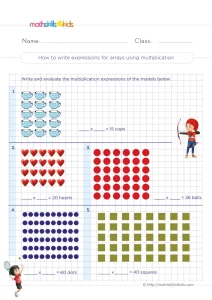 Five arrays of cups, hearts, balls, dots and squares. Your child writes the multiplication expression for each one…See the activity3rd Grade Reading a Data Table Worksheet: 2 Tables
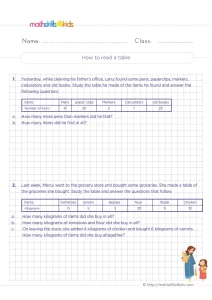 Two small tables, one of office items and one of groceries in kilograms. Your child finds the numbers,…See the activity3rd Grade 1 Times Table Worksheet: 18 Column Facts and the Identity Rule
 Eighteen column facts times 1, from 0 × 1 to 91 × 1. One rule solves them all:…See the activity
