Which One Is the Square? Four Rows of Outline Shapes for Pre-K
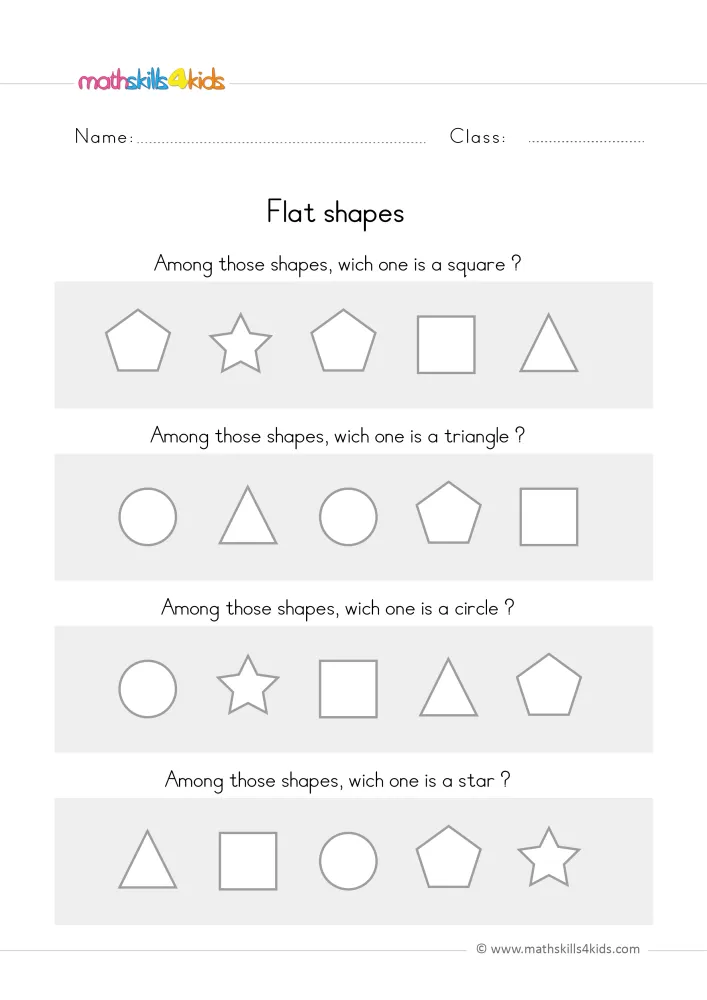
"Find the square" sounds like the easiest request in the world, until a pentagon sits right beside it. This Pre-K find the flat shape worksheet plays with exactly that moment. Four questions each name one shape: a square, a triangle, a circle, then a star. Below each question, five gray outlines share a band, and only one of them matches the name. Because every outline is the same thin gray, there is no color to help. Your child listens to the word, then looks for its shape.
From a picture in the head to a name on the page
Many young children can point to "a square" when it sits alone. Picking it out of a crowd is harder, because they must hold the word in mind and test each outline against it. That matching of word and shape is the heart of shape recognition.
The first row shows why it takes care. The square stands fourth, between two pentagons, a star and a triangle. The pentagons look like squares wearing a roof.
Then the page relaxes a little. The triangle sits second among two circles, a pentagon and a square. The circle opens the third row, and the star closes the last one. Since the answer moves every time, your child cannot guess by position. Each row asks for a real look at sides and corners, which builds geometry vocabulary.
Corners you can count with a finger
Read the first question aloud: "Which one is a square?" Then ask your child to draw a square in the air before looking down.
On this row, the likely slip is circling a pentagon, often the first shape on the left. Don't name the right answer. Instead, say, "Let's count the corners on this one." Your child taps each corner: one, two, three, four, five. Then try the square. Four corners, four sides.
Counting sides turns a hunch into a reason. It also gives your child a tool for the triangle row: "Three corners. Which one has three?"
For the circle and the star, a different question helps: "Does it have any corners at all?" A circle has none, while a star has lots of sharp points. Saying that aloud makes the choice easy to explain.
Squares in the window, stars in a book
Shapes from this page are all around the house. For example, a slice of sandwich bread is close to a square, a plate is a circle, and a folded napkin can become a triangle. Ask your child to trace each one with a finger and name it. On a walk, look for a triangle on a road sign or a square window.
These small hunts build real-world connections with geometry. They also train visual discrimination, so that a five-sided pentagon no longer passes for a square.
Suse MacDonald's Shape by Shape fits well afterwards: each page adds a cut-out shape until a hidden animal appears. Finally, name the effort: "You counted every corner on that pentagon. Now you know the difference."
About this Pre-K find the flat shape worksheet with four rows of shapes
Download the worksheet: Which One Is the Square? Four Rows of Outline Shapes for Pre-K
 Worksheet3rd Grade Counting Sides and Vertices Worksheet: 8 Flat Shapes
 Worksheet3rd Grade Open and Closed Shapes Worksheet: 8 Shapes to Check
 Worksheet3rd Grade Shapes Cut into Equal Parts Worksheet: Tick the Fair Cuts
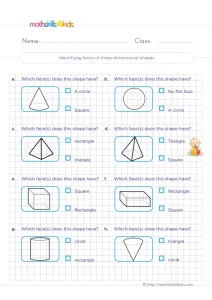 Worksheet2nd Grade Faces of Solid Shapes Worksheet: Which Flat Faces Does It Have?
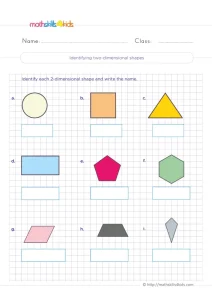 Worksheet2nd Grade Write the Shape Names Worksheet: Nine Flat Shapes on a Grid
A few related activities
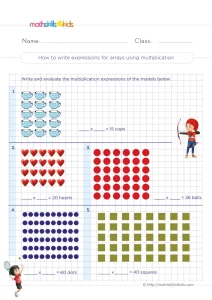 Five arrays of cups, hearts, balls, dots and squares. Your child writes the multiplication expression for each one…See the activityGrade 2 Math — Time to the half hourGrade 2 math review game (ages 7–8): time to the half hour. Instructions are read aloud, and every…See the activity3rd Grade Reading a Data Table Worksheet: 2 Tables
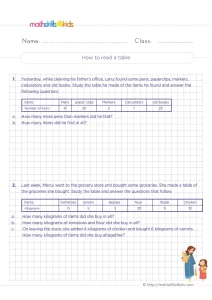 Two small tables, one of office items and one of groceries in kilograms. Your child finds the numbers,…See the activity
