Color Just Enough: 14 Circles, 16 Squares, 9 Triangles and 15 Stars
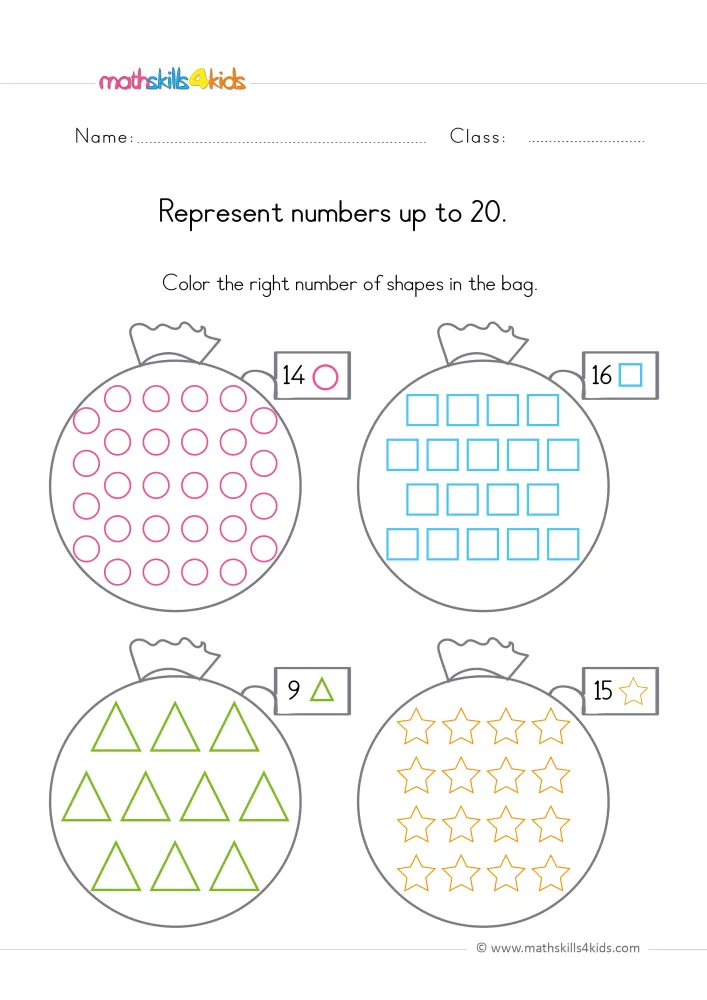
Hand a four-year-old a bowl of grapes and say, "Take nine," and you may get a whole fistful. Taking some of a pile is harder than counting all of it. This Pre-K color shapes to show numbers up to 20 worksheet practices exactly that. Four round bags sit on the page, each with a tag: 14 circles, 16 squares, 9 triangles and 15 stars. However, every bag holds more outlines than its tag asks for. So your child colors the right amount, then leaves the rest white.
Taking some, not all: why the extra shapes matter
Counting what is already there and making a set of a given size are two different skills. In the first, the pictures tell the child when to stop. In the second, only the number does. So a child has to hold "fourteen" in mind while the crayon moves, and then trust that the last number said is the amount.
That is why the leftover shapes matter. The pink bag has 28 circles for a tag of 14, so half of them must stay empty. By contrast, the star bag holds 16 for a tag of 15, and only one star stays blank. Both bags test the same thing. Your child has to know when to stop, then keep the crayon still.
In short, coloring part of a set shows whether a number has become a fixed amount, not just a word in a song.
Crayon in hand: stopping at fourteen
Before any coloring, point to the tag and read it together: "Fourteen circles. My ten fingers, then four of yours." Then let your child color one circle at a time, saying each number out loud.
The pink bag is where most slips happen. Its circles ring a block of rows, so it is easy to color fifteen, or even all 28. If that happens, don't erase. Instead, ask, "Which circle did you color when you said fourteen?" Then count the colored ones together, touching each. Often the extra circle shows itself.
The blue bag hides a smaller trap: 18 squares for a tag of 16, so two stay white. Next, ask, "How many did you leave empty?" That one question turns the page into a comparison.
This blend of coloring and counting also trains fine motor control, because each outline is small. Short strokes are fine.
Nine crackers, fifteen blocks
Everyday piles offer the same challenge. At snack time, set out a bowl of crackers and ask, "Can you put nine on my plate?" Then watch whether your child stops at nine or keeps going. Later, while you tidy up, ask for fifteen blocks from the box and let them line up the rest beside it.
If your child enjoys stories, Mouse Shapes by Ellen Stoll Walsh makes a good companion, because its three mice turn a pile of shapes into pictures, much as the bags hold circles, squares and triangles.
Finally, when the four bags are done, name the effort: "You stopped right on fifteen, with one star left over." That pause is the skill. Stopping takes more control than coloring, so it deserves the praise.
About this Pre-K color shapes to show numbers up to 20 worksheet page
Download the worksheet: Color Just Enough: 14 Circles, 16 Squares, 9 Triangles and 15 Stars
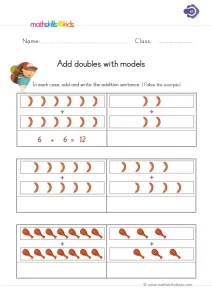 Worksheet1st Grade Adding Doubles with Pictures Worksheet: Two Equal Rows
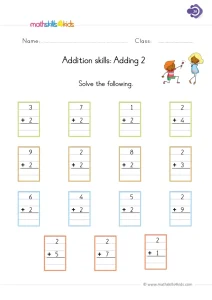 Worksheet1st Grade Adding 2 Worksheet: Count On Two in Fifteen Vertical Sums
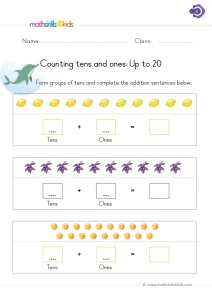 Worksheet1st Grade Circle a Group of Ten Worksheet: Tens and Ones to 20
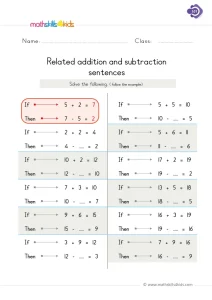 Worksheet1st Grade Related Addition and Subtraction Worksheet: If, Then
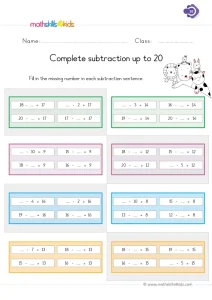 Worksheet1st Grade Complete the Subtraction Worksheet: Missing Numbers to 20
A few related activities
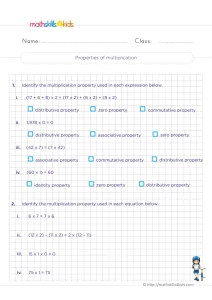 Tick the right property for four equations, from 1,978 x 0 = 0 to (60 x 1) =…See the activityGrade 1 Math — How many are left?Grade 1 math review game (ages 6–7): how many are left?. Instructions are read aloud, and every answer…See the activity3rd Grade 8 Times Table Worksheet: 12 Column Facts and a Doubling Trick
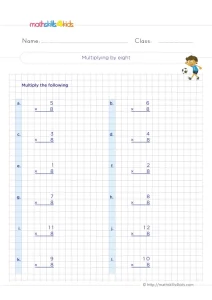 Twelve column facts times 8, from 1 × 8 to 12 × 8, in a mixed order. Double…See the activity
