1st Grade Circle a Group of Ten Worksheet: Tens and Ones to 20
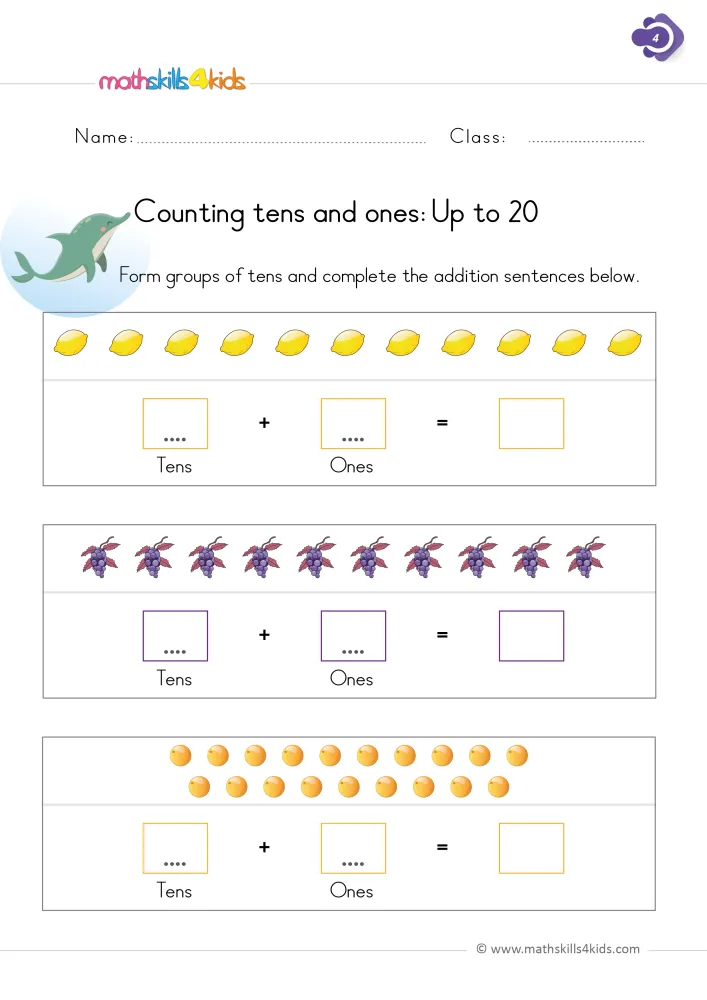
Ask a six-year-old to count eleven lemons in a long row, and they usually start at one and hope not to lose their place. Grouping changes that. This 1st grade circle a group of ten worksheet asks your child to draw one loop around ten objects, then look at what stays outside it. There are three rows: lemons, bunches of grapes and oranges. Under each row, three boxes wait for the number of tens, the number of ones and the whole number. One row has no ones at all, and another has nearly two full tens, so the page covers numbers up to 20. A second page gives the answer key.
Why one loop around ten matters
The numbers 11 to 20 hide their tens in English. "Eleven" and "twelve" give no hint that they mean ten and a bit more. So children often see 11 as two separate ones rather than one ten and one more.
Circling ten objects makes the idea visible. The loop is one ten; everything outside it is the ones. Then the written number follows: the first digit counts loops, the second counts loose objects. That is the start of tens and ones, and of place value later on.
The grapes are worth a pause. There are exactly ten bunches, so the loop takes them all. Your child must write zero for the ones. That zero has a job to do.
At the table: lemons, grapes, oranges
Begin with the lemons. Ask your child to touch each one while counting to ten, then draw the loop. One lemon stays outside. Ask, "How many tens? How many ones?"
The oranges sit in two rows, and here is the likely slip. Many children circle the whole top row, then count nineteen from scratch. That works, but it skips the point. Instead, point to the bottom row and ask, "Is this row ten, or fewer?"
For the grapes, some children leave the ones box empty. Ask, "What goes here when nothing is left?" Let them decide.
Finally, read each total aloud together. Hearing "ten and nine, nineteen" links the boxes to the number word.
Fruit bowls and bundles of ten
Groups of ten are easy to build at home. Put dry pasta or buttons in small cups of ten, then add a few loose ones and ask for the total. Also, at the shop, count lemons or oranges into a bag by tens.
A game helps the teens stick. In Go Fish, play with cards from 1 to 10, and when your child makes a pair that adds to ten, set it aside as a "ten". Then count the tens and the leftovers at the end.
Once you finish, compare the page with the answer key and name the effort: "You drew one loop and counted what was left. That is how numbers are built." Steady work.
About this 1st grade circle a group of ten worksheet and its answer key
Download the worksheet: 1st Grade Circle a Group of Ten Worksheet: Tens and Ones to 20
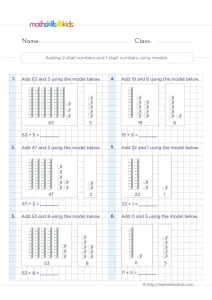 Worksheet2nd Grade Rods and Cubes Addition Worksheet: Add a One-Digit Number
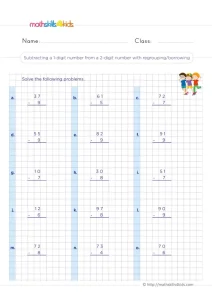 Worksheet2nd Grade Subtraction With Borrowing Worksheet: 15 Column Problems
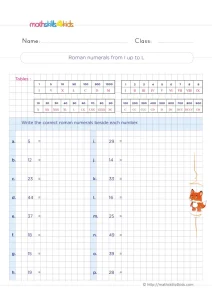 Worksheet2nd Grade Roman Numerals to 50 Worksheet: Write 16 Numbers with I, V, X, L
 Worksheet2nd Grade Regrouping Tens and Ones Worksheet: Trade Extra Ones for Tens
 Worksheet2nd Grade Skip Count by 10 Worksheet: Circle Groups of Ten
A few related activities
 Five number sentences to name, from 8 + 0 = 8 to 5 x (6 + 2). Then…See the activity3rd Grade Metric Units of Length Worksheet
 Five lengths and distances, from a toothpick to a road trip. Your child ticks the better metric estimate…See the activity3rd Grade Divide by 1 Worksheet: 20 Facts and the Rule of One
 Twenty division facts by 1, from 1 ÷ 1 to 65 ÷ 1. One rule solves them all:…See the activity
