Who Is Far Away? Check the Scene Where Two Characters Stand Apart
Ask your child to stand far from the door, and they will probably run straight to the opposite wall. Far is a word the body understands early. On paper it is harder, because nothing moves. This Pre-K far from position worksheet asks three questions with small pictures instead of words: an onion and a snail, a dolphin and a firefighter, a duck and a pig. Each question comes with two scenes. Your child ticks the box of the scene where the two characters stand far apart.
Far only makes sense next to near
Distance is always a comparison. A dolphin is not far on its own; it is far from the firefighter, and farther than in the other scene. That is why every question shows two scenes side by side. Your child judges one gap against another, which is the heart of distance comparison.
The questions use tiny drawings instead of words, so a child who cannot read still knows which two characters matter. However, the scenes also hold extra visitors: a knight, a hedgehog, a duck that is not in the question. Ignoring them takes selective attention. That is a real skill.
Two fingers, one gap
Start by naming the two small pictures in the question together: "The onion and the snail. Let's find them."
The likely mistake comes from the extra characters. In the first row, the knight is big and colorful, so your child may judge the gap between the snail and the knight. Rather than pointing to the answer, ask, "Where is the onion? Put one finger on it." Then add, "Now another finger on the snail."
Next, let your child look at the space between those two fingers. A wide stretch feels different from a pinch. That simple gesture is informal measurement, long before any ruler. Finally, in the dolphin row, watch the water. In one scene it splashes right onto the dolphin.
Hide and Seek, and other ways to feel far
Far is a body word. In the park, put down a ball and say, "Stand near the ball. Now run far from it." At home, place two toy animals side by side on the table, then let your child slide one far from the other.
Also, a round of Hide and Seek turns the idea into a game: is the hiding place near the counting spot, or far from it? These moments build a feel for near and far. Later, the same comparison supports map reading, when a drawing on paper stands for a real place.
When the sheet is done, name the work: "You found both characters every time before you ticked."
About this Pre-K far from position worksheet and its little picture rebus
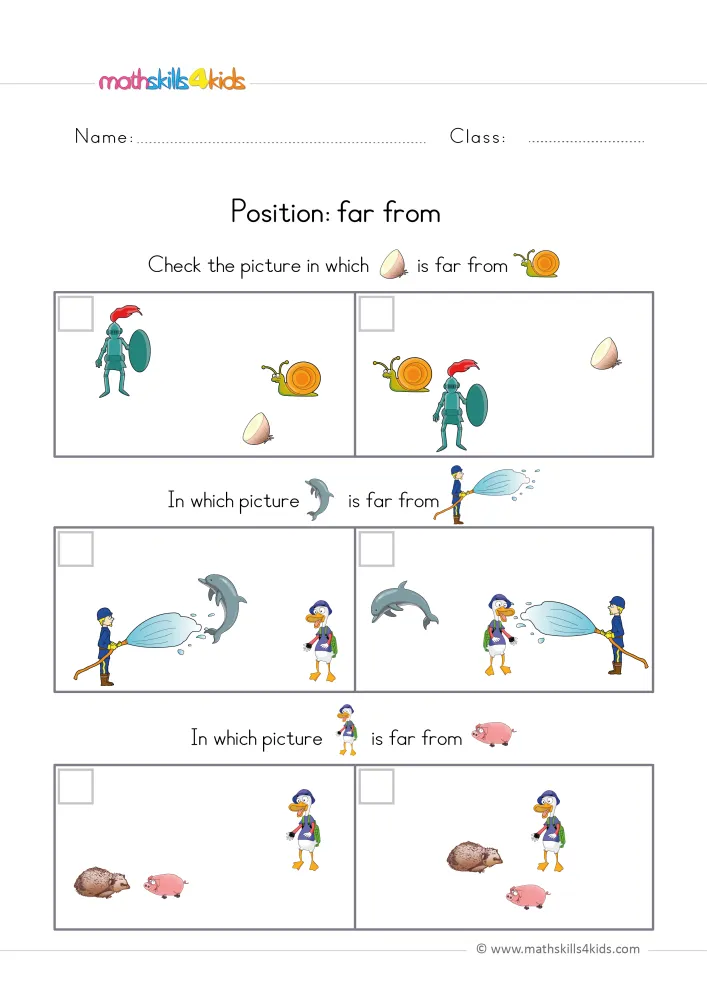
Download the worksheet: Who Is Far Away? Check the Scene Where Two Characters Stand Apart
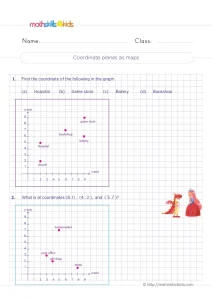 Worksheet3rd Grade Reading Coordinates on a Map Worksheet: Find the Places
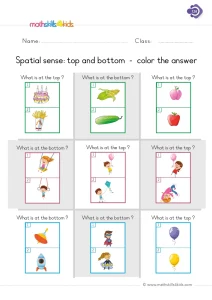 Worksheet1st Grade Top or Bottom Pictures Worksheet: Read, Then Color the Number
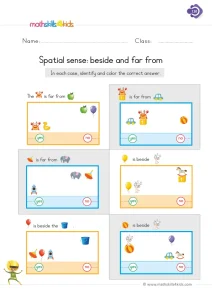 Worksheet1st Grade Beside and Far From Worksheet: Yes or No Picture Sentences
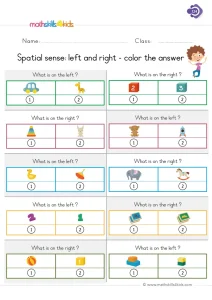 Worksheet1st Grade Left or Right Toy Pairs Worksheet: Color 1 or 2
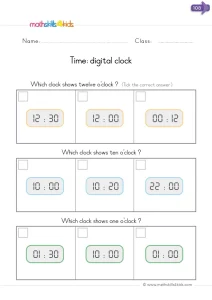 WorksheetKindergarten Digital Clock Worksheet: Which Clock Shows the Hour?
A few related activities
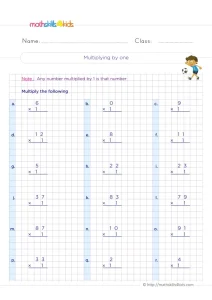 Eighteen column facts times 1, from 0 × 1 to 91 × 1. One rule solves them all:…See the activityGrade 2 Math — Time to the half hourGrade 2 math review game (ages 7–8): time to the half hour. Instructions are read aloud, and every…See the activity3rd Grade Reading a Data Table Worksheet: 2 Tables
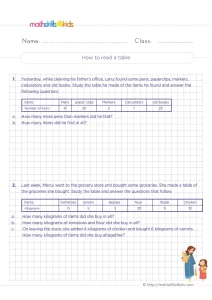 Two small tables, one of office items and one of groceries in kilograms. Your child finds the numbers,…See the activity
